Gym-goers sharing an occasional sweet
A bag or multipack lets you offer others some toffee or set aside a portion after training, without treating the sweet as your whole post-exercise snack.


Choose a toffee bag as a sweet to portion or share after the gym, rather than relying on it as a protein-containing snack: Tesco lists 0.3g and 3.4g protein per 100g for two Werther’s products, while M&S lists 1.6g for its assortment. Compare sugars and fat per 100g, then check the pack format and current allergen label before sharing.
A bag or multipack lets you offer others some toffee or set aside a portion after training, without treating the sweet as your whole post-exercise snack.
If you want protein in your post-exercise food, compare the toffee’s label and plan a separate protein-containing food or meal. University College London Hospitals NHS Foundation Trust discusses carbohydrate-and-protein snacks in its exercise guidance.
A retail sharing pack is not, by itself, evidence that a sweet can be provided at school. Department for Education guidance addresses food in state-funded schools in England; its published standards for September 2027 exclude confectionery and sweets as snacks.
Start with the type of snack you want after training, then compare nutrition on the same per-100g basis and decide whether the pack works for sharing.
| Priority | What to check | Your needs |
|---|---|---|
| Protein alongside the treat | Check protein per 100g and whether another food will provide the protein you want. Tesco lists 0.3g for Werther’s Original Butter Candies and 3.4g for Chewy Toffees; M&S lists 1.6g for its assortment. | I want something sweet after training, but I do not want to mistake the toffee for my protein-containing snack. |
| Sugars and fat | On the retailers’ per-100g labels, Werther’s Butter Candies list 71.6g sugars and 8.4g fat; Chewy Toffees list 40.4g sugars and 14.9g fat; the M&S assortment lists 46.9g sugars and 18.8g fat. Check saturates too. | A chewy texture might appeal to me, but I want to see the sugar-and-fat trade-off rather than choose by flavour wording alone. |
| Ingredients and allergens | Read the ingredients and highlighted allergens on the physical pack before offering it to anyone else. Sainsbury’s advises that product ingredients can change. | If someone sharing has a milk or soya allergy, I need to check the pack they will actually eat. |
| Pack format | Check net weight and whether the contents are separate pieces or portions. The reviewed Werther’s bags are 135g; the M&S assortment is 200g. | I would rather decide how much to share or set aside than judge the amount by the size of the bag. |
Tesco’s two Werther’s labels list 0.3g and 3.4g protein per 100g. University College London Hospitals NHS Foundation Trust discusses snacks containing both carbohydrate and protein for use around exercise.
If protein is part of what you want after training, have a separate protein-containing food or meal rather than relying on the toffee.
The Tesco and M&S labels show different amounts of sugars and fat per 100g across the bags discussed here; a description such as “buttery” does not convey those figures.
Compare the per-100g nutrition panels, then consider the portion you expect to eat.
Ingredients can change, as Sainsbury’s cautions in its product information. An earlier retailer listing may not describe the pack in hand.
Check the physical pack before sharing, particularly when someone has an allergy or intolerance.
Department for Education school-food guidance applies to state-funded schools in England. Its published standards for September 2027 expressly exclude confectionery and sweets as snacks; that future standard should not be treated as already in force.
For a school purchase, check the rules currently applicable to the relevant nation, setting and purchase date.
The 135g Butter Candy and Chewy Toffees bags offer a choice between hard sweets and chewy toffee.
Its 200g Toffee Assortment is a mixed-flavour pack for sharing.
Thorntons presents its Original Special Toffee 200g cartonette as a product to share.
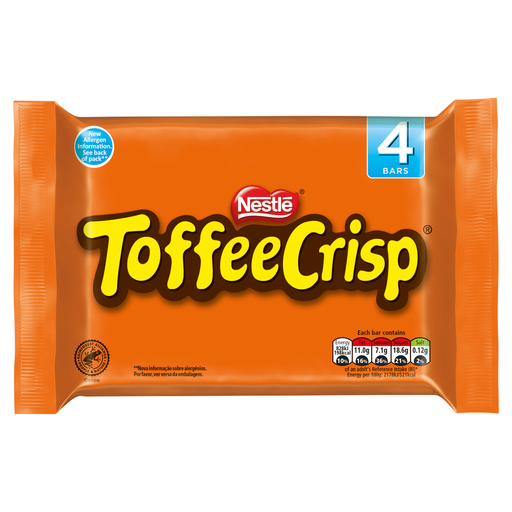
This option offers separate toffee-flavoured bars to share after the gym; it is a multipack, not a loose toffee sharing bag.
 No image available
Four 38g bars give you separate portions to share after training, though this is a bar multipack rather than a toffee sharing bag. Check the physical pack for ingredients and allergens before sharing.
Not if you are relying on it for protein. Tesco lists 0.3g protein per 100g for Werther’s Butter Candy and 3.4g for Chewy Toffees, while M&S lists 1.6g for its assortment. If you want a protein-containing snack after exercise, plan another food alongside the sweet.
On their per-100g labels, Tesco lists 71.6g sugars and 8.4g fat for Werther’s Butter Candy, and 40.4g sugars and 14.9g fat for Chewy Toffees. M&S lists 46.9g sugars and 18.8g fat for its assortment. Compare the same measures, then consider how much of the pack you intend to eat.
Read the ingredients and allergen declaration on the physical pack, particularly if milk or soya is a concern. Sainsbury’s cautions that product ingredients can change, so do not rely solely on an earlier retailer listing.
Do not assume that a retail pack qualifies for school provision. Department for Education guidance concerns state-funded schools in England, and its published standards for September 2027 say that confectionery and sweets are not permitted snacks. Check the rules in force for the relevant nation and school-food setting at the time of purchase.