Families preparing a quick snack
A wrap that can be filled and served without heating may be useful after school. Check its individual portion alongside the filling rather than assuming every wrap makes the same-sized snack.


Choose an after-school wrap by its portion and the filling you plan to add, rather than treating “medium sliced” as a tortilla size. Compare the pack weight and wrap count, then check whether the particular wrap can be served cold, how long it keeps after opening and what its current allergen label says.
A wrap that can be filled and served without heating may be useful after school. Check its individual portion alongside the filling rather than assuming every wrap makes the same-sized snack.
Wholemeal and regular flour packs can have different declared fibre figures and wrap weights. Comparing labels on the same per-wrap or per-100g basis makes the difference easier to judge.
Read the physical pack’s allergen declaration before sending a filled wrap to school. In England, Department for Education guidance says schools must publish an allergy safety policy; check the individual school’s arrangements too.
Start with the size of one wrap, then compare its label and handling instructions for the way you intend to use the pack.
| Priority | What to check | Your needs |
|---|---|---|
| Wrap portion | Divide pack weight by wrap count if a per-wrap weight is not stated. ASDA and Tesco each list a 320g eight-wrap wholemeal pack, equivalent to 40g per wrap. Check the filling separately. | I’m making a snack rather than a larger meal, so I want to know how much wrap I’m starting with. |
| Fibre | Compare declared fibre on the same basis and note wrap weight. ASDA lists 3.4g per wholemeal wrap; Tesco lists 1.7g per 40g wholemeal wrap. Old El Paso lists 0.7g per Regular Flour Tortilla. | If I prefer a wholemeal base, I want to compare the label figures without mistaking a larger serving for a direct like-for-like difference. |
| Allergens | Read the current pack for wheat and other allergen declarations, including manufacturing warnings. For food going into a school in England, check that school’s published allergy safety policy. | Before I pack a wrap for school, I need it to meet the child’s dietary requirements and the school’s arrangements. |
| Serving and storage | Check whether the product may be eaten cold and follow its own opened-pack instructions. ASDA says its wholemeal wraps can be eaten hot or cold and used within two days of opening; Tesco says to refrigerate its wholemeal wraps and use them within three days. | We may only use a few wraps at a time, so I want a pack we can store and finish as its label directs. |
The phrase describes sliced bread more readily than a wrap. It does not tell you the weight of one tortilla or whether it will fit a particular container.
Compare pack weight and wrap count. If diameter matters, confirm the measurement on the pack or with the retailer before buying.
The wholemeal wraps described by ASDA, Sainsbury’s and Tesco contain wheat or cereals containing gluten. Sainsbury’s also states further allergy limitations arising from manufacturing methods for its Stamford Street Co. product.
Read the current physical pack, including its manufacturing warnings; do not use “wholemeal” or a fibre figure as an allergen check.
A per-wrap figure and a per-100g figure describe different quantities. Wraps of different weights can also have different per-wrap figures.
Use the same measurement basis for both products and keep the planned filling in mind when deciding how much to serve.
Opened-pack instructions differ: ASDA says to use its listed wholemeal wraps within two days, while Tesco gives three days for its listed wholemeal wraps when refrigerated.
Check the instructions on the pack you buy, including whether and how it may be frozen.
Wraps left beyond the pack’s opened-storage instructions may have to be discarded.
These examples illustrate label differences across specific UK wrap listings, rather than describing every product from each brand.
ASDA lists a 320g eight-pack of wholemeal tortillas that can be eaten hot or cold.
The Stamford Street Co. wholemeal listing is an eight-pack with a declared 5.0g fibre per tortilla.
Tesco lists both wholemeal and white tortilla wraps; check the particular pack rather than applying one variant’s figures to the other.
Old El Paso’s Regular Flour Tortillas are an eight-pack; the manufacturer says this product may be eaten cold.
Mission Carb Balance Original is a distinct four-wrap wheat-tortilla option, rather than a standard eight-wrap pack.
M&S lists wholemeal tortilla wraps made with a blend of white and wholemeal flour.
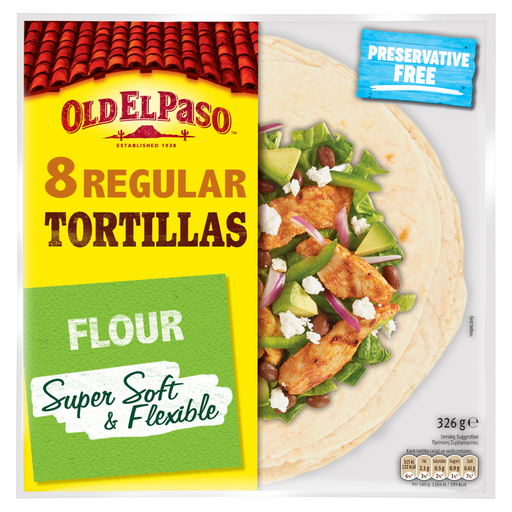
This flour-tortilla option is a starting point for an after-school wrap; check the individual pack for the portion and handling details that matter to you.
 No image available
For an after-school wrap, check the number and weight of tortillas in this 326g pack before deciding on a portion. Read its current allergen and storage instructions, particularly if the wrap will be taken to school.
Do not assume they are. The listed flour and wholemeal examples declare wheat or cereals containing gluten; check the allergen information on the specific physical pack against the person’s requirements.
Check the wrap and filling against the child’s dietary requirements and the individual school’s allergy arrangements. Department for Education guidance says schools in England must publish an allergy safety policy; it does not replace checking that school’s policy.
The listed ASDA wholemeal wraps are labelled for hot or cold use, and Old El Paso says its Regular Flour Tortillas may be eaten cold. Follow the instructions on the particular product you buy.
Follow the product’s own storage instructions. ASDA says to use its listed wholemeal wraps within two days of opening; Tesco says to refrigerate its listed wholemeal wraps and use them within three days. M&S says to keep its listed wholemeal wraps airtight and eat them within two days.
No. Wholemeal describes the wrap base, while the amount served also depends on the weight of each wrap and what goes inside it. Compare the pack’s portion information and the filling you intend to add.