Small households making occasional snacks
Compare the number of wraps with the snacks you expect to make, then read the opened-pack and freezing directions. A six-pack of mini wraps and a four-pack of larger wraps meet different needs.


Choose by how many wraps your household can use within the packet’s opened-pack storage period, then by the size of each wrap. Mini wraps are smaller individual portions, but they do not necessarily come in smaller packs; check ingredients, nutrition per wrap and storage directions, especially if a child needs to avoid gluten.
Compare the number of wraps with the snacks you expect to make, then read the opened-pack and freezing directions. A six-pack of mini wraps and a four-pack of larger wraps meet different needs.
Look at the size of one wrap and what you intend to put in it, rather than judging the portion from the packet photograph. Fruit or vegetables can be part of the snack or an alternative to a wrap.
Distinguish ordinary wheat wraps from products labelled gluten-free, and check the actual packet and fillings. If food is going into school, ask that school about its allergy arrangements rather than assuming every school follows the same rules.
Start with dietary suitability, then compare the portion, pack count and instructions for keeping any wraps left over.
| Priority | What to check | Your needs |
|---|---|---|
| Pack count | Count the wraps, not just their size. Tesco Groceries lists Mission mini wraps in six-packs, while Sainsbury's lists eight mini wraps per pack. | I make wraps only occasionally, so I want a pack count that fits the snacks we are likely to prepare. |
| Portion and nutrition | Check the weight and nutrition of one wrap for the portion you plan to serve. For different-sized wraps, compare listed nutrients per 100g, then consider the amount served and the filling. | A smaller wrap may suit one snack, but I also want to know what goes into it and how much will be served. |
| Keeping leftovers | Read the particular packet’s opened-pack and freezing directions. Tesco Groceries says to re-close its Mission Mini Original pack and use it within two days; Old El Paso UK specifies refrigeration and use within three days for its large gluten-free wraps. | If we will not finish the pack at once, I need a way to use the remaining wraps within its stated storage period. |
| Cost and waste | Compare how many wraps you expect to use, not pack count alone. Factor in any wraps likely to be left unused under the packet’s storage directions. | I do not want to buy wraps we will leave unused. In a British Nutrition Foundation-commissioned YouGov survey of 1,007 British parents of children up to 18 in February 2024, 45% said the higher cost of healthy food made feeding their children a healthy diet harder; that finding concerns family diets, not wrap purchases specifically. |
| Gluten and school rules | Check the actual packet and every filling if gluten must be avoided; ordinary wheat wraps are not a gluten-free alternative. For food taken into an English school, check that school’s allergy arrangements: Department for Education guidance on school allergy policies applies to England. | When a child needs to avoid gluten, I need a suitable product and filling. If the snack goes to school, I also need to know that school’s arrangements. |
Mini describes an individual wrap. The mini products listed by Tesco Groceries and Sainsbury's contain six and eight wraps respectively.
Compare both wrap size and pack count, then check how the packet says to keep or freeze leftovers.
ASDA Groceries lists Mission Carb Balance as four wheat wraps of approximately 50g each. Tesco’s four-pack Free From white wraps are 40g each, while Old El Paso UK lists four large gluten-free wraps of 54g each.
Choose for the eater’s ingredient requirements first, then compare the portion and number of wraps.
Product information can change, and a suitable wrap does not establish that its filling meets the child’s requirements.
Read the packet supplied and check each filling. If the food will go to school, check that school’s allergy arrangements too.
These examples show why the brand alone cannot tell you the wrap size, pack count or storage instructions; check the specific product.
Tesco Groceries lists Mini Original and Mini Wheat & White wheat wraps in six-packs; ASDA Groceries lists a separate four-pack Carb Balance wheat wrap.
Old El Paso UK describes its large gluten-free wraps as a four-pack with 54g wraps.
Tesco Groceries lists its Free From white tortilla wraps as a four-pack of 40g wraps.
Sainsbury's lists its mini plain wheat tortilla wraps in an eight-pack.
Marks & Spencer lists mini and wholemeal tortilla wraps among its wrap range.
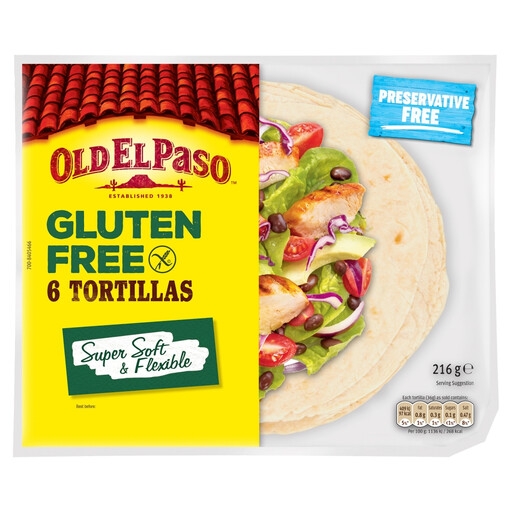
This gluten-free tortilla-wrap option is relevant when planning an after-school snack that needs a gluten-free wrap. Check the packet and filling against the child’s requirements, along with the wrap count and storage directions.
 No image available
For a snack needing a gluten-free wrap, check the actual packet and filling against the child’s requirements. This is a 216g pack; compare its stated wrap count and opened-pack directions with how many snacks you plan to make.
Not necessarily. Mini describes the size of each wrap: Tesco Groceries lists Mission mini wraps in six-packs, and Sainsbury's lists eight mini wraps per pack. Check the count if you are buying for occasional snacks.
Follow the directions on the particular packet rather than assuming all wraps are prepared alike. The Mission Mini Original listing gives ways to warm the wraps, while Sainsbury's supplies heating instructions for its mini wraps; remove packaging before heating.
Use the instructions for the specific product. Tesco Groceries says to re-close Mission Mini Original wraps and use them within two days; it lists an airtight container and a best-within-seven-days direction for Tesco Free From white wraps. Old El Paso UK says to refrigerate its large gluten-free wraps and use them within three days.
Check the child’s requirements and the particular school’s allergy arrangements before packing the snack. The Department for Education’s guidance on schools publishing allergy safety policies applies to England; it should not be treated as a single packed-food rule for every school in the UK.