Hosts making wrap pinwheels
Choose a wrap you can fill and roll, then work out how many small pieces each finished roll will provide. Pack count matters more once you have decided how the wraps will be served.


For a party where guests can eat wheat, a plain flour wrap is a starting point for filled rolls that you cut into smaller portions. Choose wholewheat when it suits the menu, or a specifically labelled gluten-free wrap when a guest needs one; check the exact pack and the venue’s allergy arrangements. Rather than relying on “medium sliced”, compare the stated wrap size and pack count, then cut the finished wraps yourself.
Choose a wrap you can fill and roll, then work out how many small pieces each finished roll will provide. Pack count matters more once you have decided how the wraps will be served.
Check the exact pack against the guest’s requirements, including its ingredients and precautionary allergen wording. If the party is at a school or venue, confirm its arrangements before bringing food.
Wholewheat offers a different option for a buffet where guests can eat wheat. Sainsbury’s lists 2.8 g fibre per wrap for its 320 g wholewheat eight-pack; that figure belongs to that product, not every wholewheat wrap.
Decide who can eat the wraps and how you will serve them before choosing a pack format.
| Priority | What to check | Your needs |
|---|---|---|
| Allergens | Read the current ingredients and allergen statement on the exact pack. Check any precautionary wording and the school or venue’s food arrangements. | If a guest needs gluten-free food, I need a specifically labelled product rather than assuming a plain or wholewheat wrap will do. The Food Standards Agency identifies wheat as a cereal containing gluten. |
| Portions | Compare wrap count, pack weight and individual weight or diameter where stated. Plan the number of filled rolls and pieces you intend to serve. | I’m serving pinwheels, so I’ll estimate portions from how I plan to cut a filled wrap—not assume that one wrap equals one child’s serving. |
| Wrap type | Compare plain and wholewheat products by their actual labels. For nutrition figures, use the same basis, such as per wrap or per 100 g. | Wholewheat may fit my buffet, but I still need to check whether guests can eat wheat. Sainsbury’s lists 2.8 g fibre per wrap for its 320 g wholewheat product. |
| Storage | Follow the chosen pack’s instructions after opening and check whether it gives freezing directions. Account for the fillings separately when planning preparation. | If I’m preparing food ahead, I need instructions for the wraps I actually buy rather than applying another product’s storage period. |
Plain and wholewheat products can contain wheat. The Food Standards Agency lists wheat among cereals containing gluten, so a colour or style name cannot establish suitability.
For a guest who needs gluten-free food, choose a specifically labelled product and check the current pack’s ingredients, allergen statement and precautionary wording.
Product listings describe wraps using measures such as pack count, weight and, sometimes, diameter. “Medium sliced” does not tell you how many party portions a finished roll will make.
Compare the stated measurements, then try filling, rolling and cutting one wrap before settling on a quantity.
Tesco cautions that ingredients and allergen information can change as products are reformulated. That matters when food is being provided for a child with a known requirement.
Read the physical pack close to the event, keep it available for reference and confirm the school or venue’s procedure for brought-in food.
The number of portions depends on the wrap and how you fill and cut it. An eight-wrap pack does not, by itself, specify eight party servings.
Choose whether you are serving whole wraps, halves or pinwheels, then calculate the packs needed for that plan and any separately prepared dietary option.
These product-line examples show why it is worth checking the exact variant rather than making a decision from the brand name alone.
Tesco lists regular flour tortillas and a separate gluten-free tortilla product under the Old El Paso name.
Mission appears in UK listings across several wrap formats, including a high-fibre wheat tortilla product.
Tesco’s own-label range includes plain, wholemeal and mini tortilla-wrap formats.
Sainsbury’s lists plain and wholewheat own-label eight-packs.
M&S Food lists several wrap formats, including plain and wholemeal products.
These options cover a flour tortilla for guests who can eat wheat and a separately labelled gluten-free tortilla. Check pack details and allergens before deciding how each will be served.
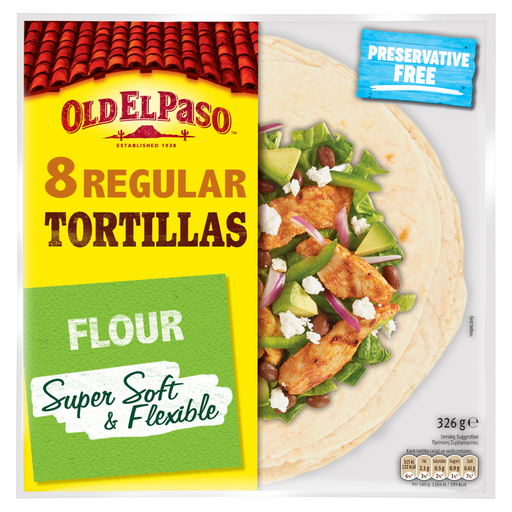 No image available
A flour tortilla option for filled rolls when guests can eat wheat. The pack is labelled 326 g; check its current wrap count, ingredients and allergen statement when planning portions.
 No image available
A separately labelled gluten-free wrap option when a guest requires one. The pack is labelled 216 g; confirm its current ingredients, precautionary allergen wording and wrap count before preparing food.
Use the pack’s stated measurements instead of treating “medium sliced” as a size specification. Compare wrap count, weight and any stated diameter, then fill and cut the wraps into the portions you want to serve.
Do not use a wheat flour wrap as the gluten-free option. The Food Standards Agency identifies wheat as a cereal containing gluten. Choose a specifically labelled product only after checking its current packaging, precautionary allergen wording and the guest’s relevant requirements.
Ask the school how it handles brought-in food and known allergens before preparing the wraps. In England, Department for Education allergy guidance describes school allergy safety policies and arrangements to reduce exposure to known allergens; check the particular school’s instructions. Elsewhere in the UK, ask the relevant school about its own arrangements.
Plan around the storage instructions on the wrap pack you buy and the ingredients you use as fillings. For example, Sainsbury’s states that its 320 g wholewheat wraps should be refrigerated after opening and used within three days; that is a product-specific instruction, not a rule for every wrap or filling.