Parents making lunchbox pinwheels
For a roll that stays together in the lunchbox, Tesco Real Food suggests rolling a mini tortilla tightly, cutting it into thick slices and wrapping the sliced roll in foil.


For thick-cut lunchbox pinwheels, choose a soft wrap you can roll tightly, then cut the filled roll into thick slices; Tesco Real Food uses this method with mini tortillas. Mini wraps suit smaller portions, while a larger wrap leaves more room for filling. Check the packet for wheat and other relevant allergens, follow the school’s allergy arrangements, and keep fillings that need chilling cold until lunch.
For a roll that stays together in the lunchbox, Tesco Real Food suggests rolling a mini tortilla tightly, cutting it into thick slices and wrapping the sliced roll in foil.
Mini wraps offer a smaller starting point for pinwheels. Standard or large wraps leave more room for a filled roll that can be cut into portions.
Ordinary wheat wraps and specifically labelled gluten-free wraps are different choices. Check the current packet for the child’s allergens and ask the school about its allergy arrangements before packing lunch.
Start with the portion and how you plan to roll it, then check the packet and the filling before it goes into the lunchbox.
| Priority | What to check | Your needs |
|---|---|---|
| Thick-cut pinwheels | Choose a wrap that rolls without splitting. Use a modest amount of filling, roll tightly and cut the finished roll into thick slices, as in Tesco Real Food’s lunchbox recipe. | I want pinwheels that stay together on the journey to school, rather than a tortilla described as physically thick. |
| Portion size | Check whether the pack contains mini, standard or large wraps, and compare pack counts and per-wrap information. | Mini pinwheels may fit the lunchbox better; for a fuller rolled lunch, I would choose a larger wrap and cut it into portions. |
| Fibre | Compare figures on the same basis. ASDA lists 4 g fibre per Mission Wholemeal wrap and 3.4 g per ASDA Wholemeal tortilla; Sainsbury’s lists 10 g per Mission High Fibre wrap. These examples contain wheat. | If fibre content matters to me, I want to compare the actual portion I am packing, not assume every wholemeal wrap has the same value. |
| Allergens | Read the current ingredient and allergen label for wheat and any other relevant allergens. Check the school’s allergy arrangements; a gluten-free label does not answer every allergen question. | Where gluten-free food is needed, I would choose a specifically labelled product rather than an ordinary flour or wholemeal wrap. |
| Chilled fillings | Check whether the filling needs refrigeration. Safefood advises keeping foods such as meat and dairy cold and using an insulated lunchbox or bag. | If I pack a filling that needs chilling, it must stay cold until lunchtime, not just overnight. |
For pinwheels, “thick-cut” can describe the slices of the finished roll rather than the thickness of the tortilla.
Choose a suitable wrap size, avoid overfilling it, roll tightly and cut the filled roll into thick slices, following Tesco Real Food’s method.
Fibre values differ by product and serving basis. The Mission and ASDA wholemeal examples contain wheat; Old El Paso’s gluten-free wrap is a separate formulation.
Compare nutrition per wrap or per 100 g on the same basis, and read the allergen declaration separately.
A listing may not reflect the packet being packed for school, which matters particularly when an ingredient must be avoided.
Check the physical packet’s ingredient and allergen information each time.
A lunch containing meat, dairy or another filling that needs refrigeration also needs appropriate temperature control until it is eaten.
Refrigerate the prepared food and use an insulated lunchbox or bag, in line with safefood’s school-lunchbox guidance.
Mission has mini, wholemeal and high-fibre wheat wraps that can be compared by portion format and stated fibre content.
Old El Paso offers regular flour tortillas and a separate, specifically labelled gluten-free large wrap.
Tesco lists own-label mini, plain and wholemeal tortilla formats.
Sainsbury’s lists an own-label Stamford Street Co. wholemeal tortilla alongside branded wraps.
Asda’s own-label wholemeal tortillas provide per-wrap nutrition information for comparison.
M&S lists mini, wholemeal and other wrap formats, including a soft 10-inch plain-wheat wrap.
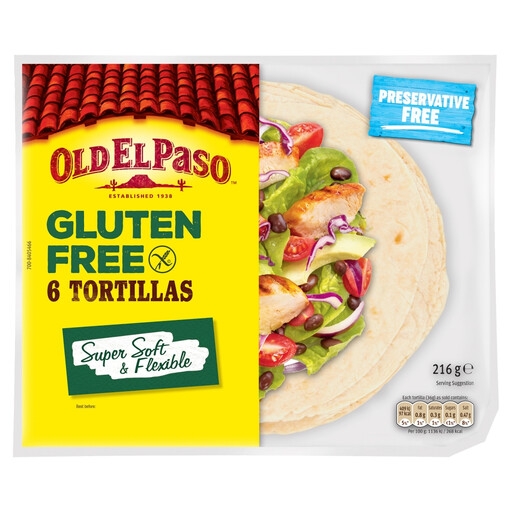
This Joybuy option is a gluten-free tortilla wrap to consider for a school packed lunch where gluten-free food is needed. Check the packet for other relevant allergens and storage instructions.
 No image available
A gluten-free tortilla-wrap option for a packed lunch where gluten-free food is needed. The pack is 216g; check its current ingredient, allergen and storage information before use.
No particular tortilla thickness is required by Tesco Real Food’s pinwheel method: it rolls a mini tortilla tightly and cuts the finished roll into thick slices. Choose a wrap you can roll without splitting, and keep the filling modest enough to hold the roll together.
No: the cited regular flour-wrap examples contain wheat. Where gluten-free food is needed, choose a specifically labelled gluten-free wrap and check the current packet for all other relevant allergens.
Keep fillings that need refrigeration cold until lunch. Safefood advises using an insulated lunchbox or bag for school lunches containing foods such as meat or dairy.
If the prepared wrap contains a filling that needs chilling, refrigerate it overnight and use an insulated lunchbox or bag the next day, following safefood’s lunchbox guidance. Also follow the wrap packet’s storage and use-after-opening instructions.