Shoppers planning filled wraps
If fillings need to be rolled or folded, look at tortilla wraps. Compare the nutrition for one wrap, its wheat ingredients and how soon the pack must be used after opening.


Choose tortilla wraps if the meal calls for fillings to be rolled or folded; choose a medium-sliced loaf if it calls for sandwich bread or toast. Once the format is clear, compare the exact pack’s ingredients, nutrition per serving and storage instructions—one slice of bread and one whole wrap are different-sized portions.
Start with the meals being planned, rather than treating a retirement shop as a reason to choose a particular food or diet.
If fillings need to be rolled or folded, look at tortilla wraps. Compare the nutrition for one wrap, its wheat ingredients and how soon the pack must be used after opening.
If the shopping list means a medium-sliced loaf, bread answers that need. A tortilla is a different format, even when both can hold a filling.
When buying for yourself or someone else, check the exact product’s ingredients, allergens and nutrition label against that person’s requirements. Retirement alone does not establish a particular dietary need.
Settle whether the meal needs a wrap or sliced bread first. Then compare portions and pack instructions within the format you intend to buy.
| Priority | What to check | Your needs |
|---|---|---|
| Food format | Check whether the product is a rollable tortilla or an explicitly medium-sliced loaf. Plan around how the filling or bread will be used. | I’m making filled wraps, so I need tortillas. If sandwiches or toast are on the menu, medium-sliced bread is the relevant choice. |
| Fibre and portion | Compare per-100g labels for a common weight basis, then check the serving you expect to eat. Tesco lists 5.1g fibre per 61g wholemeal wrap; Sainsbury’s lists 2.6g per slice of its medium-sliced wholemeal bread. Those portions are not equivalent. | I want to know what my planned portion contains, without treating a slice and a whole tortilla as the same amount of food. |
| Salt and ingredients | Read the salt figure for the stated serving and the complete ingredients and allergen declaration. Asda’s named Corn Tortillas listing declares wheat; a product name alone cannot settle an allergen question. | If I’m shopping around an ingredient requirement, I need the exact pack’s label. I’ll also consider the filling when looking at the whole meal. |
| Pack use and storage | Check the pack size, after-opening directions and any freezing instructions for the specific product. Tesco’s wholemeal wraps say to refrigerate and consume within two days of opening; Asda says its listed Corn Tortillas are not suitable for freezing. | For meals spread over several days, I need a pack whose storage directions fit how I’ll use it. |
The medium-sliced product in this choice is a loaf of bread; the tortillas are sold as wraps.
Decide whether the planned meal needs slices for sandwiches or toast, or tortillas that can be filled and rolled, before choosing a pack.
A bread slice and a tortilla can have different stated serving weights, so their per-serving figures do not provide a like-for-like weight comparison.
Use per-100g figures to compare the same weight, and per-serving figures to assess the portion you plan to use. The NHS explains that food labels give nutrition per 100g and sometimes per portion.
Asda’s listed Corn Tortillas declare wheat and are marked as not suitable for freezing. Neither point describes every corn tortilla.
Check the ingredients, allergen information and storage directions on the exact pack, particularly when buying for someone with an ingredient restriction.
These examples illustrate why the precise variant matters; a brand name alone does not establish a wrap’s ingredients or nutrition.
Mission Original provides an example of a regular tortilla wrap.
Its regular flour tortillas and separately listed gluten-free tortillas address different ingredient requirements.
The listed wholemeal tortilla eight-pack gives a per-wrap basis for comparing portions.
Its medium-sliced wholemeal loaf is an example for the sandwich-bread interpretation of this shopping decision.
The listed wheat-and-corn tortillas show why a “corn” product name needs a closer label check.
Its listed wholemeal tortillas offer another per-wrap nutrition comparison.
These two Old El Paso options are tortillas for meals that call for wraps, not medium-sliced sandwich bread. One is labelled gluten-free; the other is a regular flour tortilla, so choose between them according to the exact ingredients required.
 No image available
For a meal needing tortilla wraps and a gluten-free labelled product, this 216g pack contains six tortillas, according to Joybuy’s listing. Check the delivered pack’s full ingredient and allergen information against the intended diner’s requirements.
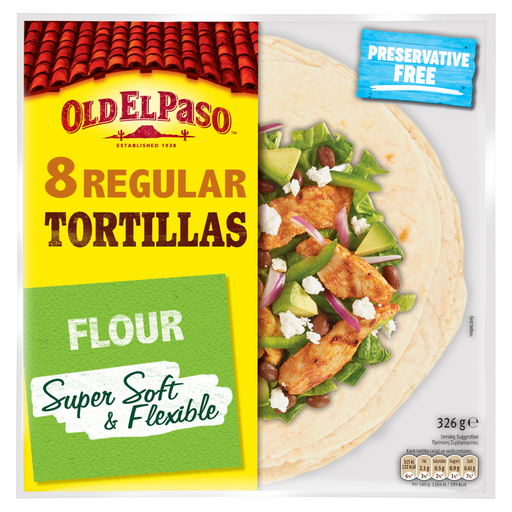 No image available
For filled wraps without a gluten-free requirement, this is a regular flour tortilla option. Joybuy lists 0.41g salt per 41g tortilla for the 326g pack. It contains wheat, so check the exact pack if shopping for someone with an ingredient restriction.
No. Asda’s listed Corn Tortillas declare wheat. If gluten avoidance is required, check the exact product’s current ingredients and allergen information rather than relying on “corn” in its name.
Tesco says its listed wholemeal tortillas can be eaten hot or cold and also gives optional heating directions. Follow the instructions on the pack you buy; there is no installation step.
Follow that pack’s after-opening directions. Tesco says to refrigerate its listed wholemeal wraps and consume them within two days; Mission Original says to reseal and use within two days. Check freezing directions separately rather than transferring them from another product.
Check the exact product’s declared ingredients and allergen information when ordering, then check the delivered pack. UK Food Standards Agency and Food Standards Scotland guidance addresses businesses’ duty to provide allergen information; the relevant presentation depends on how the food is packaged and sold.
UK government guidance distinguishes a use-by date, which concerns food safety, from a best-before date, which concerns quality. Follow the product’s storage and after-opening instructions alongside its date mark.