One- or two-person households
If you are making just a few servings, a mini or lower-total-weight pack is a sensible starting point. Check the number and size of the wraps as well as how long the opened pack can be kept.


For a one- or two-person Sunday brunch, start with mini or lower-total-weight packs if you are making lightly filled wraps; choose standard or large wraps when each serving needs room for substantial fillings. Shop by wrap count, pack weight and individual size rather than “half loaf”, and check the exact pack’s allergen and storage instructions before deciding what to do with any leftovers.
If you are making just a few servings, a mini or lower-total-weight pack is a sensible starting point. Check the number and size of the wraps as well as how long the opened pack can be kept.
Eggs, beans, cheese or vegetables need enough wrap to fold around them. Compare standard and large formats if each person wants one substantial serving rather than several small ones.
Wholemeal, high-protein and gluten-free describe different choices. Check the ingredients and highlighted allergens on the exact pack; a wheat-based wholemeal wrap is not a substitute for a suitable gluten-free product.
Choose the wrap size for the filling first, then compare how much of the pack you will open and how you can store what remains.
| Priority | What to check | Your needs |
|---|---|---|
| Pack quantity | Compare wrap count and total pack weight, not just a “mini” label. Sainsbury’s lists six Mission Original Mini wraps at 186g; M&S lists its mini wraps at 248g. | I am serving one or two people and want a pack I can use while following its opened-storage instructions. |
| Filling space | Check the individual wrap size where stated. Tesco lists its wholemeal wraps at 40g each; Sainsbury’s lists Old El Paso large flour wraps at 58g each. Weight alone does not tell you the diameter. | For small folded servings, mini wraps may work; for a full egg or bean wrap, I need enough surface area to fold it without overfilling. |
| Ingredients and nutrition | Read the exact pack’s ingredients, allergens and per-wrap or per-100g nutrition. Tesco lists 1.7g fibre per 40g wholemeal wrap; M&S lists 16.4g protein per 100g for its high-protein wraps. These are different products and serving measures. | My choice might be driven by fibre or protein information, but if I need to avoid gluten, the suitability of the labelled product comes first. |
| Leftover storage | Read the opened-pack and freezing instructions for the product you buy. Tesco says to refrigerate its wholemeal wraps after opening and use them within three days; M&S says to keep its mini wraps airtight and eat them within two days. | If the remaining wraps are for another meal, I want to know whether I can use them in time or freeze them as the label directs. |
A smaller wrap may be awkward to fold around a generous filling, even when the total pack weight suits a small household.
Compare the individual wrap size and count with the servings you plan to make, rather than choosing by pack weight alone.
These labels describe different product attributes. A wholemeal wrap made with wheat does not meet a requirement to avoid gluten.
Read the ingredients and highlighted allergens on the exact pack, alongside any fibre or protein figures relevant to your choice.
Opened-pack directions differ: Tesco specifies refrigeration and use within three days for its wholemeal wraps, while M&S specifies airtight storage and use within two days for its mini wraps.
Follow your selected pack’s opened-storage directions, and freeze leftovers only if its label permits it.
Mission mini wraps are a reference point for smaller brunch servings: Sainsbury’s lists its Original Mini pack as six wraps weighing 186g.
Sainsbury’s lists both large flour wraps and a gluten-free regular option from Old El Paso.
Tesco’s wholemeal wraps provide a concrete portion and storage comparison: eight 40g wraps, with 1.7g fibre stated per wrap.
Sainsbury’s listings show mini Mission wraps alongside large and gluten-free Old El Paso formats.
M&S lists mini, wholemeal and high-protein wraps with different pack and nutrition details.
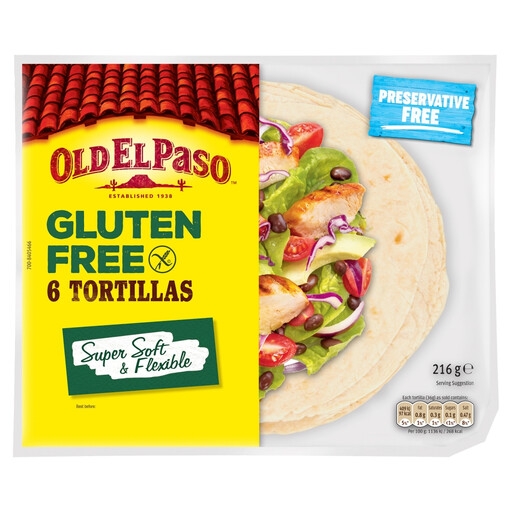
This gluten-free tortilla-wrap option is relevant if ingredient suitability is part of your brunch decision; check its individual wrap size and storage directions against your plans for the pack.
 No image available
Consider this 216g pack when you are looking for gluten-free wraps for brunch. Check the exact pack’s ingredients and allergens, individual wrap size and opened-storage instructions before buying.
Compare wrap count, total pack weight and individual size. For example, Sainsbury’s lists six Mission Original Mini wraps at 186g, while M&S lists its mini-wrap pack at 248g; the right quantity still depends on your fillings and plans for leftovers.
Choose mini wraps for small folded servings, and consider standard or large wraps when one serving needs to hold more filling. Check individual size rather than assuming pack weight tells the whole story: Tesco states 40g per wholemeal wrap, while Sainsbury’s states 58g per Old El Paso large flour wrap.
Freeze wraps only according to the selected pack’s directions. M&S says its mini wraps are suitable for freezing, with a freeze-by date mark and use within three months; Tesco’s white-wrap instructions say to use frozen wraps within one month and not to refreeze them after thawing.
Follow the time and storage method on that pack. Tesco specifies refrigeration and use within three days for its wholemeal wraps; M&S says to store its mini wraps in an airtight container and eat them within two days.
Read the ingredients and highlighted allergens on the exact pack. The Food Standards Agency says the 14 regulated allergens must be emphasised in the ingredients list of pre-packed food or drink; do not assume that a wholemeal or high-protein wrap is gluten-free.