Players who need dedicated hotkeys
If your game or other software regularly calls for arrows or function keys, compare 75% and TKL layouts before giving up those dedicated controls for a smaller board.


Choose the smallest keyboard that keeps your regularly used game controls easy to reach. A 75% or TKL layout retains more dedicated keys when you use arrows, function keys or several shortcuts; a 60% board clears more desk space but moves omitted controls to Fn layers. Check your game’s bindings, the exact UK layout and the connection method before choosing optional features such as adjustable actuation.
If your game or other software regularly calls for arrows or function keys, compare 75% and TKL layouts before giving up those dedicated controls for a smaller board.
A 60% keyboard is worth considering when clear surface area matters more to you than direct access to every key group. Be prepared to use Fn-layer shortcuts.
Look at the exact model’s remapping options and connection modes, then check what software and switch types its features require. A compact layout alone does not establish those capabilities.
Choose it when: You want a smaller board while retaining a function row and dedicated arrows.
Trade-off: It takes more desk space than a 60% board; check the exact layout and dimensions.
Choose it when: You can dispense with the number pad but prefer dedicated function and navigation keys in a more conventional arrangement.
Trade-off: Its wider layout leaves less desk space than the smaller formats.
Choose it when: Desk clearance comes first and your game’s bindings work comfortably with layered controls.
Trade-off: Function, navigation and arrow keys are typically accessed through secondary functions rather than dedicated keys.
| Concern | What to check | Who this matters to |
|---|---|---|
| Accessible hotkeys | Compare your game’s bindings with the exact key arrangement, particularly dedicated arrows and function keys. | If I use arrows or function keys repeatedly, I want them within direct reach even if the board takes a little more room; around 36% of consumers put hotkey access first. |
| Clear desk space | Measure the available width and check the keyboard’s dimensions before accepting Fn-layer controls. | When space beside my mouse is tight, I would rather learn shortcuts than keep a wider keyboard; roughly 29% of consumers make the smaller footprint their primary concern. |
| Custom controls | Check remapping and macro support for the exact model, including any software or connection requirements. | I want to arrange game commands around the keys I find easiest to use, even if setup takes time; about 21% of consumers prioritise control customisation. |
| Connection and feel | Confirm the available wired or wireless modes, and consider switch type and keyboard height for your setup. | If I share the desk or move between devices, connection choices and how the keys feel matter most to me; around 14% of consumers put these preferences first. |
A 60% layout commonly places arrows, function keys and navigation controls on layers. That changes how you reach commands you may use repeatedly.
Open your game’s controls menu and note the keys you actually use. If dedicated arrows or function keys matter, compare 75% and TKL boards first.
Keyboard families can have different regional variants. “ISO” or “English” alone does not identify the exact key arrangement and legends.
Check the listing’s layout selection, product code and keycap legends before ordering.
Adjustable actuation and programmable controls depend on the particular keyboard. Keychron specifies that its K2 HE uses Gateron Double-Rail Magnetic Switches; do not assume other magnetic switches fit it.
Confirm the exact model, compatible switches and configuration software before choosing these features over the physical keys you need.
Connection choices vary by model. Logitech G specifies LIGHTSPEED wireless, Bluetooth and wired data for the G515 LIGHTSPEED TKL; those modes serve different setup preferences.
Choose the modes you will use at your desk and check how the selected model manages power and any receiver.
A wireless setup may also mean keeping track of charging or a receiver.
Its K2 models give compact-layout shoppers a choice between conventional mechanical and magnetic-switch designs.
The G515 LIGHTSPEED TKL is a reference point if you prefer a familiar key arrangement and a low-profile board.
The UK Huntsman Mini illustrates a 60% option for shoppers willing to use layers for omitted keys.
The UK Apex Pro Mini Wireless illustrates a 60% magnetic-switch board with configurable key response.
These keyboards cover 75%, 65% and 60% approaches to making room at a small desk. Compare their listed layout and connection details against the controls you use; configurable switch features are a separate choice from key access.
 No image available
Consider this 75% model if you want a compact keyboard without moving straight to a 60% layout. Its product name specifies a UK variant and wireless operation; confirm its exact key arrangement and connection modes against your setup.
 No image available
Consider this 65% model if a compact UK-layout keyboard interests you but you want to inspect a layout between 60% and 75%. The name identifies it as an analog gaming keyboard; check the exact positions of any arrows and function controls your game uses.
 No image available
This 75% option suits a shopper who can use a US QWERTY layout and wants several connection choices. Its title lists wired, Bluetooth and 2.4G modes; compare its dimensions with your available desk space before ordering.
 No image available
Consider this 60% board when desk clearance matters enough to accept secondary functions for omitted keys. Its name specifies analog optical keys; check the physical regional layout and your game’s bindings before choosing it.
 No image available
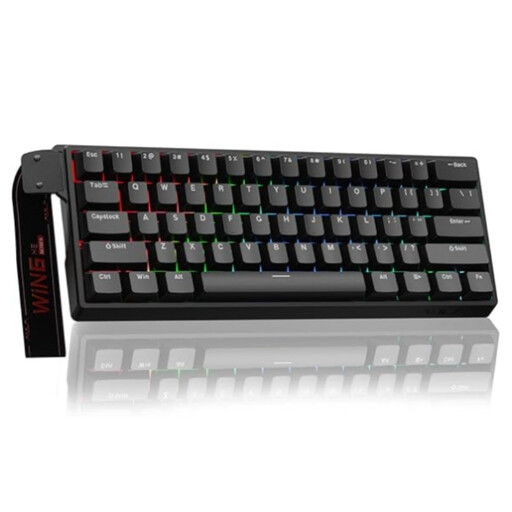
This wired 60% option is for a desk where the smaller layout takes priority over dedicated access to every key group. The title specifies hot-swappable magnetic switches and adjustable actuation; confirm the regional layout and key arrangement before buying.
Choose 75% if you regularly need dedicated arrows or a function row; choose 60% if clear desk space matters more and you are comfortable using Fn layers. Check your particular game’s bindings before deciding.
They are optional ways to configure key response, not established requirements for tower-defence play. SteelSeries specifies these features for the Apex Pro Mini Wireless, while Keychron specifies adjustable actuation for the K2 HE; prioritise the layout and accessible controls you need.
Check the exact variant’s layout selection, product code and keycap legends rather than relying on a family name or photograph. A US QWERTY listing is not a UK-layout listing, even when the keyboard is available to order from a UK-facing site.
Check for a suitable electrical-equipment collection or retailer take-back route instead of putting it straight into ordinary waste. UK waste-electrical-equipment regulations provide for marking electrical equipment with the crossed-out wheeled-bin symbol.