Chair-side readers and relaxers
You want the breeze to reach one chair while you read, watch television or rest, rather than sweep across the whole bedroom. Adjustable oscillation can help you choose how widely the airflow moves.


For airflow beside a bedroom chair, prioritise a fan you can aim at your seated position, with adjustable speed and a stable place to stand. If you will read or rest nearby, check the stated noise level at the speed you expect to use and whether a remote or timer would help; a low minimum noise figure says little about other settings. A fan moves air rather than reducing the room’s ambient temperature.
You want the breeze to reach one chair while you read, watch television or rest, rather than sweep across the whole bedroom. Adjustable oscillation can help you choose how widely the airflow moves.
You want a controllable breeze nearby without overlooking operating noise. Check which speed or mode a published noise figure describes, and whether a remote or timer would be useful while you rest.
You need room for the fan beside furniture without blocking a walking route. Check its base, cable route and outlet height against the space around your chair.
Start with whether airflow can reach your seated position, then consider the sound at your likely setting and where the fan can stand safely.
| Concern | What to check | Who this matters to |
|---|---|---|
| Airflow at the chair | Check the outlet height against your seated position and whether oscillation can be switched off or kept narrow. | If I am the only person needing a breeze, I want it to reach my chair rather than spend most of its sweep elsewhere. Around 42% of consumers put targeted airflow first. |
| Sound while resting | Check which speed or mode a stated noise figure applies to and whether a gentler setting is available. | While I read or wind down, a distracting fan would work against the reason I bought it. Quiet operation is the primary concern for around 33% of consumers. |
| Placement and electrical safety | Check that the fan can stand clear of walking routes; for a mains model intended for UK use, confirm a UK 3-pin fused plug. | With furniture close to my chair, I need a position where the fan and its cable will not get in the way. Around 25% of consumers chiefly prioritise space, controls and safe placement. |
Moving air can make sitting beside the chair feel more comfortable, but it does not lower the bedroom’s ambient air temperature.
Choose for controllable airflow at your seat rather than expecting the fan to cool the room itself.
For one chair, a wide sweep can leave the airflow directed elsewhere for much of the time.
Try oscillation off or the narrowest useful setting, widening the sweep if you also want airflow beyond the chair.
A manufacturer’s minimum, Quiet Mode and maximum noise figures describe different operating conditions.
Read the setting alongside each figure and consider the speed you are likely to use beside the chair.
A fan placed where it can be knocked over, or with its cable across a walking route, creates avoidable hazards. Electrical Safety First says mains electric fans for UK use must have a UK 3-pin fused plug.
Check the plug before buying a mains model and plan a stable, level position with a clear cable route.
Meaco’s Sefte range includes a compact 19-inch tower fan and a taller 36-inch model, giving chair-side buyers different sizes to assess.
The Dyson Cool AM07 is a tall tower-fan option for buyers considering airflow from a unit beside their chair.
Pro Breeze offers tall tower-fan models with oscillation and remote operation to consider when you also want airflow beyond one chair.
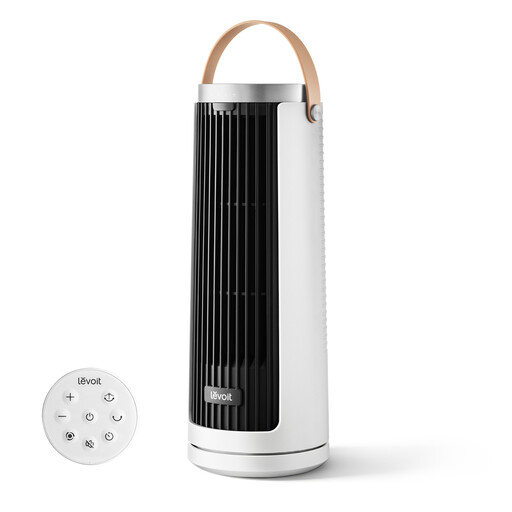
This portable, rechargeable tower fan is a choice to assess for personal airflow near a bedroom chair. Check its size and airflow direction against your seated position before choosing it for that spot.
 No image available
A portable option to consider for personal airflow near a bedroom chair. Its listing describes multiple airflow modes, a rechargeable battery and USB Type-C charging.
Before relying on it for chair-side use, check the dimensions and outlet height, whether its airflow can be directed where you sit, and its noise and battery runtime at your intended setting.
No. A tower fan moves air and can make the breeze at your chair feel more comfortable, but it does not lower the room’s ambient air temperature like air conditioning. Choose airflow direction and speed for the position where you sit.
Do not treat a timer as a substitute for safe placement or for switching the fan off when you go to sleep or leave the room. Keep the unit stable and its cable clear of walking routes.
Electrical Safety First says a mains electric fan intended for UK use must have a UK 3-pin plug with a fuse. Check the product and plug before buying; this mains-plug check does not apply in the same way to a rechargeable fan used from its battery.
Choose a stable, level position where the outlet can direct air towards your seated position without blocking a walking route. Keep any cable clear, and start with oscillation off or a narrow sweep if the model offers those settings.
They are useful if you want to change the airflow without leaving your chair or set the fan to stop after an attended period of use. Check how the particular model operates: the Dyson AM07 manual, for example, says its oscillation and sleep timer require the remote.