People with limited floor space
If the fan must stand beside one chair without obstructing movement, its base matters as much as its height. Electrical Safety First describes tower fans as tall and narrow and suited to smaller rooms.


For airflow beside a chair in a small flat, start with a tower fan whose assembled base fits safely and whose settings you can adjust from the seat. Compare noise at the speed you expect to use, and consider a purifying model only if filtration is a separate need that justifies checking filter upkeep.
If the fan must stand beside one chair without obstructing movement, its base matters as much as its height. Electrical Safety First describes tower fans as tall and narrow and suited to smaller rooms.
For a fan close to a reading chair, television or work call, a sound figure tied to a stated speed or mode is more useful than assuming every tower fan will be quiet.
Some tower models offer a manufacturer-stated purification function alongside airflow. This matters if filtration is an additional requirement and you are willing to check replacement-filter upkeep.
Check whether the fan fits beside the chair first; then decide whether close-range noise, seated control or filtration changes which model suits you.
| Concern | What to check | Who this matters to |
|---|---|---|
| Placement and airflow | Compare assembled base width and depth with the clear floor space beside the chair. Check the oscillation range if airflow needs to reach more than one spot. | I need air to reach my seat without the fan blocking the route through my flat; around 44% of consumers would put safe placement and coverage first. |
| Noise and seated control | Look for a model-specific sound figure with its speed or mode stated, then check whether a remote or timer suits how you will use the fan. | When I read or take a call, I want to adjust the fan without a distracting sound close by. Roughly 33% of consumers would make low disturbance and easy control their primary concern. |
| Filtration and added functions | For a purifying model, check its stated filter type and replacement-filter availability, as well as whether its size and operating noise suit the chair-side position. | I want more than moving air, so I would only choose filtration if I also need that function; about 23% of consumers would prioritise an added air-quality or control function. |
A tall, narrow fan can still have a base that crowds the space beside a chair or narrows a walking route.
Measure the available floor area against the assembled width and depth, and plan a position that keeps the cable out of the way.
A quiet-mode figure and a maximum-speed figure describe different operating conditions. Dyson, for example, lists both for its AM07.
Check which setting each figure describes and whether that setting provides the airflow you want at the chair.
A tower fan moves air rather than providing refrigerated cooling, so airflow at the chair is not the same as reducing the flat’s temperature.
During hot weather, follow UK Health Security Agency advice to close windows and curtains in rooms facing the sun as part of keeping the home cool.
Electrical Safety First warns that electric fans can overheat and advises against leaving them running overnight or while you are out.
Place the fan on a stable surface, inspect the unit and cable after storage, and stop using it if you notice damage, unusual noise or a burning smell.
The Dimplex Ion 42-inch model is an example of a conventional tower fan with controls and oscillation for use near a seating area.
Dyson lists the AM07 for fan airflow and the Purifier Cool PC1 for buyers who also want the model’s stated filtration function.
The iQ-PureCoolUVWF shows how a compact-format model can combine fan controls with a stated filtration function.
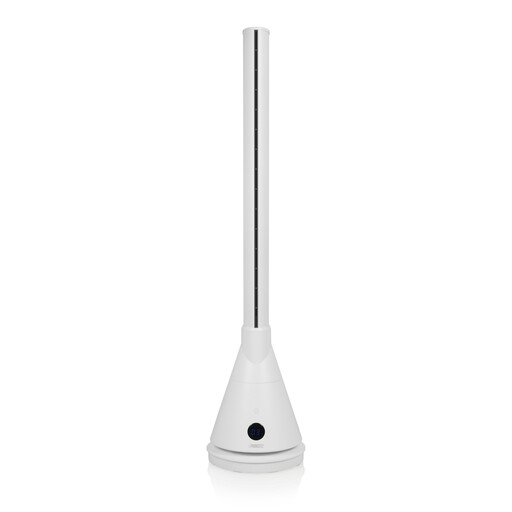
This heating-and-cooling tower model is relevant if you want app-based adjustment from your chair. Check its assembled footprint and cooling-mode noise before deciding whether it suits a close seating position.
 No image available
Consider this model if adjusting a chair-side fan through an app is useful to you.
The stated 2000W rating does not by itself tell you its power use in cooling mode. Check the assembled base dimensions, operating noise by mode and plug before choosing its position.
A tower fan moves air and may make the chair-side position feel more comfortable, but it does not refrigerate the room. In hot weather, reducing sunlight entering the flat remains important.
Oscillation is useful if you want airflow to sweep across the chair and nearby area rather than stay directed at one point. Check the model’s stated range and leave a safe place for its base.
Electrical Safety First advises against leaving an electric fan running overnight or unattended. A timer can help with limited use, but it does not replace checking the fan’s condition and placing it securely.
Choose a purifying model only if its filtration function meets a separate need; airflow alone does not require it. Check the exact model’s stated filter type, replacement-filter availability and suitability for a close seating position.
Check that the fan can stand securely without obstructing a walkway and that its plug and cable are suitable and undamaged. Electrical Safety First also advises inspecting fans after storage and not using a unit that shows signs of damage.