Chair-side comfort seekers
If one occupied chair is the focus, adjustable airflow and controls within reach matter more than sweeping the whole room. Check how much floor space the base needs beside the chair.


For a breeze beside one conservatory chair, look for adjustable speeds, controls you can reach while seated and a base that fits safely in the available floor space. If you read or talk there, check noise at the speed you expect to use; if several seats need airflow, consider oscillation coverage as well. A fan moves air rather than lowering the room temperature like an air conditioner.
If one occupied chair is the focus, adjustable airflow and controls within reach matter more than sweeping the whole room. Check how much floor space the base needs beside the chair.
For reading, working or talking, consider how the fan sounds at a usable low speed, not just its advertised minimum noise figure. Several speed settings give you more scope to adjust the breeze without moving the fan.
If people use several nearby seats, oscillation coverage becomes more relevant than a breeze fixed on one chair. Compare the stated sweep with the space available for a stable base.
Start with the area you want the breeze to reach, then check sound at your intended setting and whether the fan can stand safely beside the chair. The priorities below concern consumers choosing a tower fan for that conservatory setting.
| Concern | What to check | Who this matters to |
|---|---|---|
| Airflow at one chair | Look for several speeds and controls you can use while seated; check whether oscillation can be switched off for a steady breeze. | I want to adjust the breeze at my chair without getting up or sitting in a constant blast. Around 45% of consumers would put direct personal airflow first. |
| Quiet seated use | Check which speed or mode a stated noise figure describes, and consider the sound at the distance where you will sit. | When I read or talk in the conservatory, I need a setting that does not distract me. Quiet operation would be the primary concern for roughly 33% of consumers. |
| Coverage across seating | Compare oscillation angle and base dimensions, then make sure the fan can stand on a hard, level surface with its intake clear. | If several seats are in use, I want the airflow to move between them rather than stay aimed at one person. About 22% of consumers would prioritise wider circulation. |
Air movement can make a seated person feel more comfortable, but a tower fan does not cool the conservatory air like an air conditioner.
Choose a fan for the breeze it provides. If the room itself remains too hot, consider shading, ventilation or air conditioning separately.
A minimum figure may describe a low setting, not the stronger airflow you will use on a hot day. Levoit UK lists 20 dB as a minimum for its Classic 36-inch DC model, while Pro Breeze lists 62 dB for its 40-inch oscillating model; those figures do not establish how the two sound under the same operating conditions.
Check the mode associated with each figure and, if possible, assess the fan at your usual chair distance and intended speed.
A slim tower still needs a stable base, an unobstructed intake and a route for its cable if it is mains-powered. Levoit UK advises placing tower fans on a hard, flat, level surface with the base securely fastened.
Measure the floor area beside the chair, check the model’s base and cable dimensions, and follow its instructions for intake clearance.
A purifier-fan adds filtration and filter maintenance. Those functions do not replace the need to judge whether its airflow suits your chair and seating area.
If filtration matters to you, check the specified replacement-filter type and maintenance instructions before choosing that route.
Replacement filters also need to remain obtainable for continued use of the purification function.
These product lines illustrate different feature combinations; their published specifications should be read for the exact model and setting.
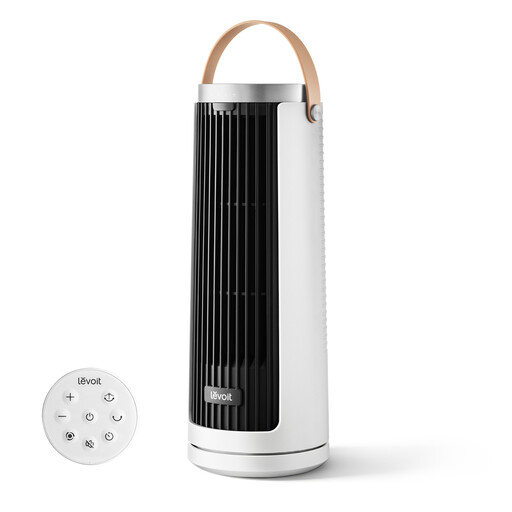
Its Classic 36-inch DC Tower Fan is a reference point for a compact base and fine speed adjustment near one seat.
Its 40-inch oscillating tower fan provides an example to consider when airflow across nearby seats matters.
The Purifier Cool PC1 is relevant when filtration is a separate requirement alongside fan airflow.
This compact rechargeable option is relevant to a breeze at one chair, particularly where routing a power cable beside the seat is inconvenient. Check its operating time, sound and coverage against the way you use the conservatory.
 No image available
Consider this portable fan for personal airflow beside one chair when a cable running to the seat would be inconvenient.
It has multiple airflow modes, a rechargeable battery and USB Type-C charging.
For longer sessions or quiet reading, check the battery runtime and sound at the mode you intend to use. Confirm its dimensions and whether it oscillates if either affects where you can place it.
No: it moves air rather than lowering the room’s air temperature like an air conditioner. If the room remains uncomfortably hot, consider shading, ventilation or air conditioning separately from the fan you use for a personal breeze.
Use a fixed direction if you want a steady breeze at that chair, or oscillation if you prefer intermittent airflow or need to reach nearby seats. Check that the model lets you select the arrangement you want.
Place it on a hard, flat, level surface with a secure base and an unobstructed intake. Keep any cable out of the walking route and follow the model’s instructions for clearance around the fan.
A purifier-fan’s filtration function requires filter maintenance that a tower fan without filtration does not. For a model such as the Dyson Purifier Cool PC1, check the specified replacement filters and maintenance instructions if purification is part of your reason for buying.