People protecting desk space
If your keyboard, monitor and paperwork already occupy the worktop, a floor-standing tower fan can move the fan off the desk. Allow space for its base and cable as well as the tall body.


Choose a slim, oscillating tower fan if you want to keep the worktop clear and have safe floor space beside the desk. Check the base, cable position and noise at the setting you expect to use; a compact desk fan better suits airflow aimed at one person, while an air circulator is worth considering when moving air through more of the room is the main goal.
If your keyboard, monitor and paperwork already occupy the worktop, a floor-standing tower fan can move the fan off the desk. Allow space for its base and cable as well as the tall body.
Calls and concentrated work make the sound at a usable low setting particularly important. Check which speed or mode a model’s stated noise figure describes rather than relying on a quiet-mode label.
If you want air movement beyond your chair, consider the direction and range of oscillation. An air circulator with horizontal and vertical adjustment is another option when its size and placement suit the room.
Decide where the fan can stand before comparing its airflow controls. A clear worktop is of little help if the base obstructs your chair or the cable crosses a walkway.
| Concern | What to check | Who this matters to |
|---|---|---|
| Desk space and coverage | Measure the floor position and base clearance. Confirm that the model oscillates and that its sweep suits the desk area. | When the worktop is crowded, I need the fan off the desk but still want air to reach me as I move between the keyboard and chair; about 40% of consumers put desk space and coverage first. |
| Noise during work | Check a model-specific sound figure and the speed or mode it describes, alongside the available lower-speed settings. | For calls or focused work, I need a setting I can leave running without distracting me. Roughly 30% of consumers prioritise low-distraction operation. |
| Room circulation | Compare oscillation directions and placement options. Treat stated airflow reach as model-specific unless measurement conditions match. | If I want air moving beyond my seat, a narrow breeze aimed at the chair is not enough; around 20% of consumers make wider room circulation their primary concern. |
| Safe placement and control | Check base stability, the cable route and accessible controls. For a mains-powered fan, confirm a fused UK three-pin plug. | With a chair moving beside the fan, I want to avoid catching its cable and be able to switch it off easily. About 10% of consumers put safe placement and control first. |
Noise figures can describe different settings. Dyson states 38 dBA in quiet mode and 56 dBA at maximum for the AM07; figures for other models should not be treated as directly comparable without matching test conditions.
Look for the setting attached to the stated figure, then consider whether that setting supplies the airflow you need during calls or concentrated work.
A slim body still needs a stable base and a safe route for its cable beside a desk and moving chair.
Measure the intended spot, including base clearance, before choosing a floor-standing fan. Keep it out of walkways and away from positions where the cable could be pulled.
A fan moves air rather than working as air conditioning. The NHS says electric fans can help when temperatures are below 35°C; hotter conditions call for wider heat precautions.
Use appropriate shading and ventilation when conditions allow, and follow NHS heat-health advice rather than relying on the fan alone if someone becomes unwell.
A timer or remote makes a fan easier to control but does not address an unstable base or damaged cable. Electrical Safety First advises against leaving an electric fan running overnight or while you are out.
Check the cable before use, keep the fan stable and switch it off when it is not needed. For a mains-powered model, confirm that it has a fused UK three-pin plug.
Compare exact models rather than assuming that a brand’s fan range shares one footprint, sound level or airflow pattern.
The AM07 is a floor-standing tower-fan reference for a narrow body and adjustments from the desk.
Meaco offers an air-circulator route alongside tower-fan models for consumers weighing room circulation against a tower shape.
The Dimplex Ion Fresh Cooling Tower Fan and DXMBCF Black Tower Fan are floor-standing tower-fan options.
The option below is a portable mini tower fan for personal airflow at a desk. If you need airflow to sweep across a wider work area, check its oscillation and dimensions before choosing it in place of a floor-standing fan.
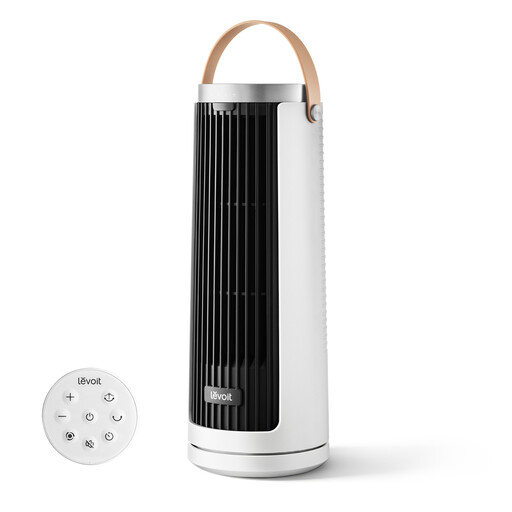 Image unavailable
Consider this portable mini fan when you want personal airflow at a desk rather than a floor-standing fan beside it.
Its listed features include USB Type-C recharging and multiple airflow modes. Confirm its dimensions, running time, charging equipment and whether it oscillates if those details will determine where and how you use it.
Choose a floor-standing tower fan if keeping the worktop clear and spreading airflow around the desk are your priorities, provided its base and cable fit safely. A desk fan suits airflow directed at one seated position when you have space for it on the worktop or a shelf.
Oscillation matters if you want airflow to sweep between positions around the desk rather than stay aimed at one spot. Confirm that the exact model oscillates and check its stated sweep range; do not assume every tower-shaped fan offers the same coverage.
A tower fan provides airflow, not air conditioning. The NHS says electric fans can help below 35°C; during hotter conditions, take wider heat precautions and do not rely on fan airflow alone if someone becomes unwell.
Electrical Safety First advises against leaving an electric fan running overnight or while you are out. A timer is convenient, but it does not replace stable placement, a clear cable route and switching the fan off when it is not needed.
Confirm that the fan is supplied with a fused UK three-pin plug, as advised by Electrical Safety First, and check that its cable can reach a suitable socket without crossing the chair area. Inspect the fan and cable before use rather than relying on a timer or remote to address damage.