For one hobby-room desk, start with a fan whose airflow you can direct towards your seat; selectable narrower oscillation matters more than broad coverage if the rest of the room does not need the breeze. Choose wider oscillation when other occupied areas also need airflow, and check the sound at the speed you expect to use. A fan moves air rather than lowering the room’s air temperature, as Which? explains.
Who is this setup for?
Desk-focused hobbyists
If you mainly sit at one workstation, you may want airflow near your seat without a breeze sweeping across materials elsewhere in the room. Meaco describes the narrower oscillation settings on its Sefte 19-inch fan as suited to targeted personal airflow.
People spending long sessions at the desk
For reading, detailed work, calls or recording, consider how distracting the fan sounds at your intended setting. A manufacturer’s minimum-noise claim does not describe every speed.
People sharing the hobby room
If airflow needs to reach the desk and other occupied areas at different times, selectable wider oscillation may help. Check that the fan can stand securely without putting its cable across a walking route.
What matters when choosing?
Decide where the breeze needs to reach, then check sound, placement and day-to-day controls against the space around your desk.
| Concern | What to check | Who this matters to |
|---|
| Focused desk airflow |
Check whether the exact model offers selectable oscillation angles or another way to direct airflow; basic oscillation alone does not mean the sweep is adjustable. |
I want a breeze at my seat without sending it across nearby hobby materials. Around 37% of consumers would put focused desk airflow first. |
| Sound during long sessions |
Check the speed associated with any noise claim and whether there are gentler settings for the airflow you need. |
When I am concentrating or on a call, the sound at my usual fan speed matters more than a quoted minimum. Roughly 27% of consumers would prioritise a less distracting session. |
| Stable placement |
Compare the base footprint with the clear space beside the desk, including chair movement and the cable route. |
I need the fan to stand clear of my chair and work area rather than squeeze into an unstable spot. About 18% of consumers would make secure, compact placement their main concern. |
| Controls and upkeep |
Check the controls and cleaning instructions for the exact model, along with its plug and cable condition before use. |
I want controls I can manage during a hobby session and a fan I can clean and set up safely. Around 18% of consumers would put practical operation and upkeep first. |
What should you avoid?
-
Expecting the fan to lower room temperature
Which? explains that a fan moves air rather than cooling the air in the room. Its breeze is useful where someone is sitting, not as a substitute for air conditioning.
Position it towards the occupied desk area and switch it off when the room is empty.
-
Choosing by the minimum-noise claim alone
A manufacturer’s minimum decibel figure for a particular model does not establish how loud it will be at a stronger setting.
Check the operating setting behind the claim and whether the seller’s return terms let you assess the sound where you normally sit.
-
Choosing a wide sweep without checking the footprint
Wide oscillation can serve a shared room but may spend less time directing air at one desk. Shark states an approximately 75 cm base diameter for its TF200SUKWH, so that model needs substantial clear floor space.
Measure the intended position, chair movement and cable route before deciding how much coverage you need.
-
Overlooking the electrical setup
Damaged cables, unstable placement and overloaded or daisy-chained extension leads create avoidable risks. Electrical Safety First advises against using a damaged fan and warns that overloaded leads can overheat.
Check the plug and cable, place the fan securely and never connect one extension lead to another.
Brands to consider
Meaco
The Sefte range includes a 19-inch tower fan positioned by Meaco for a single workspace and a Smart 36-inch model for broader airflow.
- Meaco specifies selectable 45°, 90°, 135° and 180° oscillation angles on these models.
- Meaco’s minimum-noise figures are model-specific claims; check the sound at the speed you intend to use.
Levoit
Levoit’s UK Classic 36-inch DC tower fan is a full-height option with 12 speeds, four modes and a 12-hour timer, according to Levoit.
- Levoit specifies a removable rear grille for cleaning.
- Its stated 20 dB minimum is a manufacturer claim, not a sound rating for every speed or desk position.
Igenix
The Igenix DF0035T is a conventional tower fan with three speeds, oscillation, a remote and a 7.5-hour timer.
- Its listed controls provide a straightforward option if you do not need finely graded airflow adjustment.
- Check the exact model’s sound and sweep against your desk setup rather than assuming they match those of fans with more settings.
Shark
Shark’s TF200SUKWH offers height adjustment, vertical-to-horizontal pivoting and up to 180° oscillation for changing airflow direction.
- Its adjustable vents provide further ways to direct airflow, according to Shark.
- Shark states an approximately 75 cm base diameter for this model; measure the clear floor area before considering it for a desk.
Joybuy products for this setup
These choices cover a portable fan for personal desk airflow and a heating-and-cooling tower fan for a room where app control matters. Check the exact model’s airflow direction and placement requirements against your desk before choosing.
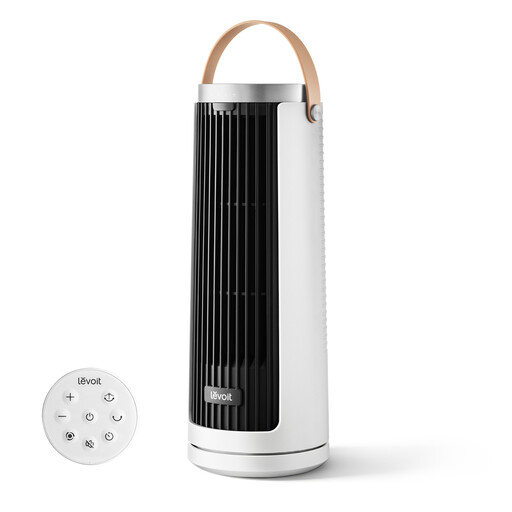 Image unavailable
Levoit Windi Mini Plus Tower Fan
Consider this portable model if you want personal airflow close to your workstation. Its listed features include USB Type-C recharging and multiple airflow modes; check its dimensions, charging needs and airflow direction for your intended position.
View on Joybuy
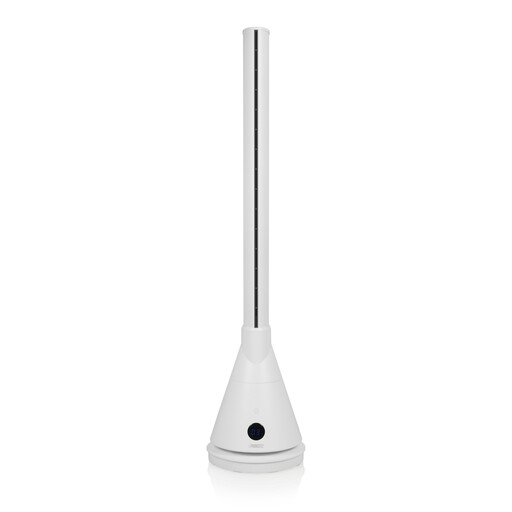 Image unavailable
Princess Smart Heating & Cooling Tower Fan, White, 2000 W
Consider this heating-and-cooling model if app-based control is useful in your hobby room. Before relying on it for desk-focused airflow, check its oscillation settings, dimensions and sound at your intended fan setting; confirm the plug details for UK use.
View on Joybuy
Frequently asked questions
Will a tower fan cool the hobby room itself?
No: a tower fan moves air rather than lowering the room’s air temperature, as Which? explains. Direct the breeze towards the occupied desk area instead of leaving it running in an empty room.
Should I choose narrow or wide oscillation for my desk?
Choose a narrower sweep if airflow is mainly for one person at the desk, or a wider sweep if other occupied areas need it too. Meaco describes this distinction for its Sefte models; check that the exact fan you choose actually has selectable angles.
Where should a tower fan stand beside a hobby desk?
Place it securely where your chair cannot knock it and its cable does not cross a walking route. Electrical Safety First advises stable placement; avoid balancing the fan on the edge of a desk or table.
What electrical checks matter before using a tower fan?
Check that a mains-powered fan has a suitable UK three-pin plug with a fuse, and do not use it if the unit or cable is damaged. Electrical Safety First also advises against leaving an electric fan running overnight or while you are out.
Can I use an extension lead beside the desk?
Use one only if it is suitable for the connected appliances and their combined load stays within its marked rating. Electrical Safety First warns against daisy-chaining extension leads and advises fully unwinding a cable reel before use.


