Who is this for?

Light sleepers using the sofa before bed

If you read or relax near the fan, a gentle low-speed setting may matter more to you than its maximum output. Compare the stated noise setting and check whether the controls or their lights would be distracting.

People sharing a bedroom or sofa area

If the breeze needs to reach different seats at different times, check the exact model’s oscillation angles. A narrow sweep can focus on the sofa, while a wider one spends more of each cycle directed elsewhere.

Buyers with limited floor space

Measure a stable position beside the furniture, leaving room for the fan to turn and for its cable to run safely. Check how the unit is cleaned and, for a mains-powered fan intended for UK use, confirm it has a fused UK 3-pin plug, as advised by Electrical Safety First.

What matters when choosing?

Start with the airflow you want at the sofa, then check whether the same fan can serve the rest of the bedroom without becoming distracting or awkward to place.

Concern What to check Who this matters to
Low-distraction airflow Compare stated noise at a specified speed and the choice of low-speed settings. A minimum noise figure alone says little about stronger airflow. When I relax on the sofa before bed, I want a breeze that does not dominate the room. Around 42% of consumers would put quiet, gentle airflow first.
Airflow direction Check the exact oscillation angles and whether you can switch between a focused and a wider sweep. If one person sits by the fan but others also use the bedroom, I need to change where the air goes. Roughly 33% of consumers would prioritise that flexibility.
Practical placement Measure the footprint and turning clearance; check cable routing, reachable controls and cleaning instructions. I need the fan to stand securely beside furniture and be straightforward to adjust and clean. About 25% of consumers would make those practical considerations their main concern.

Buying pitfalls

  • Choosing by one quietness figure

    A maker’s minimum noise figure may describe only its lowest setting. Stronger airflow can sound different, and figures from different brands need not describe the same operating mode.

    Check which speed the figure describes, then look at the low-speed choices you would actually use beside the sofa.

  • Assuming any oscillation will suit the room

    A wide sweep may point away from the sofa for much of its cycle; a narrow sweep may not reach other parts of the bedroom.

    Work out where the fan can stand and check the exact model’s available angles against the seats you want it to serve.

  • Treating a sleep timer as permission to run the fan overnight

    A timer can make pre-sleep use convenient, but Electrical Safety First advises against leaving electric fans running overnight or while you are away.

    Switch the fan off before sleeping. Inspect the unit and cable, and stop using it if you notice damage, a burning smell or unusual noise.

  • Overlooking the space around the fan

    An unstable position or a cable across a walkway can make sofa-side use impractical even if the fan itself is slim.

    Use a stable floor position with room for the fan to turn, route the cable clear of traffic and check the retailer’s electrical take-back arrangements if you are replacing an old unit.

Brands to consider for this use

Meaco

The Sefte tower-fan models are worth examining if low stated noise and selectable airflow direction are priorities.

  • Meaco states a minimum of 22 dB for its 19-inch Sefte and 20 dB for its 36-inch Smart model. It lists 45°, 90°, 135° and 180° oscillation options for the 36-inch model.
  • Those minimum noise figures are maker specifications, not a like-for-like comparison at your intended speed. Check the exact variant’s dimensions and current availability.

DREO

The Tower Fan 307S offers a feature set to check if you want to change settings from the sofa or bed.

  • DREO lists eight speeds, a 90° sweep, an eight-hour timer and app and voice controls for the 307S.
  • DREO’s 20 dB figure is a brand specification; check the relevant operating setting and whether a 90° sweep suits your placement.

Dyson

Dyson describes the AM07 tower fan as engineered for larger spaces, making its size and intended reach relevant if airflow must extend beyond the sofa.

  • Dyson lists 10 airflow settings for the AM07 and describes its oscillating airflow.
  • Check the AM07’s dimensions against the space beside your furniture; its larger-space positioning does not establish how quiet it will feel close to your seat.

Joybuy products for nearby airflow

This portable tower fan is a choice to examine for personal airflow near a bedroom sofa. Check its reach and placement against your room before deciding whether it can also serve a wider area.
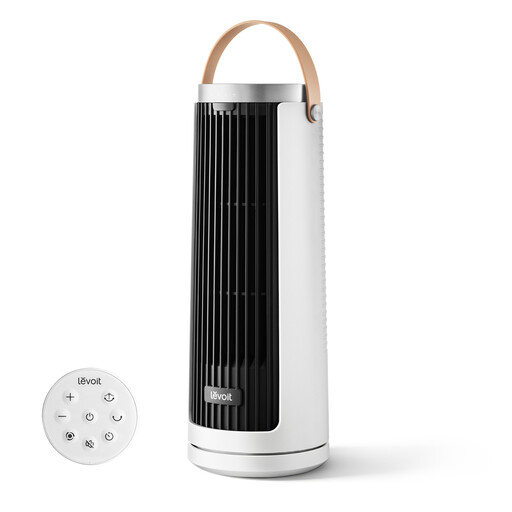
Levoit Windi Mini Plus portable tower fan

Levoit Windi Mini Plus Tower Fan

Its portable design makes it a choice to examine for airflow close to a bedroom seat.

USB Type-C recharging and multiple airflow modes are stated in the product name. Check the dimensions, oscillation options, noise at your intended setting and whether a USB power adapter is supplied.

Joybuy

Common questions

Should I leave a tower fan running overnight?

Electrical Safety First advises switching electric fans off before sleep or leaving the house. A timer or sleep mode is a convenience for use while you are awake, not a substitute for that advice.

What electrical feature should I check on a mains-powered fan for UK use?

Confirm that it is fitted with a fused UK 3-pin plug, as advised by Electrical Safety First. Inspect the fan and cable before use, particularly after storage.

Where should a tower fan stand beside a sofa?

Place it on a flat, stable floor surface with room for its airflow and any oscillation. Keep the cable away from walkways and where children or pets could pull or chew it; unplug the fan before cleaning it.

Is a fan useful during very hot weather?

UK Health Security Agency guidance for England says electric fans can be used when the air temperature is below 35°C. In hot weather, also use curtains or blinds to reduce daytime sun and ventilate when outdoor air is cooler, where it is safe to do so.

What should I do with an old tower fan when replacing it?

Arrange an appropriate electrical-waste collection or take-back route rather than putting it in ordinary household rubbish. Check the replacement retailer’s take-back arrangements, including any collection conditions, before ordering.