Sleep-and-study users
Students using a fan near their bed or desk who need to consider low-speed sound, a timer and whether the controls or display will disturb them.


For a small student room, choose a tower fan whose low-speed sound, footprint and airflow controls suit its position beside a bed or desk. Adjustable oscillation matters more when airflow must reach several occupied positions, but a fan moves air rather than lowering the room temperature. Check your accommodation rules and where it can stand and plug in safely before buying.
Students using a fan near their bed or desk who need to consider low-speed sound, a timer and whether the controls or display will disturb them.
Students with limited clear floor or storage space who need to check the fan’s base, cord route and stable position before choosing a size.
Students directing air towards more than one occupied position, for whom an adjustable sweep may be more useful than a fixed stream at one seat.
Check accommodation permission and a safe position first. Then weigh sound at the speed you expect to use against how far the airflow needs to reach.
| Concern | What to check | Who this matters to |
|---|---|---|
| Sleep and study noise | Check which speed a quoted sound level describes, plus low-speed controls, timer and display behaviour. | If I run the fan while sleeping or concentrating, I want a manageable low setting without a distracting display; around 36% of consumers put quiet sleep-and-study use first. |
| Airflow reach | Check whether oscillation is adjustable and whether its stated angle covers the positions you use. | When the desk and bed are both occupied, I need air to reach beyond one seat without repeatedly moving the fan; roughly 29% of consumers prioritise reach and shared use. |
| Space and handling | Measure the floor position and cord route; compare the base dimensions and storage space needed. | With little clear floor space, I need a fan that fits beside furniture and can be put away; around 21% of consumers put space and everyday handling first. |
| Permission and electrical setup | Confirm your accommodation rules, a stable position and a socket arrangement that will not be overloaded. | Before using a fan in halls, I need to know it is permitted and can be plugged in safely; roughly 14% of consumers put accommodation and electrical checks first. |
A quoted sound level may describe a minimum setting or an unspecified operating condition, so figures for different models do not necessarily describe the same experience.
Check the speed associated with the figure and look at low-speed control, timer and display behaviour if the fan will run overnight.
A tower fan moves air towards occupants; it does not lower the room’s air temperature in the way an air conditioner does.
Choose it for directed airflow, positioning it where the air reaches people rather than treating it as a solution to the room temperature itself.
A narrow sweep can keep airflow near one desk or bed, while a wider sweep distributes it across more positions.
If the room alternates between solo study and shared use, check whether you can change the oscillation angle.
Accommodation rules can differ, and Electrical Safety First warns that overloaded sockets and extension leads create a fire risk.
Ask your accommodation provider about portable fans. Place the appliance securely, inspect its plug and cable, and do not overload sockets or connect one extension lead to another.
Its Sefte® tower-fan range includes a compact 19-inch model and a larger Smart 36-inch model, both worth considering when adjustable airflow is a priority.
The FlexBlade listing represents a bladeless option for directing air towards more than one part of an occupied room.
Its 30-inch touch-panel tower fan offers published details that can help with room layout and control choices.
This heating-and-cooling tower fan is an option to assess if app control matters in your room. Check its fan setting, room fit and accommodation rules before treating it as a bedside choice.
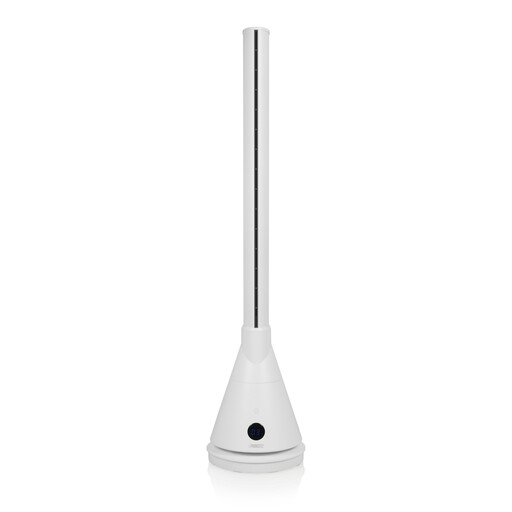 No image available
Consider this model if app control would be useful from your desk or bed, but check whether its fan settings and sound suit use nearby.
The white variant has app control and a 2000 W heating function. Confirm that your accommodation permits the intended use, and check its dimensions, cord reach, UK plug and voltage before choosing a position.
No. A tower fan moves air rather than lowering the room’s air temperature like an air conditioner. Direct its airflow towards occupied positions, and consider adjustable oscillation if it needs to reach more than one.
An extension lead is only an option if it is in good condition, its marked rating accommodates the combined connected load and it is not connected to another lead. Electrical Safety First warns that overloaded sockets and leads create a fire risk.
Place it upright on a stable, level surface where its air openings remain clear and the cable will not obstruct movement. Dimplex gives stable-placement and unobstructed-opening instructions for the model covered by its manual; follow the instructions for whichever fan you choose and do not use a damaged cable or plug.
Yes. The UK Office for Product Safety and Standards maintains product-safety alerts and recall information. Check the exact model against any relevant notice, and follow its published instructions if your product is affected.