Chair-side study users
If the fan will mainly serve one chair during reading, gaming or work, prioritise airflow that reaches your seated position, easy adjustment and a footprint that fits beside you.


For airflow at one chair, start by looking for a compact tower fan whose outlet height and direction suit your seated position. Low-speed noise and controllable airflow matter more than height alone if you also study or sleep nearby; consider a taller fan when it needs to serve more of the room. If you need to lower the room’s air temperature rather than feel a breeze, compare portable air conditioners instead.
If the fan will mainly serve one chair during reading, gaming or work, prioritise airflow that reaches your seated position, easy adjustment and a footprint that fits beside you.
If the same fan will run near your bed, pay particular attention to low-speed sound, timer controls and whether its display can be dimmed or switched off.
If airflow must also reach a bed or another part of the room, check the fan’s height and available oscillation angles rather than choosing solely for the smallest footprint.
Start with whether the airflow reaches your chair, then consider overnight use and any need to cover more of the room.
| Concern | What to check | Who this matters to |
|---|---|---|
| Quiet, focused airflow | Compare outlet height with your seated position, and check low-speed sound and whether oscillation can be narrowed or switched off. | When I am studying at one chair, I want a breeze I can aim without having to turn the fan up so far that it distracts me. Around 42% of consumers would put focused study-time airflow first. |
| Sleep-compatible use | Check which speed a stated sound level describes, plus timer and display-light controls. | If I also run the fan near my bed, its light and sound at a comfortable speed matter as much as daytime airflow. For around 33% of consumers, overnight use would be the primary concern. |
| Airflow beyond the chair | Check height, base dimensions and oscillation range, while allowing enough floor space beside furniture. | I may need the same fan to reach my chair and another part of the room, even if that means giving it more floor space. Broader coverage would come first for around 25% of consumers. |
As Joybuy Insights explains, a fan moves air and can make you feel cooler, but it does not lower overall room temperature in the way an air conditioner does.
If a lower air temperature is the goal, compare portable air conditioners and their exhaust-hose and window-kit requirements rather than choosing a larger fan for that reason alone.
A taller, wider-sweeping fan can serve more of a room, but its airflow may pass your chair or require more floor space than you have available.
Measure the intended spot and compare the outlet height with your seated position. Check whether direction, oscillation and lower speeds give you enough control.
An unsuitable extension arrangement introduces an electrical safety risk in a room where the fan may run close to furniture and bedding.
Electrical Safety First advises against overloading extension devices or connecting one extension lead to another. Check the lead’s rating and connected load, inspect plugs and cables for damage, and fully unwind a cable reel before use.
Meaco offers compact and taller tower-fan formats. Its Sefte 19-inch model is the relevant reference for a small space beside a chair.
The Purifier Cool PC1 combines fan airflow with air-purification features and app connection for consumers who want both functions.
A PELONIS 42-inch floor-standing tower fan is relevant when one fan needs to serve a chair and more of the room.
This portable tower fan is an option for a small study area. Check its outlet height and airflow direction before choosing it specifically for the space beside your chair.
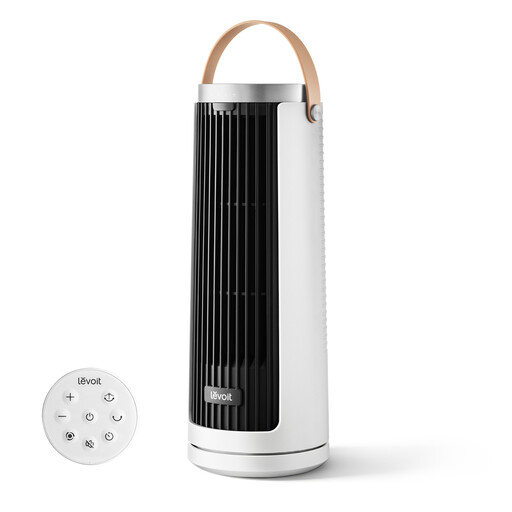 No image available
Its portable format suits a small study area if the airflow reaches your seated position. It has USB Type-C recharging and multiple airflow modes; check its direction, dimensions, sound at your intended setting, runtime and included charging accessories before purchase.
A tower fan can make you feel cooler by moving air, but it does not lower overall room temperature like an air conditioner. If lowering the air temperature is essential, compare portable air conditioners along with their exhaust-hose and window-kit requirements. The Met Office also advises closing curtains or blinds against strong sun and ventilating when outdoor temperatures fall.
Put it upright on a stable, level surface where its airflow can reach you without a cable crossing a walkway. Try a fixed direction or the narrowest available oscillation setting for one chair, and keep clothing and other clutter clear of the electrical equipment.
You can use a suitably rated extension lead if the combined load of connected appliances stays within its rating. Electrical Safety First advises using no more than one extension device per socket and never connecting extension leads together; inspect the cable and plug before use and fully unwind a cable reel.
Check that its plug and power requirements suit the connection you will use, and look for clear instructions and seller or manufacturer contact details. The Office for Product Safety and Standards explains that electrical equipment placed on the Great Britain market must meet applicable safety objectives; do not assume Great Britain guidance states the position for Northern Ireland.