What should you check before buying?
Check socket fit and charger input first: Electrical Safety First notes that adapters do not change voltage or frequency. For portable power, GOV.UK advises travellers to check airline battery restrictions.
| Concern |
What to check |
Who this matters to |
| Socket and electrical compatibility |
Match the adapter to each destination socket. Read the charger’s input rating and the adapter’s maximum rating; check earth-connection suitability if your equipment needs it. |
At an unfamiliar wall socket, I need my charger to connect without assuming the adapter changes the electricity supply; about 36% of consumers put compatibility and safety first. |
| Power away from sockets |
Match the power bank’s connector to the phone and check its stated capacity. Check every operating airline’s carriage and in-flight-use rules. |
On long transfers or days away from an outlet, I need a way to charge my phone that I can take on the flight; roughly 29% of consumers prioritise portable power and airline rules. |
| Charging several devices |
Count the USB-C and USB-A connections needed at once. Check the charger’s total output and whether its plug arrangement fits the destination. |
If my phone and other USB devices need charging from one outlet, I want a setup that accommodates them together; around 21% of consumers put multi-device charging first. |
| Spare cable or charger |
Match both cable ends to the phone and power source. For a spare wall charger, check its connector and input rating. |
When a lost cable or charger could leave my phone unusable during the trip, a compatible spare matters most; about 14% of consumers prioritise charging continuity. |
Joybuy wall chargers and cable
These options cover charging from a compatible wall socket and keeping a spare USB-C cable for a matching phone and power source. Check plug fit and connectors against your own trip before choosing.
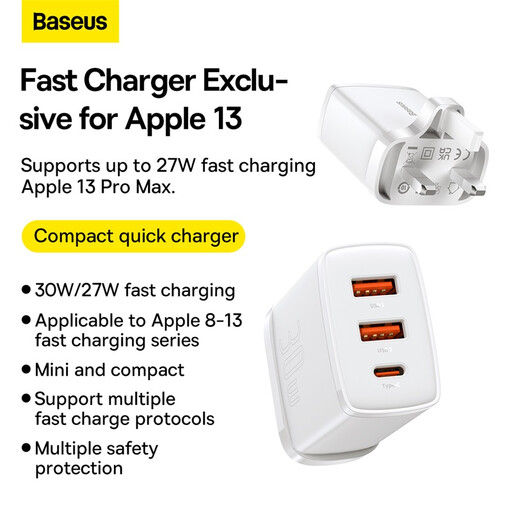 Image unavailable
Baseus Quick Charger 2U+C 30W, 3-Port UK Plug
For a phone and other USB devices sharing a wall outlet. Check whether its UK plug fits the destination socket, or whether you need a suitable adapter; confirm that the output available when using several ports meets your devices’ needs.
View on Joybuy
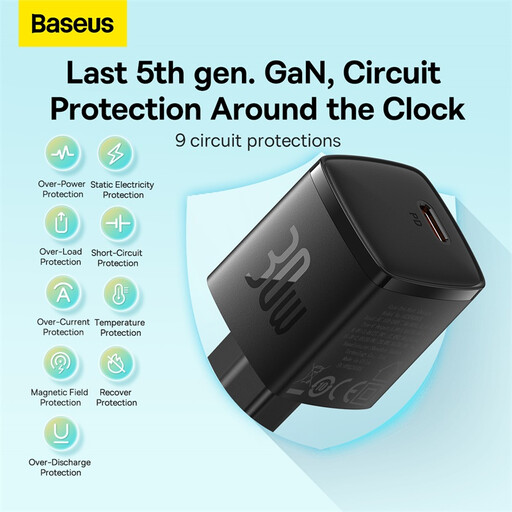 Image unavailable
Baseus 30W GaN5 Compact USB-C Charger, EU Plug
For a separate phone charger where EU-standard pins fit the socket. Check the destination plug type, the charger’s input label and whether a USB-C output suits your charging cable.
View on Joybuy
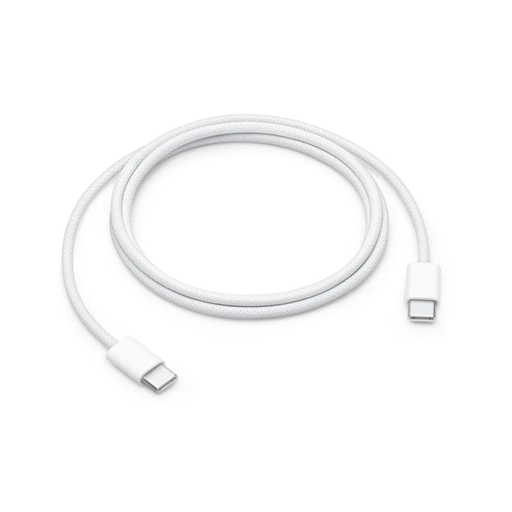 Image unavailable
Apple USB-C to USB-C Woven Charge Cable (1m)
For a spare cable when both the device and power source use USB-C connections. Check both ends of your setup before buying; this cable does not take the place of a wall charger.
View on Joybuy
Phone charging abroad: common questions
Does a travel adapter convert voltage?
No. Electrical Safety First explains that a travel adapter changes plug fit but does not convert voltage or frequency. Compare the input rating printed on your charger with the destination supply before connecting it.
Can I take a power bank on a flight from the UK?
Check the rules of every operating airline rather than assuming one allowance applies to all flights. GOV.UK advises checking battery restrictions with the airline; easyJet, for example, specifies cabin-baggage carriage, no more than two power banks per passenger, and no use or recharging on board.
How do I check whether a travel adapter suits my devices?
Match its plug coverage to each destination, then check its maximum rating and whether it supports an earth connection if your equipment needs one. Also read the connected charger’s input label: an adapter cannot make an unsuitable voltage rating suitable.
Can I buy a universal adapter before choosing my destination?
Wait until you can check the sockets on your itinerary. A universal adapter’s stated plug coverage, electrical rating and suitability for the connected equipment still need to match each place where you plan to use it.
How can I avoid buying the wrong spare cable?
Match the connector at the phone with the connector on the charger or power bank. A USB-C-to-USB-C cable needs compatible connections at both ends; its charging rating does not make it fit a Lightning or USB-A connection.


