What matters when choosing
Decide whether you will take the complete camera kit out each day, then compare the lens range and controls you need for the photographs your phone misses.
Fixed-lens compact
Choose it when: A self-contained camera is more likely to come along on a full day out.
Trade-off: Its lens cannot be exchanged if your preferred focal lengths change.
Mirrorless camera
Choose it when: Lens choice and photographic control matter enough to carry a complete kit.
Trade-off: The fitted lens and carrying accessories add to the body you must pack.
| Concern | What to check | Who this matters to |
|---|
| Carrying the camera |
Handle or weigh the camera with its fitted lens and the accessories you would take for a day. |
If a camera feels awkward to carry all day, I may leave it behind rather than photograph the trip with it. Around 31% of consumers put carrying the camera first. |
| Image and creative control |
Compare the exact sensor, lens aperture and controls for the scenes your phone struggles with; a camera is not automatically better in every condition. |
I want to choose settings for difficult light or a particular look, and I am prepared to carry equipment to do it. For around 31% of consumers, that control is the main concern. |
| Optical zoom range |
Check the lens-based focal-length range of the exact compact or mirrorless kit; assess digital zoom separately. |
My itinerary includes both broad scenes and distant details, and I would rather not change lenses repeatedly. That one-lens range comes first for around 23% of consumers. |
| Power and photo workflow |
Test transfer with your phone, plan charging and memory capacity, and check the airline's battery rules if flying. |
I need to keep taking photographs and safeguard them throughout the trip, without discovering a transfer or charging problem away from home. Around 15% of consumers prioritise this workflow. |
Camera brands to consider
These examples illustrate different travel-camera approaches; a brand name alone does not tell you which complete kit fits your trip.
Sony
Sony's RX100 VII illustrates the fixed-lens compact route for travellers seeking optical reach without a separate lens.
- Sony specifies a 1.0-type sensor and a built-in 24–200mm equivalent F2.8–4.5 lens with 8x optical zoom for the RX100 VII.
- That lens is fixed, so changing to another focal-length range means choosing a different camera rather than swapping lenses.
Canon
Canon's EOS R50 illustrates an APS-C mirrorless route for travellers who want to choose lenses and use phone connectivity.
- Canon lists a 24.2-megapixel APS-C sensor, Bluetooth, Wi-Fi and USB charging for the EOS R50.
- An EOS R50 body needs a compatible lens; assess the weight and contents of the complete kit you intend to carry.
Nikon
Nikon's Z50II with its 18–140mm kit lens illustrates a one-lens travel-zoom approach within a mirrorless system.
- Nikon specifies a 7.8x zoom and in-lens vibration reduction for that kit lens; Nikon Imaging Cloud offers uploads to supported cloud-storage services.
- It remains a camera-and-lens package, and cloud transfer depends on setting up a suitable connection and service.
Joybuy camera choices
These compact and mirrorless cameras offer different ways to take a separate camera travelling. Check each model's actual lens and complete carrying setup against your priorities: not every compact here has optical zoom, and the mirrorless choices require carrying a lens.
 No image available
Sony Alpha ZV-E10 II K with 16–50 mm f/3.5-5.6 Power Zoom kit lens
Consider this APS-C mirrorless kit if you want an included starting lens for travel stills and video and are comfortable carrying a lens system.
The product name specifies 26 megapixels and 4K60p video. Check the complete camera-and-lens size for your day bag, and include a memory card in your packing plan.
Joybuy
 No image available
Sony ZV-E10K with 16–50mm Power Zoom lens
This interchangeable-lens camera suits a traveller who wants to begin with one supplied zoom lens rather than a fixed-lens compact.
Compare the fitted kit's dimensions with your carrying plan, particularly if you intend to add another lens later.
Joybuy
 No image available
Sony ZV-1 II compact camera, 1-inch stacked sensor
Consider this fixed-lens option if you want to avoid carrying an interchangeable-lens kit and favour wide travel scenes.
The product name specifies 20MP stills and 4K video. Confirm its optical focal-length range before relying on it for distant subjects, and check its dimensions against the bag you will use.
Joybuy
 No image available
Sony ZV-1F compact camera, 1-inch sensor and ultra-wide lens
This compact suits travellers whose priority is a wide view or self-framed photographs rather than magnifying distant details.
Its lens is a fixed wide prime, not an optical zoom. Check the camera and accessories together when planning what you will carry.
Joybuy
 No image available
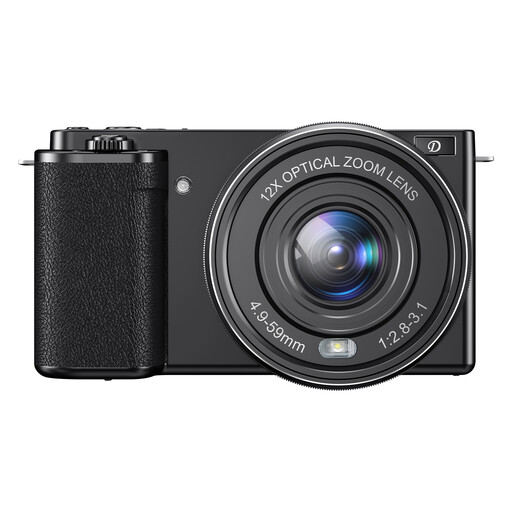
Komery W6 digital camera, 12× optical zoom
Consider this fixed-lens camera if an optical zoom without a separate lens is your starting requirement.
Its product name also specifies 4K recording, Wi-Fi and 64MP. Check the lens's focal-length endpoints and the camera's carry weight before deciding whether it fits your trip; those named features do not establish its image quality against your phone.
Joybuy
Travel camera questions
When is a travel camera worth carrying instead of just a phone?
A separate camera is worth considering when you regularly want optical reach, different controls or more lens choice for photographs your phone does not give you. Which? identifies low-light and creative-flexibility advantages that dedicated cameras can offer, but the benefit depends on the camera, conditions and whether you will actually carry it.
Should I choose a compact or mirrorless camera for a holiday?
Choose a compact if a self-contained camera is your priority, and mirrorless if lens choice and control justify taking a body-and-lens kit. Check the exact compact's optical lens range and the mirrorless camera's fitted lens: neither category name alone guarantees the reach you want.
How should I pack spare camera batteries for a flight?
Keep spare batteries in cabin baggage and protect them from damage and short circuits, as the UK Civil Aviation Authority advises. Check the capacity of your particular batteries and your operating airline's current conditions before flying.
What should I test before relying on camera-to-phone transfer?
Transfer photographs to your own phone and check that you can store and back them up before departure. Canon specifies Bluetooth and Wi-Fi for the EOS R50, while Nikon describes cloud-upload options for the Z50II; using either workflow still calls for suitable setup, connectivity and storage.
Can I return a travel camera if I change my mind?
For an eligible UK distance purchase, Citizens Advice describes a 14-day cooling-off period, subject to the applicable conditions and exceptions. An in-store change-of-mind return for a non-faulty camera normally depends on the retailer's policy; remedies for faulty goods are distinct from either change-of-mind route.


