One-bag holiday photographers
You want a dedicated camera you will carry on city breaks and day trips. A fixed-lens model keeps the kit together, but check whether its lens gives you the optical reach you want beyond your phone.


Choose a compact or travel-zoom camera when you want a self-contained camera with optical reach; check the lens, as some compacts have no zoom. A mirrorless system makes more sense if you will use interchangeable lenses enough to justify carrying the complete kit. Choose an action camera when mounted, water-oriented or first-person footage is central to the trip, rather than expecting it to replace every travel camera.
You want a dedicated camera you will carry on city breaks and day trips. A fixed-lens model keeps the kit together, but check whether its lens gives you the optical reach you want beyond your phone.
You are willing to pack a lens-based kit because choosing lenses for different scenes or video work matters more to you than carrying one self-contained camera.
Rain, water or moving subjects shape your choice. Check protection for the exact camera-and-lens combination, or consider an action camera when mounting and first-person footage are central to the trip.
Choose it when: You want a self-contained camera for sightseeing without packing separate lenses.
Trade-off: Its fixed lens cannot be exchanged; check its focal-length range because a compact may have a prime lens rather than a zoom.
Choose it when: Distant subjects are a main reason to take a camera, but you do not want to change lenses.
Trade-off: Reach alone does not tell you how the camera handles lower light or stabilises video at the long end.
Choose it when: You expect to use different lenses for the subjects on your itinerary.
Trade-off: The lens and accessories add to the body weight and take up luggage space.
Choose it when: Mounted, first-person or water-oriented footage is the purpose of the camera.
Trade-off: Check the fitted accessories and intended conditions rather than assuming every configuration offers the same protection.
| Concern | What to check | Who this matters to |
|---|---|---|
| Easy to carry | Compare packed size and weight, including the lens, battery and accessories. Check whether the fixed lens actually zooms. | On a walking day, I want a camera I will keep with me that addresses a specific limitation of my phone. Around 33% of consumers put that carryable, dedicated-camera need first. |
| Distant subjects | Check the optical focal-length range and the aperture at its long end; check stabilisation in the video mode you intend to use. | For wildlife or details I cannot approach, I need reach without packing another lens. Consumers who put all-in-one optical reach first account for around 27%. |
| Lens flexibility | Confirm lens-mount compatibility and assess the weight of a working body-and-lens kit. | If my trip calls for different framing or more deliberate photo and video work, I am prepared to carry lenses. Around 27% of consumers prioritise that flexibility. |
| Weather and activity use | Check protection for the exact body, fitted lens or accessory, along with any mounts needed for the activity. | When water, exposed conditions or hands-free filming shape my trip, the complete setup matters more than a camera name alone. That is the primary need for around 13% of consumers. |
Canon lists the EOS R50 V at 370 g with card and battery before a lens is added. That figure does not describe the space or weight of the camera you will carry ready to shoot.
List the lens, batteries, charger, card and protection you intend to pack, then assess the complete kit.
Panasonic lists a 24–720mm-equivalent lens for the LUMIX TZ99, but its maximum aperture is F6.4 at the long end. Panasonic also specifies that its 5-axis video compensation does not operate during 4K recording.
Compare long-end aperture and stabilisation in the precise stills or video mode you expect to use.
OM SYSTEM describes weather protection for the OM-5 Mark II alongside compatible weather-sealed lenses. GoPro states different waterproof depths for HERO13 Black configurations with a standard lens and an Ultra Wide Lens Mod.
Check the complete configuration and its stated operating conditions before using it in rain or water.
International Air Transport Association guidance says spare lithium batteries belong in cabin baggage and must be individually protected against short circuits.
Check battery markings and your airline’s current requirements before departure, particularly if you plan to carry several spares.
Sony’s RX100 VII is an example of a fixed-lens compact for travellers considering optical zoom without a separate lens kit.
The LUMIX TZ99 represents the fixed-lens travel-zoom route when distant framing matters.
The EOS R50 V is a compact-body example for travellers considering an APS-C mirrorless camera with interchangeable RF/RF-S lenses.
The OM-5 Mark II is a mirrorless option to examine when outdoor conditions influence the camera choice.
The HERO13 Black action-camera route is relevant when mounted or water-oriented footage is a main purpose of the trip.
These choices cover lens-based photography, self-contained wide-angle and handheld video, and activity-focused filming. Match the camera format to what you plan to shoot before comparing individual features.
 No image available
Consider this interchangeable-lens kit if changing lenses for different travel scenes matters to you. The named bundle includes a 16–50mm Power Zoom lens; assess the complete kit you would carry, and check protection for both body and lens if rain is likely.
 No image available
This fixed-lens compact suits travellers considering wide-angle, self-facing video rather than an interchangeable-lens kit. Its named configuration has an ultra-wide lens; if framing distant subjects matters, check whether its fixed lens meets that need rather than assuming it offers optical zoom.
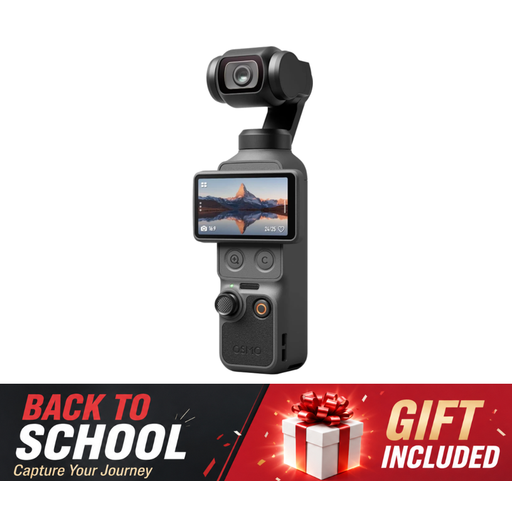 No image available
Consider this pocket-gimbal format when handheld travel video is the priority. The named configuration specifies 3-axis stabilisation and 107 GB of built-in storage. Its 4K/240fps figure applies to slow-motion mode, so check the ordinary recording modes you need.
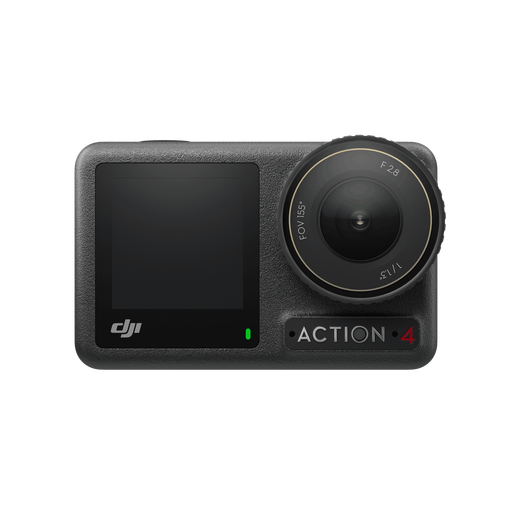 No image available
This action-camera bundle is a more relevant format when activity footage, rather than general holiday stills, is the aim. Its name specifies 4K/120fps recording, a 1/1.3-inch sensor and a 155° field of view. Check the exact configuration and operating conditions before relying on a waterproof claim.
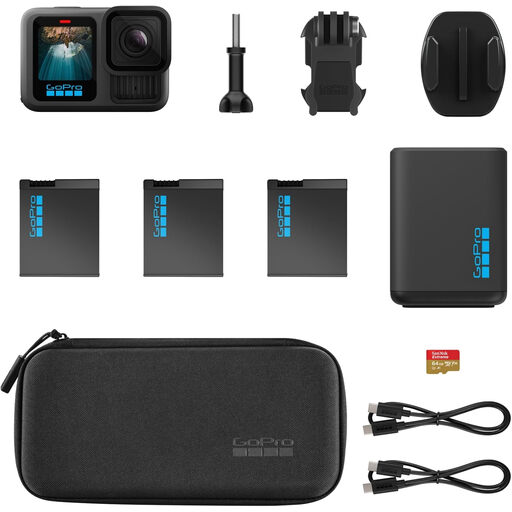 No image available
Consider this action-camera bundle if mounted or activity footage is central to your trip. Check the included power accessories against what you intend to carry, and confirm the protection stated for the lens configuration you will use. It is not a like-for-like substitute for every compact or mirrorless travel photograph.
Usually, yes: GOV.UK says camera equipment can generally travel in hand or hold luggage, though specialist equipment may face restrictions. Check your airline’s rules, and be prepared to switch on an electronic device if asked during security checks.
Pack spare lithium batteries in cabin baggage and protect each one against short circuits, in line with International Air Transport Association guidance. Check their watt-hour markings and your airline’s current limits, particularly for larger batteries or multiple spares.
No. Check the fitted lens as well as the body: OM SYSTEM specifies IP53-certified weather sealing for the OM-5 Mark II and discusses compatible weather-sealed lenses, not every lens that can be attached to it.
No. For the HERO13 Black Ultra Wide Edition, GoPro specifies waterproofing to 10 m with its standard lens and 5 m with the Ultra Wide Lens Mod; GoPro says that mod is not intended for underwater use. Check the configuration you will actually take into the water.