Who might need a travel camera?
A separate camera is easier to justify when it addresses a subject or shooting condition you encounter repeatedly, rather than an occasional photo your phone can already take.
Travellers photographing distant subjects
If you cannot move closer to wildlife, sport or architectural details, check the actual optical zoom or compatible telephoto lens. Which? identifies lens-based reach as a reason to consider a dedicated camera for these subjects.
Travellers shooting in difficult light
For interiors and evening scenes, compare the camera and lens together, especially if exposure control or background blur matters to you. Which? notes that dedicated cameras can offer advantages in low light, but the result depends on the equipment and conditions.
Travellers packing light
A fixed-lens compact avoids carrying and changing lenses. If you prefer an interchangeable-lens camera, assess the size and weight of the complete kit you would take out each day, not just the body.
What should you check before choosing?
Start with the subjects your phone struggles to capture, then check whether the camera, lens and travel accessories needed to address them form a kit you will actually carry.
| Priority | What to check | Your needs |
|---|
| Distant subjects |
Compare optical zoom or the focal lengths of compatible lenses. For an interchangeable-lens camera, assess reach with the lens you intend to pack, not the body alone. |
I often photograph wildlife or details I cannot approach. A compact's fixed zoom may be simpler; a mirrorless or DSLR kit lets me choose a lens for those subjects. |
| Difficult light |
Assess the exact camera and lens, including lens aperture and the exposure controls you will use. Stabilisation can help with camera movement, but it does not freeze a moving subject. |
Evening streets and interiors matter more to me than extra zoom. I want to compare complete camera-and-lens options rather than assume every dedicated camera will improve those shots. |
| Portability |
Check body-plus-lens size and weight, and whether you would carry a second lens. A fixed-lens compact removes lens changes; a one-lens mirrorless kit can reduce what you pack. |
If the kit stays at my accommodation, it will miss much of the trip. I would favour the setup I can comfortably keep with me. |
| Lens compatibility |
Confirm the body's mount, the exact lens model and any adapter required. Check the functions you need with that combination before planning to reuse existing lenses. |
I already own lenses, or may add a telephoto later. I need to know whether they fit and work with the camera I choose. |
| Weather and flights |
Check protection for both body and lens; weather sealing is not waterproofing. For flights, check your carrier's current battery rules: British Airways requires spare batteries and power banks in hand baggage, not checked baggage. |
I may shoot in changeable weather or fly with spare batteries. I want a workable protection and packing plan for the whole itinerary. |
Brand and system references
These brands illustrate different camera and lens-system choices; a brand name alone does not establish the size, protection or suitability of a particular travel kit.
Canon
Canon offers fixed-lens compacts alongside EOS R mirrorless bodies, giving travellers a choice between an all-in-one camera and an interchangeable-lens kit.
- Canon describes the EOS R7 as an APS-C camera suited to using telephoto lenses for distant subjects.
- Canon says EF and EF-S lenses can work with the EOS R7 through an adapter; check the adapter and each lens before planning to reuse a DSLR kit.
Nikon
Nikon's Z50II travel kits provide one-lens and two-lens mirrorless approaches, while its D780 represents a Nikon F-mount DSLR route.
- Nikon's Z50II kits pair the body with either an 18–140mm travel zoom or separate 16–50mm and 50–250mm lenses.
- NIKKOR Z lenses are made for Z cameras, while the D780 uses Nikon F mount; plan around the exact mount when considering existing lenses.
Sony
Sony's Alpha E-mount range gives travellers an interchangeable-lens route, including full-frame bodies.
- A full-frame body such as the α7C II can be considered when building an E-mount kit around particular focal-length needs.
- Check the exact lens as well as the body: E-mount lenses do not all have the same size or weather protection.
Joybuy camera options
These options include interchangeable-lens camera kits and a standalone optical-zoom camera. Compare their supplied lenses or zoom specifications against your planned subjects; the list does not, by itself, settle whether you need a camera instead of your phone.
 No image available
Sony A6400 APS-C with 16–50mm power-zoom lens
This mirrorless kit offers an interchangeable-lens starting point for travel scenes. The named lens covers 16–50mm; check whether that range meets your plans for distant subjects and compare the complete kit's carrying weight.
View on Joybuy
 No image available
Sony A6100 APS-C with zoom lens
This interchangeable-lens camera is an option if you want to build a travel kit around Sony E-mount lenses. Confirm the supplied zoom lens before buying: the product information gives conflicting 16–55mm and 16–50mm ranges. Check its reach and the complete kit's weight against your itinerary.
View on Joybuy
 No image available
Sony Alpha ZV-E10 II K with 16–50mm power-zoom lens
The supplied 16–50mm lens provides a starting range for a small interchangeable-lens travel kit; check whether you would need another lens for distant subjects. The product information lists a 26 MP APS-C camera and says a memory card is not included, so plan storage before departure.
View on Joybuy
 No image available
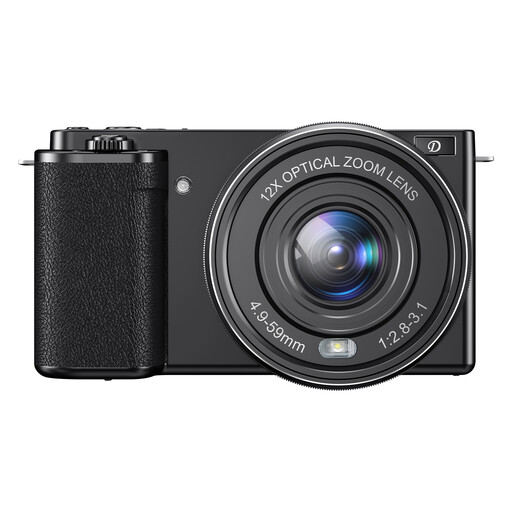
Komery W6 digital camera, 12X optical zoom
This standalone camera states 12X optical zoom, which may appeal if you want lens-based framing without assembling an interchangeable-lens kit. Check the focal-length range for your intended subjects. The product description says the camera is not waterproof and warns that its zoom mechanism is sensitive to drops.
View on Joybuy
Travel camera questions
Can I take a camera and spare batteries on a flight?
Check the rules for your carrier and itinerary before packing. British Airways says spare batteries and power banks must be carried in hand baggage, not checked baggage, and advises travellers to check applicable airline, airport and country rules.
Does weather sealing make a camera safe to use in heavy rain?
No: weather sealing is product-specific and is not waterproofing. Canon advises checking protection before shooting in a downpour; confirm the exact body and lens, and use a suitable cover when conditions call for one.
Will my DSLR lenses fit a mirrorless travel camera?
Not automatically; the mount and any required adapter matter. Canon says EF and EF-S lenses can be used on the EOS R7 through an adapter, while Nikon identifies the D780 as F-mount and its NIKKOR Z lenses as intended for Z cameras. Check each lens and the functions you need with the proposed body.
Is a compact camera enough for distant travel subjects?
It can be if its actual optical zoom range covers your subjects and you are content with a fixed lens. Compare that range before buying; if you need to change to a different telephoto or other specialised lens, consider an interchangeable-lens kit and its carrying burden.
Do I need a second lens for travel?
Only if one lens does not cover subjects you expect to photograph regularly. Nikon offers a Z50II kit with one 18–140mm zoom and another with separate 16–50mm and 50–250mm lenses; compare their coverage with the weight and inconvenience of carrying and changing lenses.


