Phone-first travellers who miss distant subjects
If landmarks or wildlife are often too far away for the framing you want, compare the optical zoom range of a travel compact with the reach and larger body of a bridge camera.


Carry a compact camera if you regularly want optical zoom or dedicated controls but still want a small, fixed-lens kit. A bridge camera makes more sense when distant subjects justify a larger body; choose mirrorless when changing lenses is worth the extra kit to carry. If those needs rarely arise and quick sharing matters most, your phone may be enough.
If landmarks or wildlife are often too far away for the framing you want, compare the optical zoom range of a travel compact with the reach and larger body of a bridge camera.
A fixed-lens compact lets you carry a dedicated camera without choosing lenses. If travel video matters, check the exact model’s recording features and microphone connection rather than assuming every compact has them.
Mirrorless is worth considering if different subjects regularly call for different lenses. Compare the complete camera-and-lens kit with a fixed-lens option, not just the camera body.
Choose it when: You will use optical zoom or dedicated controls often enough to carry a second device, but want a fixed lens.
Trade-off: The lens cannot be changed, and zoom range varies considerably between models.
Choose it when: Distant wildlife, sport or other far-away subjects are a recurring reason to bring a camera.
Trade-off: A long fixed zoom comes in a larger body than a pocket-oriented travel compact.
Choose it when: You want to select lenses for different subjects and are willing to plan a kit around the trip.
Trade-off: Lenses add to what you must choose, pack and carry.
Keep it when: Convenience and quick sharing matter more than a recurring need for optical reach or dedicated controls.
Trade-off: A phone accessory does not give the phone a compact camera’s dedicated optical zoom.
| Priority | What to check | Your needs |
|---|---|---|
| Reason to carry it | Identify the shots or controls you repeatedly miss on your phone. Check whether a fixed-lens camera addresses them before committing to another device. | My phone is convenient, but I would carry a separate camera for a problem I encounter regularly—not just for occasional use. |
| Optical reach | Compare both ends of the stated 35mm-equivalent focal-length range, not just the zoom multiplier. Panasonic lists 24–720mm equivalent for the TZ99 and 20–1200mm equivalent for the larger FZ82D. | I photograph wide scenes and distant details, and want to know whether one lens covers the subjects on my trips. |
| Carry size | Check dimensions and ready-to-carry weight, including the lens on a mirrorless camera. Canon’s approximately 375g figure for the EOS R50 includes its battery and card, but not a lens. | If the kit feels awkward to take on a day out, its extra options will be of little use to me. |
| Travel video | Check recording format, screen movement, stabilisation and microphone connection on the exact model. Canon specifies 4K video for the PowerShot G7 X Mark III; its listed features alone do not establish finished-video quality. | I want to frame and record travel clips without taking production equipment. Spoken pieces would also make a microphone connection relevant. |
Panasonic’s FZ82D offers a longer stated zoom range than its TZ99, but it is a larger bridge camera rather than a pocket-oriented compact.
Think about how often you photograph distant subjects and whether you would bring the larger camera on an ordinary day out.
Canon’s EOS R50 figure of approximately 375g includes a battery and card, but a working kit also needs a lens.
Compare complete kits, including the lens, charging equipment, memory card and how you will carry them.
Additional lenses and accessories can add to the kit you need to pack.
Panasonic states that its TZ99 does not include a USB cable or AC adapter.
Check the in-box list and whether a cable and charger you already own meet the camera’s charging requirements.
The UK Civil Aviation Authority says spare batteries should travel in the cabin and be protected against short circuits.
Check the battery’s Wh rating and your airline’s current baggage rules before departure, including what to do if your cabin bag is taken for the hold.
Panasonic’s TZ99 travel compact and FZ82D bridge camera illustrate two ways to get optical reach without changing lenses.
Sony’s RX100 VII is a fixed-lens compact to consider when a 24–200mm equivalent range meets your travel needs.
Canon’s PowerShot G7 X Mark III is a fixed-lens video-capable compact, while the EOS R50 is an interchangeable-lens route.
These options include fixed-lens cameras with listed optical zoom and mirrorless kits for travellers who want to choose lenses. Compare each complete kit with what you would actually carry.
 No image available
A mirrorless kit for travel stills and video if you are comfortable carrying an interchangeable-lens camera.
The product title lists an APS-C camera, a 16–50 mm f/3.5–5.6 power zoom lens and 4K60p recording. Check the complete kit’s dimensions and ready-to-carry weight before choosing it for travel.
 No image available
This APS-C mirrorless kit is an option if lens choice and autofocus controls matter enough to justify carrying a camera system.
The product title identifies a 16–50 mm lens and AI-powered autofocus. Check the complete kit’s weight and dimensions rather than relying on a camera-body figure.
 No image available
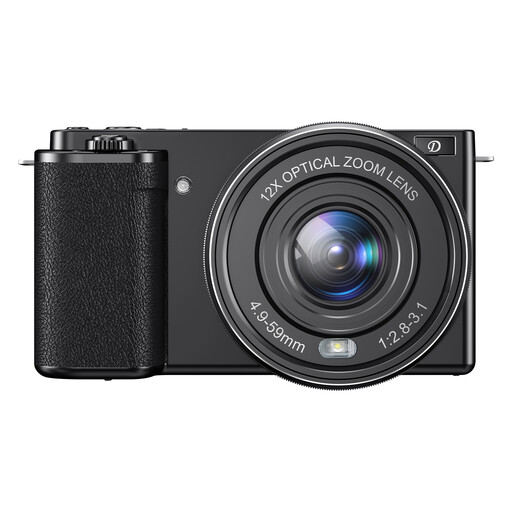
A fixed-lens option to examine if optical zoom is your main reason for taking a camera alongside your phone.
The product title lists 12X optical zoom, 64MP, 4K video and Wi-Fi. Check the equivalent focal-length range to judge reach, and the dimensions and weight if pocketability matters.
 No image available
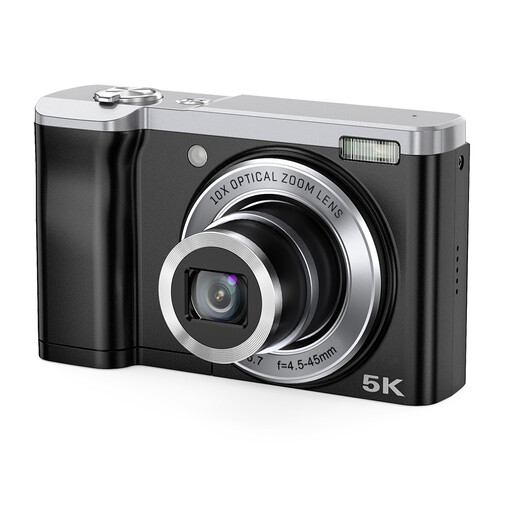
Consider this fixed-lens option if you want a separate camera for photos and video without selecting interchangeable lenses.
The product title lists 10X optical zoom, front and rear cameras, 56MP and 5K recording. Check the equivalent focal-length range and carrying dimensions before relying on it for distant subjects or everyday travel.
Keep spare batteries in cabin baggage and protect them against short circuits, as the UK Civil Aviation Authority advises. Check your airline’s current requirements before departure, especially if your cabin bag may be placed in the hold.
Check the Wh rating on the exact battery and confirm your airline’s rules before travelling. Do not assume that permission for a smaller camera battery applies to a higher-capacity one.
Rules can differ by destination and location. GOV.UK’s foreign travel advice covers legal differences abroad; also check the current rules of the attraction, local authority or transport operator where you intend to shoot.
Confirm the exact model, included lens and charging accessories, seller and warranty terms, then keep your proof of purchase. Canon describes its commercial warranties as additional to consumers’ statutory rights, not a replacement for them.