A phone may be all you need for a city break. Carry a dedicated camera when a particular advantage matters to your trip: a compact with a suitable fixed lens for lighter packing, an all-in-one travel zoom for distant subjects without lens changes, or a mirrorless kit when you intend to use different lenses. Check the complete carry load and lens coverage before buying; for water or dust exposure, choose protection documented for the exact model.
Who might need a travel camera?
City-break photographers packing light
If a bulky camera would stay in your accommodation, compare a compact with a small mirrorless kit. Think about the street scenes, buildings, food and portraits you want to photograph, and whether the lens offers framing your phone does not.
Holidaymakers photographing distant subjects
If viewpoints, wildlife or events feature in your plans, compare an all-in-one zoom with the reach of a mirrorless kit that includes a telephoto lens. The latter means carrying and changing lenses.
Travellers expecting water, dust or rougher handling
For beach, pool, snorkelling or dusty activities, look for protection specified for the exact camera and conditions. An ordinary compact should not be treated as waterproof simply because it is marketed for travel.
What should you prioritise?
Start with the subjects on your itinerary and the equipment you will actually carry. Keep your phone if none of the camera routes offers an advantage you expect to use.
Pocket compact
Choose when: You want a separate camera for city walks without packing another lens.
Trade-off: Its fixed lens sets the framing range; some compacts have a zoom, while others have a single focal length.
All-in-one travel zoom
Choose when: Distant subjects matter and you do not want to change lenses.
Trade-off: Check the whole camera's size: a long-zoom bridge model need not be pocketable. Wex Photo Video describes the wide-to-telephoto range available in this category.
Mirrorless kit
Choose when: You plan to use different lenses for city scenes and more distant subjects.
Trade-off: The extra reach depends on taking the extra lens, as Nikon's one- and two-lens Z50II kits illustrate.
Rugged or action camera
Choose when: Water, dust or active use makes documented protection a priority.
Trade-off: Protection and lens coverage vary by model; check any conditions attached to a waterproof rating, including use of a case.
| Concern | What to check | Who this matters to |
|---|
| Packability |
Compare loaded weight, dimensions and fit in the day bag you will use. |
For a day of city sightseeing, I want a camera I will keep with me rather than leave behind; around 31% of consumers put easy carrying first. |
| Distant-subject reach |
Compare 35 mm-equivalent focal-length ranges and check stabilisation, not just the zoom multiplier. |
If I expect distant landmarks or wildlife, I want tighter framing without repeatedly changing lenses; reach is the main concern for around 31% of consumers. |
| Lens flexibility |
Check the lenses supplied and the complete kit you would need for your intended subjects. |
I may want one lens for wide streets and another for distant details, even if that means more to carry; around 23% of consumers prioritise lens choice. |
| Environmental protection |
Match the exact model's water, dust and temperature ratings to your activity; check whether a case is required. |
For wet or dusty activities, I need protection specified for those conditions rather than a general travel label; that is the primary concern for around 15% of consumers. |
Buying mistakes to avoid
-
Choosing by zoom multiplier alone
A long zoom may help frame distant subjects without lens changes, but it does not tell you whether the camera will fit your day bag or meet your other photography needs.
Compare equivalent focal-length range, stabilisation and camera dimensions against the subjects and bag planned for your trip.
-
Assuming a travel camera is waterproof
Protection belongs to the exact model and its stated conditions. OM Digital Solutions, for example, specifies water and dust resistance for the Tough TG-7; that does not establish equivalent protection for other cameras.
Check the manufacturer's rating for your activity and whether underwater use requires a compatible housing.
-
Putting spare batteries in checked baggage
The UK Civil Aviation Authority says spare batteries and power banks should travel in the cabin, not in checked baggage. Airline restrictions may also apply.
Protect spare batteries, check their watt-hour rating and confirm your airline's current rules before flying.
-
Comparing a mirrorless body with a complete compact camera
A mirrorless camera needs a lens for the photographs you plan to take. Nikon's Z50II listings, for instance, offer a 16–50 mm kit and a two-lens kit that also includes a 50–250 mm lens.
Compare the complete equipment you would carry, including any second lens and the charging and storage accessories you need.
Brands to consider for these camera routes
Sony
Fixed-lens options worth comparing when you want optical zoom without carrying separate lenses.
- Sony specifies a 24–200 mm equivalent, 8x optical zoom lens and optical stabilisation for the RX100 VII.
- That lens is fixed; check the exact model's protection rating before planning wet-weather use.
Canon
A compact-camera reference for travellers weighing packed size against the framing range they need.
- Canon lists the PowerShot G7 X Mark III at approximately 304 g including battery and card, with a 24–100 mm equivalent f/1.8–2.8 zoom and USB charging.
- Its fixed 4.2x zoom does not provide the reach of a long-zoom camera or a mirrorless kit with a telephoto lens.
Nikon
Mirrorless kits to compare if lens choice is worth carrying additional equipment.
- Nikon describes the Z50II kit's 16–50 mm lens as retractable and offers a separate kit that adds a 50–250 mm lens.
- The additional telephoto coverage requires you to pack and use the second lens.
OM SYSTEM
A model-specific rugged-camera reference for trips involving water, dust or cold.
- OM Digital Solutions specifies that the Tough TG-7 is waterproof to 15 m, dustproof to IP6X and freezeproof to −10 °C.
- The TG-7 has a fixed 25–100 mm equivalent 4x lens; its protection claims do not apply to every OM SYSTEM camera.
Joybuy cameras for different trips
These cameras cover compact city-break shooting and an action-camera option for active trips. Decide whether you need a zoom, a wide fixed view or a case-dependent option for water use before comparing the models.
 No image available
Sony ZV-1 II compact camera
Consider this for city scenes and casual travel video if you want a compact camera with a zoom rather than a fixed view.
The product title lists a 1-inch stacked sensor, wide-angle zoom lens, 20 MP stills and 4K video. Check its focal-length range against any distant subjects you plan to photograph, and arrange protection before wet-weather use.
View on Joybuy
 No image available
Sony ZV-1F compact vlog camera
Consider this for wide city scenes and casual video if a compact camera matters more to you than zoom framing.
The product title lists a 1-inch sensor and an ultra-wide lens. Its fixed-lens framing is a limitation if distant details are central to your trip; check the model's protection requirements before wet-weather use.
View on Joybuy
 No image available
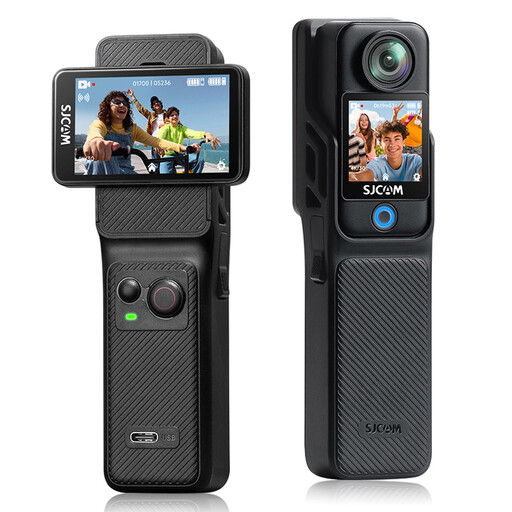
SJCAM C400 4K action camera
Consider this for active or water-based travel if its wide action-camera view suits the footage you want.
The product title lists 16 MP photos, a 154° wide-angle lens and 6-axis electronic image stabilisation. Its stated 30 m waterproof depth applies with the case; check the case and its instructions before underwater use.
View on Joybuy
Travel camera questions
Do I need a separate camera for a city break if I have a good phone?
No: a separate camera is optional. Consider one if a particular feature you will use, such as optical zoom, interchangeable lenses or documented water protection, justifies carrying it; Wex Photo Video discusses compact and interchangeable-lens cameras as travel options, not necessities for every traveller.
Can spare camera batteries go in checked baggage?
The UK Civil Aviation Authority says to take spare batteries and power banks in the cabin rather than checked baggage. Protect the batteries and check your airline's current restrictions before departure.
Is a waterproof camera necessary for a rainy city break?
Not necessarily, but do not assume an ordinary travel camera is weatherproof. If your plans include water or dust exposure, check the exact model's rating against the activity; OM Digital Solutions specifies waterproofing to 15 m and IP6X dust protection for the Tough TG-7.
What should I check before relying on USB charging abroad?
Confirm that the exact camera supports USB charging and take a compatible cable and suitable power source. Canon lists USB charging for the PowerShot G7 X Mark III, but charging arrangements and accessories vary between models and kits.


