What matters when choosing?
Start with the subject you most often struggle to photograph, then decide how much camera equipment you are willing to carry. Which? identifies optical zoom, low light and creative flexibility as reasons to consider a dedicated camera, but none makes one camera type right for every trip.
| Concern |
What to check |
Who this matters to |
| Reach for distant subjects |
Compare the stated optical focal-length range and stabilisation, then check the size you would carry. |
If I cannot get closer to wildlife or sport, I need enough optical reach to frame it from my position. Around 31% of consumers put reach first. |
| Low-light photos |
Check the chosen lens’s maximum aperture and whether the subject will be moving; stabilisation addresses camera movement, not subject movement. |
For indoor or evening photos, I want a camera-and-lens combination suited to the available light without assuming every scene will stay still. Low light is the main concern for around 31% of consumers. |
| Lens choice and creative control |
Confirm the lens mount, the first lens’s range and aperture, and compatible memory cards for the exact camera. |
When one lens cannot cover the kinds of photos I plan to take, I want the option to change lenses rather than replace the camera. Around 23% of consumers prioritise that flexibility. |
| Carrying and charging |
Compare the complete camera-and-lens kit for bag fit, and check how it charges and what comes in the box. |
If extra equipment would stay in my accommodation, I would rather carry a small fixed-lens camera or use my phone. Keeping the kit simple comes first for around 15% of consumers. |
Joybuy camera choices
These cameras cover different travel priorities: compact fixed-lens shooting, an interchangeable-lens kit and a camera listed with optical zoom. Compare each one with your main subject rather than treating them as interchangeable answers to low light and distant reach.
 No image available
Sony ZV-1 II compact camera
Consider this fixed-lens camera if you want a compact travel setup and do not need long telephoto reach.
The product name lists a 1-inch stacked sensor, wide-angle zoom lens, 20MP stills, 4K video and smartphone transfer. Check the lens range against the distant subjects you plan to photograph.
View on Joybuy
 No image available
Sony Alpha ZV-E10 II K with 16–50mm f/3.5–5.6 kit lens
Consider this interchangeable-lens kit if choosing other lenses later matters more than keeping everything in one fixed-lens camera.
Its product name specifies an APS-C mirrorless camera, a 26MP sensor and a 16–50mm f/3.5–5.6 power-zoom kit lens. Check whether that included lens covers your intended reach and lighting, and compare the weight of the complete kit you would carry.
View on Joybuy
 No image available
Sony ZV-1F compact camera
This is a fixed-lens option for travellers who favour a compact camera for nearby scenes rather than zooming in on distant subjects.
The product name identifies a 1-inch sensor and an ultra-wide lens. Its fixed lens does not offer the optical zoom needed to change the framing of distant wildlife or sport.
View on Joybuy
 No image available
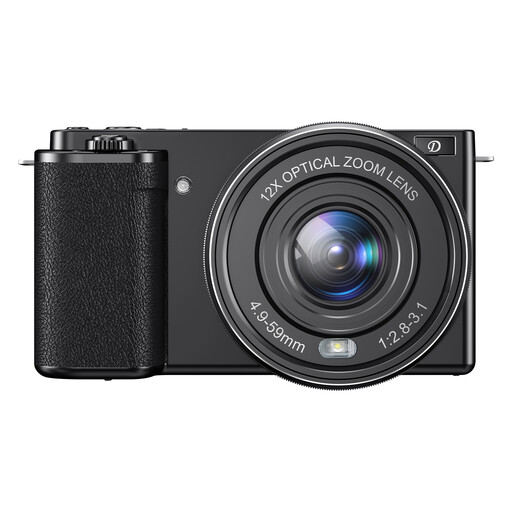
Komery W6 digital camera with 12X optical zoom
Consider its stated optical zoom if distant subjects are your priority, but check the actual framing before choosing it for wildlife or sport.
The product name also lists 64MP, 4K video and Wi-Fi. Confirm the lens’s equivalent focal-length range and aperture for the scenes you intend to photograph; zoom alone does not establish low-light suitability.
View on Joybuy
Frequently asked questions
Is my smartphone enough for travel photos?
A smartphone may be enough if having a camera ready without carrying extra equipment matters most to you. If you regularly cannot get close enough to a subject or want interchangeable lenses, compare dedicated-camera options against those specific needs; Which? highlights zoom and creative flexibility as reasons to consider one.
Which lens should I start with for a travel mirrorless camera?
Start with a lens suited to the subjects you photograph most often. Nikon’s Z50II kits illustrate the choice between a compact retracting standard zoom, a broader travel zoom and an f/2.8 zoom; compare each kit’s actual range, aperture and packed size before deciding.
How do I choose a memory card for my camera?
Check the exact camera specification and the requirements of the shooting modes you intend to use. Fujifilm, for instance, lists SD, SDHC and SDXC cards up to 2TB with UHS-I support for the X-M5; do not assume another model has the same requirements.
Where should I pack spare camera batteries when flying?
The UK Civil Aviation Authority says to take spare batteries and power banks in the cabin. Check your airline’s requirements for the batteries you plan to carry before you travel.
Will travel insurance cover my camera and lenses?
Do not assume your policy covers the full value of every item. The UK Foreign, Commonwealth & Development Office advises checking exclusions, and Post Office Travel Insurance describes limits on electronic-item cover in its standard policies; review your own policy’s item limits, excess and any optional equipment cover.


