Who needs which setup?
Start with the devices you carry and the points in your journey where you can actually use a socket.
Carry-on travellers using a phone or tablet
If boarding passes, maps or messages need to remain accessible between charging stops, consider a power bank with the right cable. Check its watt-hour label and your operating airline’s rules before relying on it for a flight; permission to carry a battery does not necessarily mean permission to use it on board.
Laptop travellers working between stops
Check the laptop maker’s recommended charging wattage, the charger’s USB Power Delivery support and the cable’s power rating. If a phone will share a wall charger, compare the output available to each port when both are in use. Assess a separate power bank on its own output and airline eligibility.
Travellers staying abroad
Check the destination socket and the input-voltage range printed on your charger. An adaptor may make the plug fit, but Electrical Safety First advises that it does not convert voltage or frequency.
What should you check before buying?
Decide where power will come from, then check flight conditions, device requirements and any shared charging output.
| Priority | What to check | Your needs |
|---|
| Power between sockets |
Compare the power bank’s labelled watt-hour rating with each operating airline’s current limit. Check where it must be carried and whether onboard charging is allowed. |
I need my phone or tablet available during waits and connections, but I cannot assume the battery can be used during the flight. |
| Device charging |
Check the device’s charging connector and standard. For a USB-C laptop, compare charger output with the maker’s recommended minimum wattage and check the cable rating. |
If I work on a laptop between stops, I need the charger and cable to meet that model’s requirements, not merely to have USB-C plugs. |
| Charging together |
Read the exact charger’s one-port and simultaneous-output figures. Check the connector and allocated power for each device you plan to connect. |
I may want to charge a laptop and phone from one socket without assuming each port receives the advertised total output. |
| Charging abroad |
Check the destination socket type and the charger’s printed input-voltage range. Electrical Safety First advises that a travel adaptor does not convert voltage or frequency. |
At a temporary stay, I need the plug to fit and the charger to be rated for the local supply. |
| Cables and vehicle stops |
Check the cable connector and stated power rating. For vehicle charging, check the available socket and the accessory’s output against the device’s requirements. |
I would rather carry the cables my devices actually use and rely on a car charger only when the vehicle has a suitable connection. |
Brand ranges to consider
These ranges illustrate different charging formats; compatibility and flight conditions still depend on the exact product and journey.
Anker
Anker UK lists power banks, USB-C chargers and cables for phone-oriented and higher-output setups.
- Its listed range includes power banks described as 20K/220W and 26K/300W, alongside a 140W four-port laptop charger.
- Those brand specifications do not establish a particular power bank’s flight eligibility; check its watt-hour label and the carrier’s conditions.
UGREEN
UGREEN UK lists compact USB-C and multi-port chargers for charging while travelling and at temporary stays.
- The range describes products using technologies including Power Delivery, Quick Charge, Qi, Qi2 and MagSafe.
- Those technologies vary by model. Check the exact ports, output allocation, plug and cable requirements rather than assuming every product supports them all.
Belkin
Belkin UK lists wired and magnetic power banks, USB-C chargers and laptop-oriented portable-power models.
- Its listed power-bank range includes capacities from 2,500mAh to 25,000mAh and models described with USB-C PD output up to 140W.
- Output can change when ports are used together; check the simultaneous-output figures for the particular model.
Joybuy charging options
These options cover mains-powered travel chargers and power banks for time away from sockets. Choose between those routes before comparing models, and check a separate adaptor or cable where your destination or device requires one.
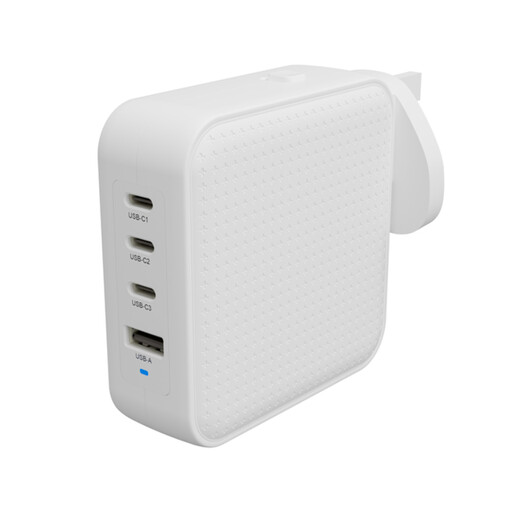 Image unavailable
Hyper HyperJuice 100W USB-C GaN Travel Charger (3C+1A), White
For charging at a mains-powered stop. The stated 100W rating and 3C+1A port configuration are starting points; check the power allocated to each port when your devices are connected together. This charger cannot provide power away from a socket.
View on Joybuy
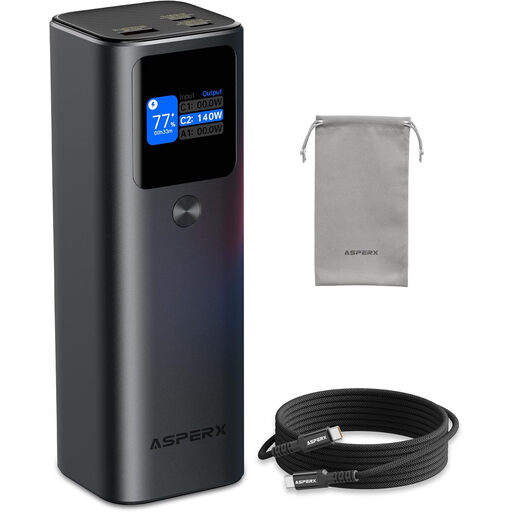 Image unavailable
AsperX 27,600mAh 162.5W PD3.1 Laptop Power Bank, 99.36Wh
For assessing laptop charging away from a socket, compare the stated 162.5W output with your device and cable requirements. Compare the stated 99.36Wh capacity with the operating carrier’s current battery rules; it does not guarantee permission to carry or use the bank on every flight. Check output per port if charging devices together.
View on Joybuy
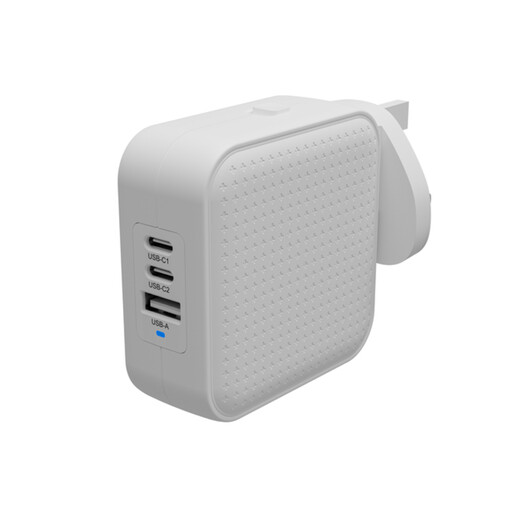 Image unavailable
Hyper HyperJuice 70W USB-C GaN Travel Charger, White
For charging at a mains-powered stop, with a stated 70W rating. Check the exact port layout and simultaneous-output figures against the devices you will connect. A wall charger cannot supply power between sockets.
View on Joybuy
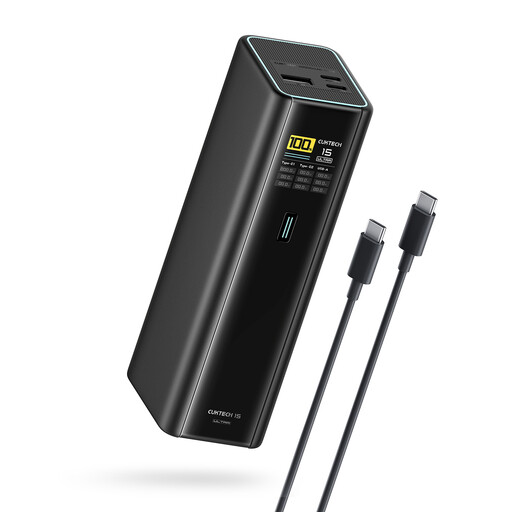 Image unavailable
CUKTECH 15 Ultra PB200U 20,000mAh 140W Power Bank, Black
For charging away from sockets, with a stated 20,000mAh capacity and 140W output. Check the battery’s labelled watt-hour rating against each operating airline’s rules, and compare the exact port-output figures with your devices before relying on it for laptop charging.
View on Joybuy
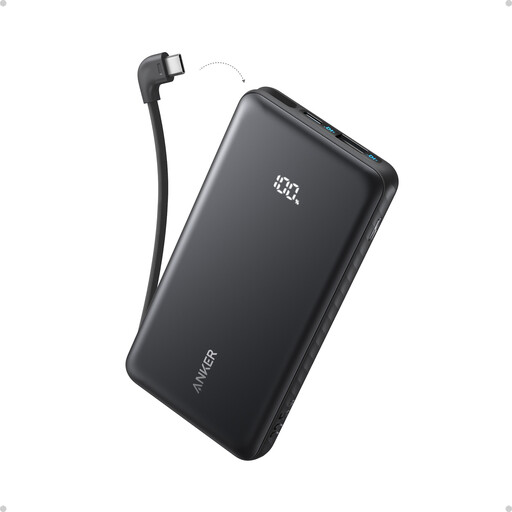 Image unavailable
Anker Zolo 10,000mAh 22.5W Power Bank with Built-in USB-C Cable
For phone charging away from a socket, with a stated 10,000mAh capacity and 22.5W output. Check that the built-in USB-C cable fits your device, and compare the battery’s labelled watt-hour rating with your operating airline’s current rules.
View on Joybuy
Travel charging questions
Can I take a power bank on a flight from the UK?
Check every operating airline rather than assuming one rule covers the itinerary. Ryanair specifies no more than two power banks per passenger, each up to 100Wh, carried on the person or in an underseat bag. easyJet allows up to two in cabin baggage. Compare the exact battery label with the current conditions for your flights.
Can I charge my phone from a power bank during a flight?
Only if your operating airline permits it at that point in the flight. easyJet prohibits using a power bank to charge another device on board; Ryanair permits use except during taxi, take-off and landing or when crew instruct otherwise. Check the current policy for each flight.
What should match in a USB-C laptop charging kit?
Match the laptop’s charging requirements with a suitable charger and cable. Apple advises using a USB Power Delivery charger providing at least the recommended minimum wattage for a USB-C-chargeable Mac; check your own laptop maker’s guidance and the cable’s power rating. If other devices share the charger, check the laptop port’s simultaneous output too.
Does a travel adaptor convert voltage?
No. Electrical Safety First advises that an adaptor changes plug fit but does not convert voltage or frequency. Check the destination supply against the input rating on your charger; a suitable converter is needed where the supply differs and the appliance or its power supply is not rated for it.
Do electronic devices need to be charged for airport screening?
Keep them sufficiently charged to switch on if requested. GOV.UK advises that an electronic device that does not switch on when requested will not be allowed onto the aircraft.


