For tumble-safe bedding in a tight indoor laundry area, start with a heat-pump dryer only if its dimensions, open-door space and required clearances fit. Check the care label and the exact dryer manual before relying on its capacity or a bedding programme: neither makes every bulky item suitable. A conventional condenser dryer also avoids an external vent, while a vented dryer needs a suitable route outdoors.
Who this choice affects
Households drying bedding in a small space
If you regularly dry tumble-safe sheets or duvet covers, the dryer must fit the available area without blocking the door or access around it. The product information advises allowing space for the door to open and for ventilation.
Households focused on fabric care
Lower-temperature heat-pump drying, moisture sensing and model-specific bedding programmes may matter if you want to avoid unnecessary heat exposure or drying beyond the selected level. Check the instructions for each bedding item as well as the dryer.
Energy-conscious households
If bedding is dried regularly, compare the applicable energy information alongside capacity and cycle time. Bosch UK says a typical conventional condenser dryer dries faster than a heat-pump model but uses considerably more energy.
What matters when choosing
Heat-pump dryer
Consider it when: you need a separate dryer without an external wall vent and expect to dry bedding regularly.
Trade-off: Bosch UK says heat-pump drying can take longer than drying in a typical conventional condenser model.
Conventional condenser dryer
Consider it when: an external vent is impractical and shorter drying cycles matter more to you than lower energy use.
Trade-off: Bosch UK says a typical condenser model uses considerably more energy than a heat-pump dryer.
Vented dryer
Consider it when: the installation position has a suitable route to an external opening.
Trade-off: its extractor tube and outlet restrict where it can go in a tight laundry area.
Washer-dryer
Consider it when: there is room for one appliance but not a separate washer and dryer.
Trade-off: check the model's drying capacity and bulky-item instructions against the bedding you intend to dry.
| Concern | What to check | Who this matters to |
|---|
| Fit and access |
Measure usable height, width and depth past plugs and pipes; check door-opening space and the maker's ventilation clearances. |
I need to load bedding without the dryer blocking a cupboard or passageway. Roughly 29% of consumers put physical fit and installation first. |
| Bedding suitability |
Check the bedding care label and the dryer manual's load limits; look for a programme suited to the item where one is specified. |
If I dry bulky bedding, a kilogram rating alone does not tell me whether my item is permitted. Around 29% of consumers make bedding suitability their primary concern. |
| Energy and fabric care |
Compare applicable energy information and cycle details; check whether the exact model specifies moisture sensing. |
For regular bedding loads, I would weigh electricity use and heat exposure against drying time. Approximately 24% of consumers prioritise energy and fabric care. |
| Safe use and upkeep |
Check access to a suitable wall socket, the required clearances and the manual's filter-cleaning instructions. |
I need a position where I can connect and maintain the dryer as instructed. Roughly 18% of consumers put safe installation and upkeep first. |
Mistakes to avoid
-
Buying by drum capacity alone
A 9 kg rating does not establish that a particular duvet or other bulky item can be dried in the machine.
Check the item's care label and the exact dryer manual for permitted loads and programmes. Electrical Safety First advises particular caution with large, bulky items such as duvets.
-
Measuring only the closed appliance
A dryer can fit its recess yet leave too little space to open the door or meet ventilation requirements. LG lists its FDV309WN at 660 mm deep, or 1,115 mm with the door open at 90 degrees.
Measure past obstructions and compare the exact model's door-open dimensions and specified clearances with the installation area.
-
Choosing a vented dryer without an external route
A vented model needs its extractor tube connected to an external opening, limiting where it can be installed.
Confirm a suitable route before choosing this type; otherwise, compare heat-pump and conventional condenser models that do not require an external wall vent.
Creating a suitable vent route may also involve installation work.
-
Treating a self-cleaning condenser as maintenance-free
A condenser-cleaning feature does not replace lint-filter cleaning or the other upkeep specified in the manual.
Electrical Safety First advises removing lint from the filter after every use. Follow the model's remaining maintenance instructions and avoid using an extension lead to power the dryer.
Brands and models to consider
Bosch
The Bosch WQG24502GB is worth examining when bed-linen handling and a stated 613 mm cabinet depth are relevant to your space.
- Bosch UK lists 9.0 kg capacity, a bed-linen programme with a reversing drum, AutoDry and a self-cleaning condenser for this model.
- Its 842 × 598 × 613 mm dimensions do not replace checking door access, clearances and the instructions for your bedding.
Beko
The Beko BM3T3922 may suit a measured space that can accommodate its stated 607 mm cabinet depth.
- Beko UK lists a 9 kg heat-pump dryer with sensor drying and dimensions of 84.6 × 59.8 × 60.7 cm.
- Confirm the exact bedding programme and bulky-item instructions before choosing it for your bedding.
LG
The LG FDV309WN offers a listed Duvet programme if its dimensions work in your laundry area.
- LG UK lists 9 kg capacity, sensor drying and a Duvet programme for this heat-pump model.
- Its stated depth is 660 mm, increasing to 1,115 mm with the door open at 90 degrees; the bedding label and manual still govern each load.
Miele
The Miele TWC640WP is another model to examine if a listed bed-linen programme matters more than matching a 9 kg capacity.
- The product information identifies 8 kg capacity and a bed-linen programme for this heat-pump model.
- Check its full dimensions, installation requirements and the instructions for your bedding before deciding whether it fits.
Heat-pump dryers on Joybuy
These heat-pump models are choices to examine if you want a separate dryer without an external wall vent. For each one, confirm door access, installation clearances and whether the manual permits your tumble-safe bedding.
 No image available
Hoover HRE H9N2TE-80 9 kg Heat-Pump Dryer
Consider this model if you want a separate heat-pump dryer with a stated 9 kg capacity and Sensor Dry. Its title also identifies Wi-Fi connectivity and an A++ rating. Check the manual for the intended bedding load, then confirm open-door space and installation clearances.
View on Joybuy
 No image available
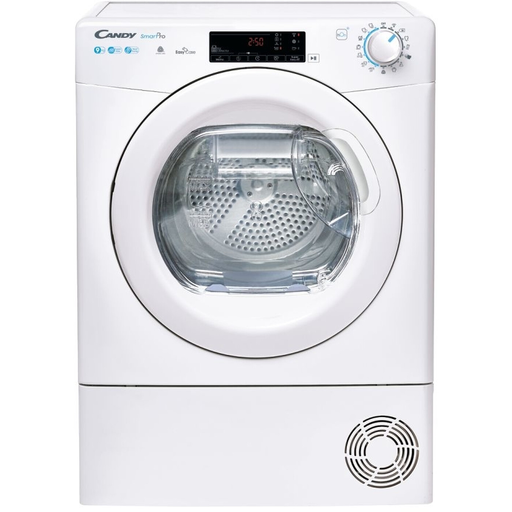
Candy Smart Pro CSOE H9A2TE-80 9 kg Heat-Pump Dryer
This 9 kg heat-pump model is relevant if you need a separate ventless dryer. Its product title states an A++ rating. Check the exact manual for bedding loads and programmes, and measure the space needed to open its door.
View on Joybuy
 No image available
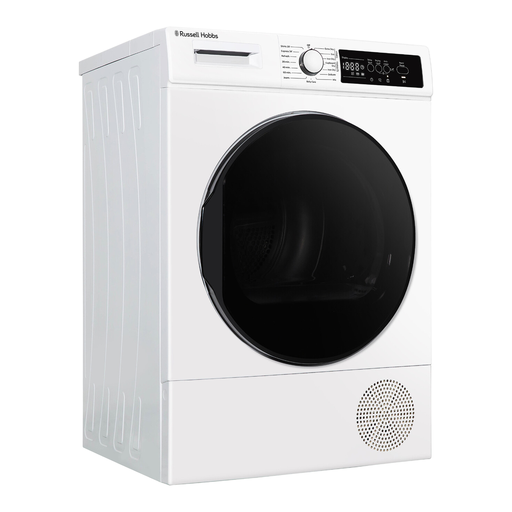
Russell Hobbs RH9HPTD1E12W 9 kg Heat-Pump Dryer
Consider this 9 kg heat-pump model for a separate dryer where an external wall vent is impractical. Before using it for bedding, check the manual's bulky-load instructions and measure the required door-opening and ventilation space.
View on Joybuy
 No image available
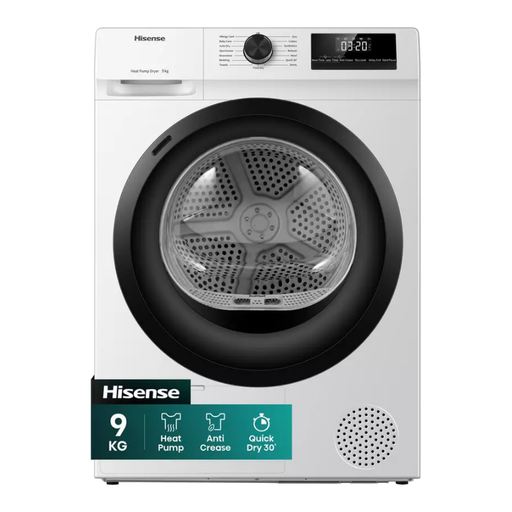
Hisense DH1Q902BW2 1 Series 9 kg Heat-Pump Dryer
This model is a heat-pump choice to assess for a separate laundry space; its title identifies a 9 kg capacity and A++ rating. Confirm the exact model and series designation before purchase, then check its bedding instructions, door-opening space and clearances.
View on Joybuy
Common questions
Can I dry any tumble-safe duvet in a 9 kg dryer?
No: a tumble-safe care label and a 9 kg rating do not establish that a particular duvet is suitable. Check the dryer manual's bulky-item limits and programme instructions; Electrical Safety First advises particular caution with large items such as duvets.
Does a dryer in a small utility area need an outside wall?
A vented dryer needs a suitable route to an external opening, but a conventional condenser or heat-pump dryer does not need an external wall vent. Any model still needs the ventilation clearance specified in its installation instructions.
What should I measure before ordering?
Measure the usable height, width and depth past plugs and pipes, then allow for the open door and the model's required clearances. A closed-door cabinet measurement alone may not show whether you can load bedding comfortably.
Can I connect a tumble dryer through an extension lead?
Avoid using an extension lead for a tumble dryer. Electrical Safety First advises placing the appliance near a suitable wall socket and checking that it has a UK 3-pin plug and fuse.
How often does the lint filter need cleaning?
Electrical Safety First advises cleaning lint from the filter after every use. Follow the exact appliance manual for cleaning around the door and any additional maintenance, even if the dryer has a self-cleaning condenser.


