For a shared house without a suitable external vent, a heat-pump dryer with moisture sensing is a sensible choice when several people regularly dry small loads and there is room to install it correctly. A condenser dryer also avoids an external vent but needs a workable plan for its water container; choose a vented dryer only where a suitable, permitted route outside is available. For any type, check the small-load programme limits, dimensions and shared cleaning routine before buying.
Who is this for?
Housemates drying small loads frequently
If you often dry just a few items, moisture sensing and the limits of small-load programmes matter more than drum capacity alone. Sensor drying responds to moisture in the clothes rather than running for a fixed time, and some manufacturers publish specific load limits for quick programmes.
Households sharing electricity use
When several people use one machine, compare energy information for the exact models under consideration and agree how the dryer will be used. Which? measures model energy use on its two main test programmes; your usual small-load programme may be different.
Renters with limited installation options
A condenser or heat-pump dryer avoids the need for an external vent hose, but still needs a suitable position, electrical connection and the clearance specified in its manual. Check whether the tenancy requires permission for the proposed installation.
What matters when choosing?
Heat-pump dryer
Consider it when: Several housemates will use the dryer regularly and there is no suitable external vent route.
Allow for: Programme times that can be longer; compare the exact model rather than assuming every heat-pump dryer handles small loads alike.
Condenser dryer
Consider it when: External venting is unavailable and collecting extracted water in a tank works for the household.
Allow for: Regular tank emptying unless the exact model supports a suitable drain connection.
Vented dryer
Consider it when: The property has a suitable external vent route and the installation is permitted.
Allow for: The hose and outlet to restrict where the machine can go; follow the model’s installation instructions.
| Concern | What to check | Who this matters to |
|---|
| Small-load cycles |
Check for moisture sensing and the stated load and fabric limits of quick or small-load programmes. |
If I usually dry only a few items, I want a programme suited to that load rather than choosing by drum size alone. Around 31% of consumers put small-load suitability first. |
| Shared electricity use |
Compare model-specific energy information and the programmes housemates expect to use. |
With several people using one dryer, I want to understand its electricity use over repeated cycles. For around 25% of consumers, that is the primary concern. |
| Installation space |
Measure the full space, check manual clearances and confirm a suitable wall socket and any required permission. |
If the available space or tenancy restricts installation, I need to establish where the dryer can safely go before choosing a type. Placement comes first for around 25% of consumers. |
| Shared upkeep |
Check the stated noise figure and agree who cleans filters and empties the water container, if fitted. |
When the dryer is near shared rooms, I need its use and upkeep to fit a routine everyone can follow. Around 19% of consumers chiefly prioritise disruption and maintenance. |
Common buying mistakes
-
Choosing by drum capacity alone
An 8 kg rating does not tell you the permitted load for a quick programme. AEG, for example, states a limit of up to 4 kg for SpeedDry on its TE718D4B.
Read the exact model’s programme table for load and fabric limits, and check whether its moisture-sensing settings suit the clothes housemates usually dry.
-
Assuming vent-free means maintenance-free
Hotpoint explains that condenser dryers collect extracted moisture in a built-in tank. In a shared house, someone needs to take responsibility for emptying it unless a compatible drain arrangement is in place.
Check the model’s water-container and drainage instructions, including whether any required drain accessory is supplied, then agree a cleaning and emptying routine.
Without a compatible drain connection, regular tank emptying remains part of using the dryer.
-
Squeezing the dryer into a cupboard or relying on an extension lead
Electrical Safety First advises against placing a tumble dryer in an enclosed cupboard and recommends a position close enough to a wall socket to avoid an extension lead.
Measure the space, follow the model’s clearance instructions and use a suitable wall socket without overloading it.
-
Leaving filter cleaning to the next housemate
Lint builds up during use. London Fire Brigade advises cleaning a tumble dryer’s filter after every load.
Make that task part of the shared laundry routine and follow the manufacturer’s instructions for any additional filters.
Brands to consider for these dryer types
Bosch
A heat-pump range worth examining when permanent placement and model-specific dimensions matter.
- Bosch lists an 8 kg capacity and dimensions of 842 × 598 × 613 mm for its WTH85222GB, alongside an AutoDry feature.
- That cited model is a full-size appliance; measure the space and check the installation instructions rather than treating its heat-pump design as a compact option.
AEG
A heat-pump option to examine if a stated quick-programme load limit is important.
- AEG states that SpeedDry on the TE718D4B takes up to 4 kg in 75 minutes under the programme’s specified conditions.
- That limit and timing belong to the named programme and model; check the fabric instructions and do not assume they apply across AEG dryers.
Hotpoint
Its condenser and heat-pump ranges offer two vent-free types to compare for a shared house.
- Hotpoint describes condenser models as collecting moisture in a built-in tank rather than using an external vent hose.
- Check the exact model’s dimensions, energy information and tank or drain arrangement; the type alone does not establish its suitability for frequent small loads.
Russell Hobbs
A freestanding heat-pump range to compare when the available floor space is a key constraint.
- Russell Hobbs lists its RH8HPTD1E12B as an 8 kg heat-pump dryer measuring 85 × 60 × 56 cm.
- Its stated 56 cm depth does not include a conclusion about the space needed for installation or access; check the manual and measure the proposed position.
Heat-pump dryers on Joybuy
These heat-pump models are relevant if your shared house wants a dryer without an external vent hose. Their drum capacities differ, so check each model’s small-load programmes and installation requirements rather than choosing by capacity alone.
 No image available
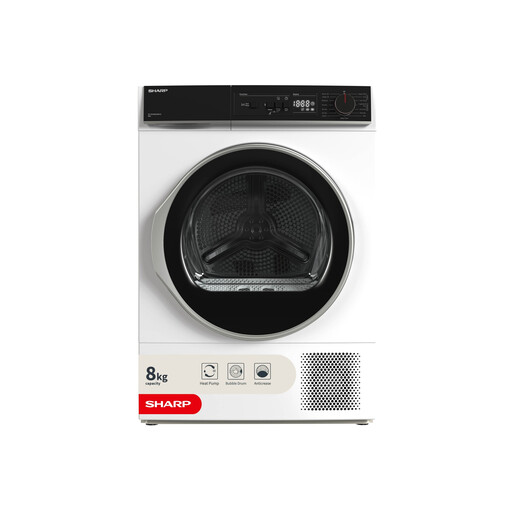
Sharp KD-NHA8S6GW1D-EN 8 kg heat-pump dryer, white
For frequent small loads, check the programme table’s load and fabric limits before choosing a short cycle.
8 kg heat-pump model in white. Check the manual for installation clearance and water-container care.
View on Joybuy
No image available
Sharp KD-NHA0S6GM1D-EN 10 kg heat-pump dryer, matte black
If your household also dries larger loads, compare the programmes you would use for those loads and for just a few items.
10 kg heat-pump model in matte black. Check the small-load programme limits and the manual’s space and water-handling requirements.
View on Joybuy
 No image available
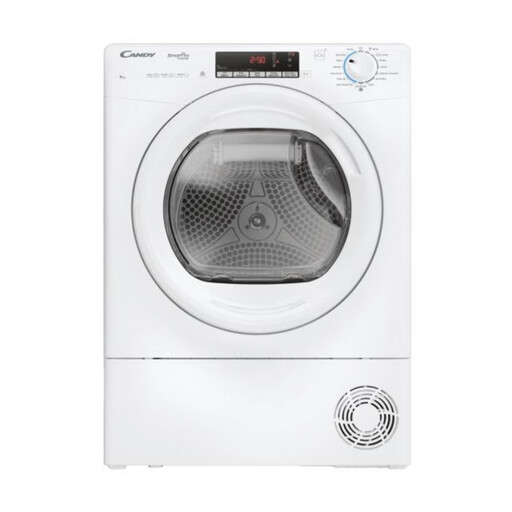
Candy CROE H9A3TE-80/N 9 kg heat-pump dryer, white
For repeated shared use, compare its model-specific energy information and check which programme suits your usual small load.
9 kg heat-pump model with Wi-Fi connectivity. Check installation clearance and the water-container and filter instructions.
View on Joybuy
 No image available
Hoover HRE H9N2TE-80 9 kg heat-pump dryer, white
If housemates often dry only a few garments, check the permitted load and fabrics for the programme they would actually use.
9 kg heat-pump model with Wi-Fi connectivity. Confirm its energy information, installation clearance and maintenance instructions.
View on Joybuy
 No image available
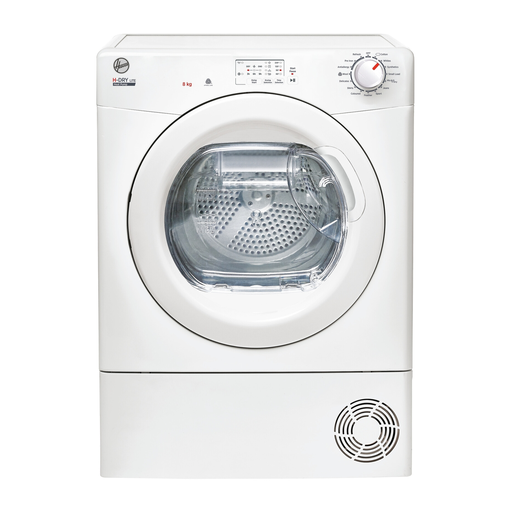
Hoover H-Dry 300 HLE H8A1LE-80 8 kg heat-pump dryer, white
For a shared-house routine, check that its programmes suit your typical small load and that everyone can manage the cleaning tasks.
8 kg heat-pump model with NFC One Touch and Aquavision. Check the manual’s clearance, water-container and filter instructions.
View on Joybuy
Questions about shared-house dryers
Is an 8 kg dryer too large if we usually dry only a few items?
Not necessarily: check the programmes for small loads rather than treating the rated drum capacity as a minimum load. AEG, for example, states that SpeedDry on its 8 kg TE718D4B handles up to 4 kg in 75 minutes; that programme’s limits do not apply to every dryer.
Does a dryer in a rented shared house need an external vent?
A condenser or heat-pump dryer does not need an external vent hose, whereas a vented dryer needs a suitable route outside. Whichever type you choose, follow its installation instructions, avoid an enclosed cupboard and check whether the proposed installation requires tenancy permission.
How should we compare electricity use?
Compare energy information for the exact dryers under consideration, then check the programmes your household expects to run. Which? measures energy use on two main programmes in its testing, but a dryer’s energy class alone will not tell you whether its small-load cycle suits your laundry.
What cleaning rule should housemates agree on?
Agree that the lint filter is cleaned after every load. London Fire Brigade gives that advice for tumble dryers; also follow the model’s instructions for other filters and assign responsibility for emptying its water container if it has one.


