For regularly drying tumble-safe sportswear, consider a heat-pump dryer with a programme intended for sportswear and sensor drying. Heat-pump dryers do not need an external wall vent, and Electrical Safety First describes them as more energy-efficient than conventional condenser and vented dryers. Check each garment’s care label, the exact model’s programmes and the space and socket available in your utility room before choosing.
Who this choice affects
Frequent sportswear dryers
If you regularly dry tumble-safe training tops or other technical garments, start with the garment labels and the exact dryer’s programme list. A sportswear programme and moisture sensing may matter more to your routine than a larger drum.
Energy-conscious households
If the dryer will run often, compare the current energy label and product information sheet for models that suit your loads. Energy Saving Trust explains the A-to-G rating scale; an older A+++ claim should not replace a current model-specific comparison.
Buyers with limited utility-room space
Measure the appliance space, door-opening area and access needed for cleaning. Check the model’s clearance instructions and the position of a direct wall socket before deciding whether an externally vented dryer is practical.
What to check before buying
A heat-pump dryer is a useful starting point when sportswear drying is frequent and an external vent is inconvenient. A conventional condenser dryer also avoids a wall vent; a vented dryer needs a suitable exhaust route to the outside. Whatever the type, confirm the garment and programme requirements before comparing capacity and energy information.
Heat-pump dryer
Consider it when: You dry tumble-safe sportswear regularly and want a ventless option with lower-temperature drying.
Check: Sportswear programmes, cycle duration and energy information vary by model; a heat pump alone does not confirm a suitable cycle.
Condenser dryer
Consider it when: You need to avoid an external wall vent but prefer a conventional condenser model.
Bear in mind: Electrical Safety First describes heat-pump dryers as more energy-efficient; check how your chosen condenser model collects or drains water.
Vented dryer
Consider it when: A suitable external exhaust route can be installed for your utility room.
Bear in mind: The exhaust requirement limits where it can go; Electrical Safety First recommends professional installation.
| Concern | What to check | Who this matters to |
|---|
| Sportswear care |
Check each garment’s tumble-dry label and the exact model’s Sportswear, Activewear or relevant Outdoor programme; check whether it has sensor drying. |
If I regularly dry technical training clothes, I want a cycle intended for those garments rather than relying on a generic setting. Around 31% of consumers put sportswear care first. |
| Utility-room fit |
Measure the appliance and door-opening space, follow its clearance instructions and confirm a direct wall socket. A vented model also needs an external exhaust route. |
When utility-room space or socket position limits my options, I need to know the dryer can be installed and accessed safely; roughly 25% of consumers make installation their primary concern. |
| Energy use |
Compare current A-to-G labels and product information sheets for models suited to your load size and expected use, rather than brand-level saving claims. |
If I expect frequent loads, the electricity used over time matters to my choice. About 25% of consumers prioritise energy use. |
| Load and routine |
Match capacity to typical washed loads, and check drainage, filter access and the exact model’s noise information where these affect your routine. |
If household loads are awkward to split or the water container is inconvenient to reach, everyday handling becomes decisive; around 19% of consumers put load size and convenience first. |
Buying pitfalls
-
Assuming every heat-pump dryer has a sportswear cycle
Heat-pump drying does not establish which fabric programmes an individual model offers, or whether a particular garment can be tumble dried.
Check the exact programme list and follow both the garment care label and the dryer manual.
-
Ordering before measuring the utility room
A dryer may fit between walls but leave too little room to open its door, reach its filters or meet its installation clearances.
Measure the full installation area and check the socket position against the model’s instructions. Plan an external exhaust route if you choose a vented dryer.
-
Using a headline saving claim as the energy comparison
Brand comparisons can depend on a particular machine or test condition, while capacity and programmes differ between models.
Use the current energy label and product information sheet for each exact model, alongside the loads you expect to dry.
-
Treating filter cleaning as optional
Lint is flammable. Electrical Safety First advises cleaning lint and fluff from the filter and around the door after every use.
Before buying, check that you can reach the filters comfortably; then follow the model’s cleaning instructions throughout use.
Brands to consider
AEG
Relevant if you want to compare model-specific fabric programmes in the AbsoluteCare range.
- AEG lists SportWear and Outdoor programmes, SensiDry and a 9 kg capacity for its TR849P4B heat-pump model.
- AEG’s statements about AbsoluteCare drum movement and temperature are manufacturer claims; check the programme list and current energy information for the model you intend to buy.
LG
Relevant if an Activewear programme and sensor drying are priorities.
- LG lists Activewear, Sensor Dry and a 9 kg capacity for its FDV309WN heat-pump model.
- Check the exact model’s programmes, energy information and installation requirements rather than extending those features to every LG dryer.
Hotpoint
Relevant if drainage arrangements and filter access affect your utility-room routine.
- Hotpoint lists a direct-drain option, a 2-in-1 filter and 9 kg capacity for its C HD 93M GG UK model.
- Check the chosen model’s garment programmes and current energy label; brand energy-saving claims do not describe every load.
Bosch
Relevant if you want to compare heat-pump models with AutoDry moisture sensing.
- Bosch describes AutoDry sensing and lower-temperature heat-pump drying in its dryer range.
- Check which features and sportswear programmes the exact model offers; Bosch’s brand-level energy comparison is not a saving figure for every dryer or cycle.
Heat-pump dryers on Joybuy
These heat-pump models offer ventless options to consider for a utility room. Before choosing one for tumble-safe sportswear, check its exact fabric programmes, your garments’ labels and the installation instructions.
 No image available
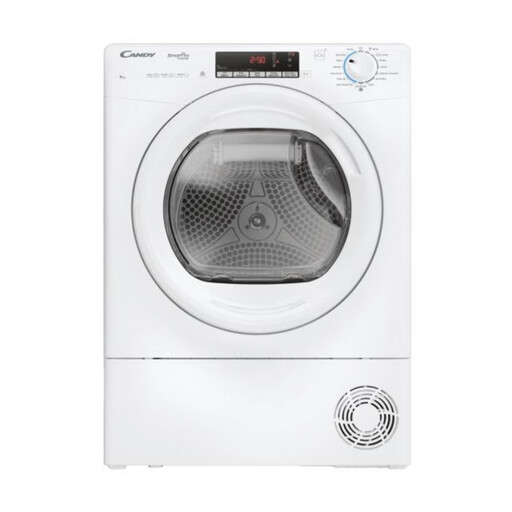
Candy CROE H9A3TE-80/N 9 kg heat-pump dryer
Consider this ventless model if a 9 kg capacity suits your loads. Its title lists Sensor Dry and Wi-Fi connectivity; check the exact sportswear programmes and required installation clearances before ordering.
View on Joybuy
 No image available
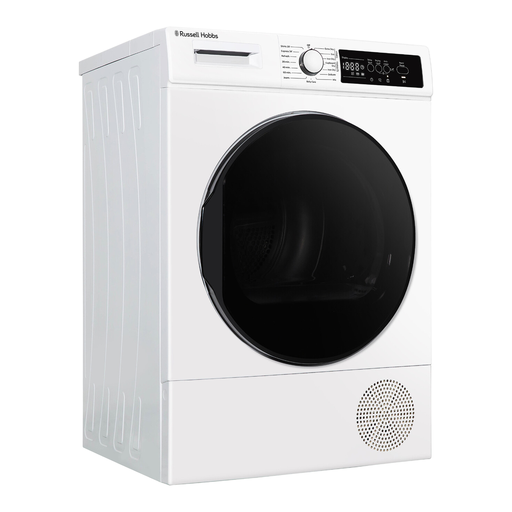
Russell Hobbs RH9HPTD1E12W 9 kg heat-pump dryer
Consider this ventless 9 kg model if its capacity matches your usual loads. Check its exact sportswear programmes, drainage arrangement and installation instructions against your utility room.
View on Joybuy
 No image available
Hoover HRE H9N2TE-80 9 kg heat-pump dryer
Consider this ventless model if you want to assess a 9 kg dryer with Sensor Dry and Wi-Fi connectivity. Confirm its sportswear programmes and installation requirements, and use the current UK energy label to compare energy use.
View on Joybuy
 No image available
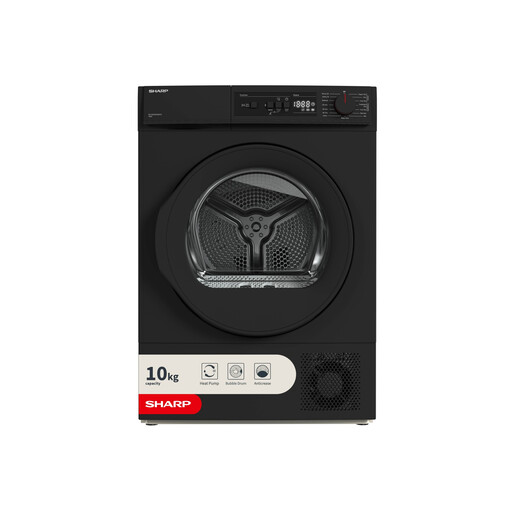
Sharp KD-NHA0S6GM1D-EN 10 kg heat-pump dryer
Consider this ventless 10 kg model if your usual washed loads call for that capacity. Check its sportswear programmes, dimensions and required clearances rather than choosing on drum size alone.
View on Joybuy
 No image available
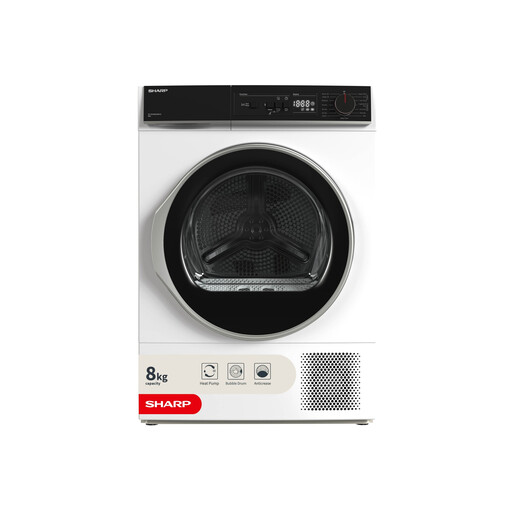
Sharp KD-NHA8S6GW1D-EN 8 kg heat-pump dryer
Consider this ventless 8 kg model if that capacity fits your routine. Check its sportswear programmes, door-opening space and model-specific installation requirements before deciding whether it fits your utility room.
View on Joybuy
Common questions
Do I need a Sportswear or Activewear programme?
A dedicated programme is worth checking if you regularly dry tumble-safe technical clothing. AEG and LG list sportswear-related programmes on particular models, but programme names and settings vary; the garment’s care label still determines whether it can be tumble dried.
Can a heat-pump dryer go in a utility room without an outside vent?
Yes, a heat-pump dryer does not need an external wall vent, according to Electrical Safety First. It still needs the space and ventilation specified in its installation instructions; do not assume an enclosed cupboard is suitable.
Can I use an extension lead for a tumble dryer?
Plan for a direct wall socket instead. Electrical Safety First warns that using an extension lead with other appliances can overload it and create a fire risk; check the dryer’s installation instructions and your socket position before buying.
How often should I clean the lint filter?
Clean lint and fluff from the filter and around the door after every use, as Electrical Safety First advises. Follow the manufacturer’s instructions for other cleaning tasks, and check that the filters will be easy to reach in your planned installation.


