For regular loads of towels labelled as tumble-safe, start by comparing heat-pump dryers with sensor drying and enough capacity for your usual wash load. The Department for Energy Security and Net Zero identifies heat-pump dryers as a higher-efficiency option than conventional dryer technologies offering the same household function, but the right model still needs to fit your space and drying routine. Check its current energy information, programme options, water-handling arrangements and maintenance instructions before choosing.
Who this is for
Households drying towels regularly
If bath and hand towels make up frequent loads, match the dryer’s capacity to the laundry you normally wash and compare its energy information. Heat-pump operation is particularly relevant when repeated electricity use matters to your choice.
Buyers focused on towel care
If you want to avoid drying towels longer than necessary, look for sensor drying, a suitable programme and a selectable dryness level. Miele’s towel-care guidance also notes that washing habits can affect texture and absorbency, independently of the dryer.
Households with limited installation space
If an external vent is impractical or the available space is tight, check the appliance dimensions, required clearance and how collected water is handled. Plan for a suitable wall socket and access to the lint filter, following Electrical Safety First’s safety guidance.
What matters when choosing
Begin with the energy information and capacity for your usual towel load, then check drying controls and whether the appliance can be installed and maintained in its intended position.
| Concern |
What to check |
Who this matters to |
| Energy use |
Compare current energy information for models of suitable capacity, alongside the stated programmes and cycle times. |
If I dry towels regularly, electricity use across repeated loads matters more to me than a single short cycle. Around 31% of consumers put energy use first. |
| Dryness and towel feel |
Look for sensor drying, selectable dryness levels and a programme appropriate to the towel’s care label. |
I want to take out dry towels without routinely leaving them in the machine longer than needed; around 25% of consumers place this towel-care need first. |
| Load size and turnaround |
Match rated capacity in kg to your usual wash load; check the conditions attached to any short programme. |
Several towels may need drying together, so splitting loads would disrupt my laundry routine. Capacity and turnaround are the primary concern for around 25% of consumers. |
| Installation and upkeep |
Check dimensions, clearances, vent or water-handling requirements, socket location and filter access. |
If space or electrical arrangements limit where I can put a dryer, it has to fit and be practical to maintain. Around 19% of consumers put that requirement first. |
Buying pitfalls
-
Judging energy use by an older letter rating alone
An older label does not give you a straightforward comparison with every model carrying current energy information. Capacity and the programme used also affect what a comparison tells you.
Read the exact model’s current energy information and compare dryers on a suitable capacity and programme basis.
-
Relying on a timer when avoiding over-drying matters
A fixed duration may not suit every towel load. As John Lewis & Partners explains in its tumble-dryer guidance, sensor drying responds to moisture and ends the cycle when the selected dryness target is reached.
Check that the exact model offers sensor drying and choose a programme appropriate to your towels’ care labels.
-
Leaving installation checks until delivery
A vented dryer needs an external vent route; a heat-pump or condenser model still needs space and a way to manage collected water.
Measure the appliance position and access route, then check the model’s clearance, socket and drainage or tank instructions.
-
Overlooking lint cleaning and the power connection
Lint build-up presents a fire risk. Electrical Safety First advises cleaning fluff from the filter and around the door after every use and warns against overloading extension leads.
Allow easy access to the filter, follow the appliance’s cleaning instructions and plan to use a suitable wall socket.
Brands to consider
These brands offer relevant dryer ranges; features and capacities need checking on the particular model rather than assumed across a brand.
Bosch
Bosch’s heat-pump range is relevant if you are comparing sensor controls and capacities for regular towel loads.
- Bosch lists AutoDry and a self-cleaning condenser on the 9 kg WQG24502GB.
- Confirm those features and the required programme on the exact model; they do not apply automatically to the whole range.
Miele
Miele’s range may interest buyers comparing fabric-care and convenience controls alongside heat-pump drying.
- Miele describes features including its honeycomb drum and, on selected models, QuickPowerDry and DryCare.
- Feature availability varies by model. Miele’s towel-care guidance also says detergent residue and frequent fabric-conditioner use can affect towels regardless of dryer choice.
AEG
AEG’s heat-pump range provides models to compare by capacity, energy information and programme options.
- AEG lists heat-pump models in capacities including 8 kg and 9 kg, with SensiDry features on selected models.
- Check the exact model’s dimensions and product information rather than treating a range-level feature claim as standard.
Beko
Beko’s heat-pump range is worth examining where capacity or an integrated installation affects the choice.
- Beko lists different capacities and sensor programmes on selected heat-pump models.
- Check the specific model’s load size and installation requirements. Beko states that its integrated 7 kg DTIKP71131 is not available in Northern Ireland.
LG
LG’s heat-pump models provide options for buyers comparing sensing functions and condenser maintenance.
- LG lists AI Dry on the RHX5009TBB and automatic condenser cleaning on the FDV309WN.
- Those are separate, model-specific features. Check the programme list, dimensions and current energy information for the model you are considering.
Joybuy product choices
These heat-pump dryers are options to compare for tumble-safe towel loads. Match the stated capacity to your washing routine, then check each model’s controls and installation instructions before choosing.
 No image available
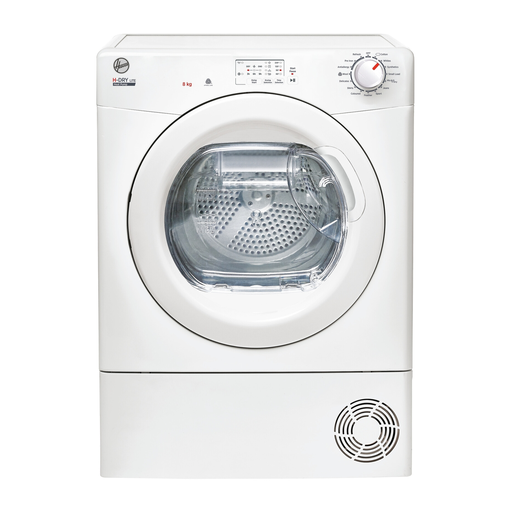
Hoover H-Dry 300 HLE H8A1LE-80, 8 kg heat-pump dryer
Consider its stated 8 kg capacity against your normal towel load, and check which drying settings suit the finish you want.
The product name specifies Sensor Dry and Aquavision. Confirm the installation space and water-handling instructions for this model.
Joybuy
 No image available
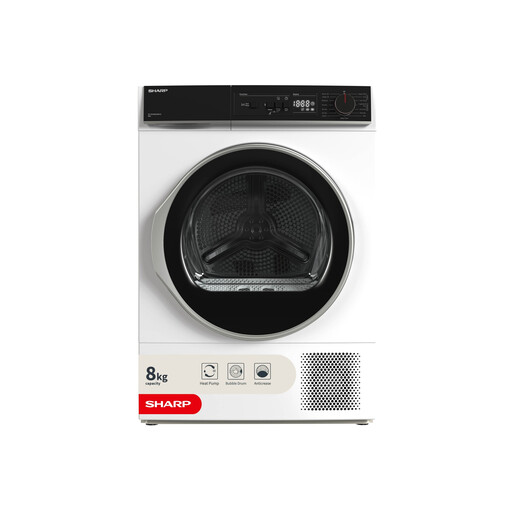
Sharp KD-NHA8S6GW1D-EN, 8 kg heat-pump dryer
For routine towel loads, compare its stated 8 kg capacity with the amount you normally wash.
Check the exact model’s drying controls, programme conditions and required installation clearance before choosing it.
Joybuy
 No image available
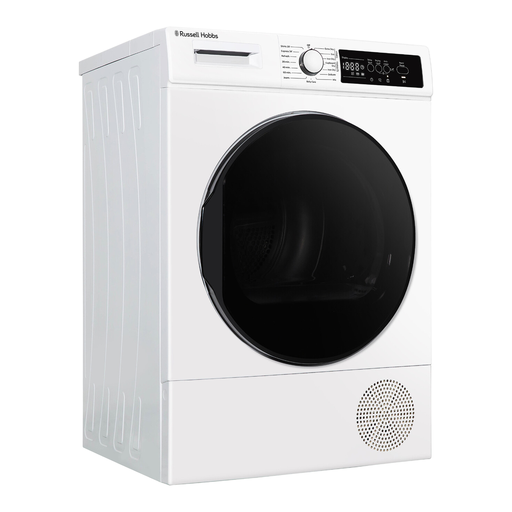
Russell Hobbs RH9HPTD1E12W, 9 kg heat-pump dryer
Its stated 9 kg capacity is a useful starting point if your usual towel wash load needs that much dryer capacity.
Compare the model’s programme conditions and current energy information, and check how its water tank and installation clearances would work in your space.
Joybuy
 No image available
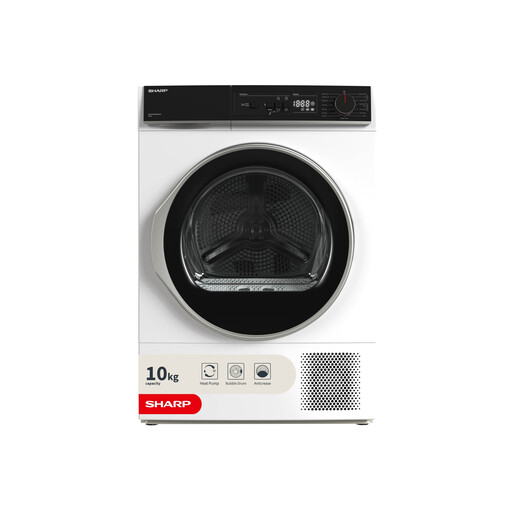
Sharp KD-NHA0S6GW1D-EN, 10 kg heat-pump dryer
If you regularly wash larger towel loads, compare its stated 10 kg capacity with your actual load rather than assuming extra capacity means a shorter cycle.
Check the model’s towel-suitable programmes, dimensions and water-handling instructions.
Joybuy
 No image available
Hoover HRE H9N2TE-80, 9 kg heat-pump dryer
For repeated towel loads, compare its stated 9 kg capacity with your wash load and decide whether its drying controls meet your needs.
The product name specifies Sensor Dry and Wi-Fi connectivity. Check the exact programme settings, installation requirements and current energy information.
Joybuy
Common questions
Which type of dryer should I consider for regular towel loads?
A heat-pump dryer is a sensible starting point when repeated energy use and avoiding an external vent matter. The Department for Energy Security and Net Zero identifies heat-pump technology as a higher-efficiency option for the same household function; still compare capacity, programme times and installation needs on the exact models.
Is sensor drying useful for towels?
Yes, if avoiding unnecessary drying is a priority: sensor drying is designed to end a cycle at the selected dryness level rather than after a fixed time. Choose a programme suitable for the towels’ care labels and follow the machine’s loading instructions.
Why might towels still feel rough after tumble drying?
The washing routine can affect towel texture as well as the drying cycle. Miele’s towel-care guidance notes that detergent residue can leave towels rough and that frequent fabric-conditioner use can reduce absorbency.
What should I check before installing a dryer?
Check the model’s dimensions, clearances, water-handling or vent requirements and access to a suitable wall socket. Electrical Safety First advises against using an extension lead for a tumble dryer and recommends professional installation for vented models; follow the manufacturer’s instructions for the chosen appliance.
How often does the lint filter need cleaning?
Clean lint and fluff from the filter and around the door after every use, as Electrical Safety First advises. Follow the model’s instructions for any additional cleaning of other components.


