For regular small loads in a student house, consider a heat-pump dryer with a confirmed small-load or sensor-drying function, particularly if there is no suitable external vent. Which? reports lower running costs for heat-pump dryers than for condenser or vented types, but the right choice still depends on the available space, socket, drying programmes and how the household will handle collected water.
Who is this choice for?
Students sharing electricity bills
If several housemates dry clothes each week, electricity use matters across repeated cycles. Which? reports lower running costs for heat-pump dryers than for condenser or vented types; compare the exact models and programmes you might use.
Renters with limited installation options
If an external vent is impractical, a condenser or heat-pump dryer avoids the vent hose needed by a vented model. You still need a suitable location, socket and way to deal with collected water.
Housemates drying a few items at a time
An 8 kg or 10 kg rating does not tell you how a dryer handles a small load. Check the exact model for a half-load setting, sensor drying or a rapid programme with a stated load limit.
What matters when choosing?
Start with the space and installation arrangements, then compare how each dryer handles frequent small loads. A shared cleaning routine matters whichever type you choose.
Heat-pump dryer
Consider it when: Small loads will be dried regularly and there is no suitable external vent; seek an exact model with useful small-load controls.
Bear in mind: Which? reports lower running costs than for condenser or vented dryers, while standard cycles may take longer.
Condenser dryer
Consider it when: An external vent is not possible and you can manage a water tank or a compatible drain connection.
Bear in mind: Which? reports higher running costs than for heat-pump dryers, so frequent shared use deserves a close look at energy information.
Vented dryer
Consider it when: The property has a suitable route to discharge moisture outside and the installation is permitted.
Bear in mind: It needs an external hose; Electrical Safety First recommends professional installation for vented dryers.
| Concern |
Buying checks |
Who this matters to |
| Electricity use |
Compare the exact models’ energy information and the programmes likely to be used for small loads. |
When several housemates run separate loads each week, I want to keep recurring electricity use manageable. Roughly 29% of consumers would put running costs first. |
| Fit and installation |
Measure the appliance route, final space and door swing; check clearances, the wall socket and the plan for venting or collected water. |
I need a dryer that fits the rented space without an unsuitable vent route or electrical workaround. For about 29% of consumers, safe installation would be the primary concern. |
| Small-load programmes |
Check the exact-model manual for sensor drying, a half-load setting or a rapid programme’s load and fabric limits. |
If I regularly dry just a few essentials, I care about the programme intended for that load rather than drum capacity alone. Around 24% of consumers would prioritise small-load handling. |
| Shared upkeep |
Check access to the lint filter and agree who will clean it after each use and follow the manual’s other maintenance instructions. |
With several people using one machine, I want cleaning tasks to be clear so they are not missed. Approximately 18% of consumers would make shared-use safety and upkeep their first priority. |
Mistakes to avoid
-
Choosing by drum capacity alone
An 8 kg rating describes the rated load, not how the dryer adjusts when you put in only a few items.
Look for small-load settings on the exact model and check any rapid programme’s load and fabric limits. A feature listed for another model from the same brand does not establish that this one has it.
-
Ignoring electricity use across housemates
Separate loads run by several people make programme choice and energy consumption relevant to the household’s recurring bills.
Compare exact-model energy information against how often the house expects to use the dryer, rather than relying on dryer type alone.
-
Assuming a non-vented dryer fits anywhere
Heat-pump and condenser dryers do not need an external vent hose, but they still need the space and electrical arrangement required by their installation instructions.
Measure the route into the room as well as the final position, including door opening and required clearances. Use a suitable nearby wall socket rather than an extension lead as a workaround.
-
Leaving lint cleaning to someone else
In a shared house, an essential task can be missed when nobody takes responsibility for it. Electrical Safety First advises removing lint and fluff from the filter and around the door after every use.
Agree that the person unloading the dryer cleans it, and assign responsibility for recall registration and maintenance specified in the manual.
Relevant dryer brands
Beko
Selected Beko 8 kg heat-pump models illustrate features worth checking when small loads and available space matter.
- Beko lists sensor-drying programmes and a 54.5 cm depth for the BM3T3822. For the separate B5T48231R, Beko states that its RapiDry programme can dry a 5 kg load in one hour.
- Those features apply to the named models, not every Beko dryer. Beko identifies both cited models as unavailable in Northern Ireland and the Republic of Ireland, so check availability for the delivery area.
Bosch
Bosch provides an example of the exact-model half-load feature to look for, rather than a reason to assume all its 8 kg dryers have one.
- Bosch says the WQG233D8GB half-load option adjusts drying settings for a smaller load.
- Bosch marks the WQG233D8GB as no longer available. Its WTH85226GB is also an 8 kg heat-pump model, but check that model’s own programmes if half-load drying is important.
Hotpoint
The Hotpoint C HSD 82M WW UK is an 8 kg heat-pump model to consider if a suitable drain connection could simplify shared use.
- Hotpoint states that this model can connect to a drain instead of relying on regular water-tank emptying.
- A drain connection helps only where the household has a compatible setup and permission for any necessary work. Check the model’s dimensions and programmes against the space and small loads.
Heat-pump dryers on Joybuy
These Sharp heat-pump models offer two rated capacities for households considering a dryer without an external vent. For mainly small loads, compare the exact programme limits and installation requirements before choosing between them.
 No image available
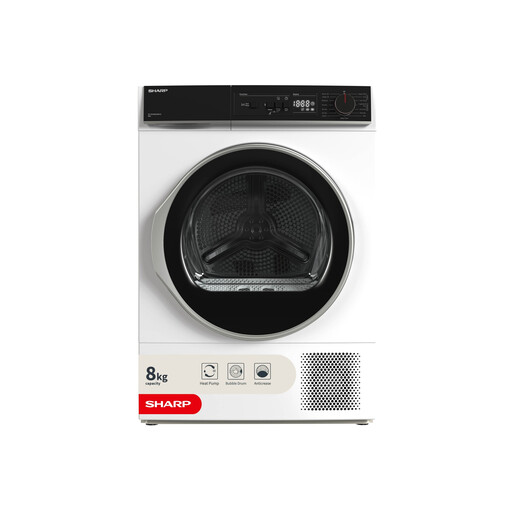
Sharp KD-NHA8S6GW1D-EN 8 kg heat-pump dryer, white
Consider this 8 kg heat-pump model if the house needs a dryer without an external vent and can accommodate its full-size drum.
If you plan to use Express 34 for small loads, confirm its load and fabric limits in the exact-model instructions. Measure the installed space, including clearances, and decide whether routine water-tank emptying suits the household.
View on Joybuy
 No image available
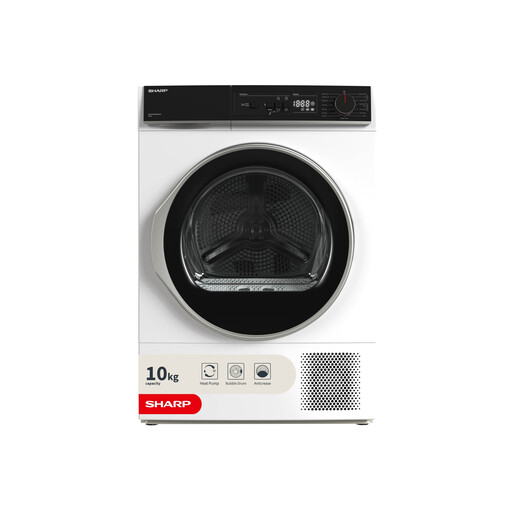
Sharp KD-NHA0S6GW1D-EN 10 kg heat-pump dryer, white
Consider this 10 kg heat-pump model if the shared house also needs a larger rated capacity; that rating alone does not establish how it handles a few items.
Check the exact load and fabric conditions for Express 34 and Shirts 20 before relying on either programme for small loads. Confirm that the space, required clearances and water-tank routine work for the household.
View on Joybuy
Student-house dryer questions
Does a student house need an external vent for a tumble dryer?
A condenser or heat-pump dryer does not need an external vent hose, while a vented dryer does. That distinction affects how you site the machine; whichever you choose, follow the exact model’s siting and ventilation instructions.
Can we use an extension lead for the dryer?
Use a suitable nearby wall socket rather than an extension lead as a workaround. Electrical Safety First warns that an extension lead can be overloaded when a tumble dryer is used with other appliances; check the model’s installation instructions before choosing its position.
Should we ask before installing a dryer in rented accommodation?
Check the tenancy agreement and ask the landlord or property manager before arranging installation, particularly if it affects drainage, venting or fixed electrics. GOV.UK guidance on electrical safety in rented homes in England addresses landlords’ installation duties and excludes student halls; it does not itself settle whether a tenant has permission to add a dryer.
What maintenance should housemates agree on?
Agree who will clean the lint filter and door area after every use and who will handle the manual’s other maintenance tasks. Electrical Safety First also advises registering the appliance for recall contact and avoiding operation overnight or when everyone is out where possible.


