For winter cotton laundry where floor space is limited, compare heat-pump dryers by the space they need when installed before choosing between 8 kg and 9 kg capacities. A shallower freestanding model may fit where a deeper one obstructs access; an integrated dryer makes sense only with compatible cabinetry. Check the exact model’s clearances, door opening and suitability for the room’s winter temperature.
Who needs to consider what?
Consumers planning a restricted laundry area
If the dryer must sit in a shallow utility area or beside a narrow walkway, start with its stated depth, then allow for the door, connections and installation clearances. An integrated model also needs a compatible appliance space.
Households drying regular cotton loads
If clothing, towels or bedding go into the dryer frequently, compare drum capacity with your usual wash load. Check the cotton programmes and available dryness settings rather than assuming a short programme applies to a full load.
Consumers focused on electricity use and fabric care
Heat-pump drying and moisture-sensing options may be priorities if you use the dryer regularly through winter. Compare the exact model’s programme information and check whether its intended room meets the manufacturer’s operating instructions.
What matters when choosing?
Start with practical fit, then decide whether the usual cotton load calls for an 8 kg or 9 kg drum. Compare drying controls and product information for models that can be installed in your space.
| Concern |
What to check |
Who this matters to |
| Practical fit |
Measure usable width, depth and height; check door swing and the exact model’s required clearances. Confirm whether the space is for a freestanding or integrated appliance. |
If the dryer would project into a walkway, cabinet depth alone will not tell me whether I can use the space comfortably. Around 42% of consumers would put practical fit first. |
| Energy use and fabric care |
Read the model’s energy label and product information sheet together; check its cotton programmes and whether it offers moisture sensing or selectable dryness levels. |
When drying cotton regularly through winter, I want to compare electricity-use information and avoid running a programme longer than I need. Around 33% of consumers would make energy use and fabric care their primary concern. |
| Cotton-load capacity |
Compare the 8 kg or 9 kg drum with your usual cotton wash load, especially if you routinely dry towels or bedding. |
If bulky laundry often needs splitting, fitting the usual load into a cycle matters more to me than choosing the shallowest cabinet. Around 25% of consumers would prioritise cotton-load capacity. |
Mistakes to avoid
-
Measuring width but not installed depth
Beko specifies its 8 kg BM3T3822 at 54.5 cm deep, while Hoover specifies the 9 kg HRE H9N2TE-80 at 607 mm deep. Neither cabinet measurement includes every part of the space needed to open and install the appliance.
Measure the access route and available floor area, then use the exact installation instructions to check door movement, rear connections and clearances.
-
Assuming a cold outbuilding is suitable
Hoover’s installation guidance says heat-pump dryers work best in spaces above 10°C. A garage or unheated utility area may be colder during winter.
Check the precise model’s operating-temperature range and air-clearance instructions before deciding where it will go.
-
Choosing by energy-class letter alone
A class letter does not tell you whether the drum suits your cotton loads, how the relevant programme is described or whether the dryer fits its intended position.
Read the label alongside the product information sheet and compare the exact models and programmes relevant to your use.
-
Expecting a quick programme to dry a full cotton load
Hisense describes the Quick Dry 30′ programme on the DH1Q902BW2 for three lightweight shirts, not a full 9 kg load.
Use the cotton programme information to assess normal laundry; check the stated load for any quick cycle separately.
Brands to consider
These brands provide model examples for comparing depth, capacity and drying controls; check specifications for the particular appliance rather than applying one model’s features to a whole range.
Beko
Consider its specified 8 kg freestanding and integrated heat-pump examples if installation depth is a priority.
- Beko specifies the freestanding BM3T3822 at 84.6 × 59.8 × 54.5 cm and the integrated DTIKP81131 at 84.6 × 59.7 × 53.7 cm, with dimensions given as height × width × depth.
- The DTIKP81131 requires a suitable integrated installation. Beko states that this model is unavailable in Northern Ireland and the Republic of Ireland.
Bosch
Its heat-pump range is relevant when comparing lower-temperature drying and automatic controls.
- Bosch describes heat-pump dryers that recirculate air and selected models with Auto Dry moisture and temperature sensing.
- Check capacity, depth and maintenance requirements for the exact model; features described for selected dryers do not establish those details for every Bosch appliance.
Samsung
Its DV90T5240AW/S1 is a specified 9 kg heat-pump example for comparing load capacity with available space.
- Samsung specifies the DV90T5240AW/S1 at 600 × 850 × 600 mm, given as width × height × depth, and says its Optimal Dry control uses moisture and temperature sensors.
- Allow for its stated 600 mm cabinet depth plus the installation space required by the model’s instructions.
Hoover
Its 9 kg heat-pump models offer examples for comparing dryness controls and water-container arrangements.
- Hoover lists four dryness levels and an Aquavision water tank for the HRE H9N2TE-80.
- Hoover specifies depths of 607 mm for the HRE H9N2TE-80 and 604 mm for the NDE H9A3TCE-80/N; measure the intended space before considering either model.
Hisense
The DH1Q902BW2 is a 9 kg freestanding heat-pump example with anti-crease and short-programme options.
- Hisense describes an anti-crease function and a Quick Dry 30′ programme for three lightweight shirts on the DH1Q902BW2.
- That short programme does not establish a 30-minute drying time for a full cotton load; check the model’s cotton programme and installation dimensions separately.
Joybuy tumble dryer choices
These heat-pump dryers offer 8 kg and 9 kg options for comparing your usual cotton load with the space available. Check each model’s installation instructions before treating its cabinet dimensions as the space it will occupy.
 No image available
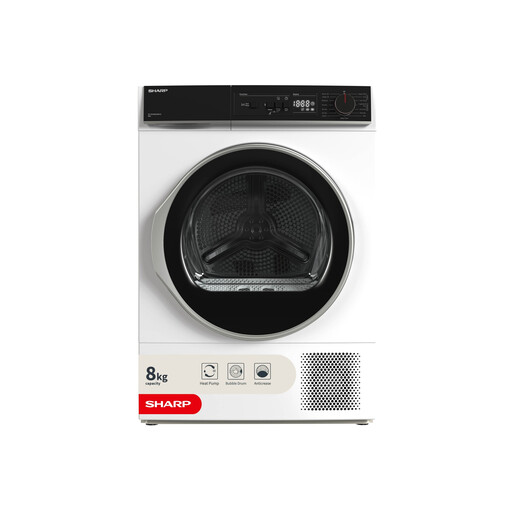
Sharp KD-NHA8S6GW1D-EN 8 kg heat-pump tumble dryer
Consider this 8 kg model if that capacity suits your usual cotton load and you need to assess a dryer for a restricted space.
Check its installed depth, door opening and operating-temperature instructions before choosing a winter location.
View on Joybuy
 No image available
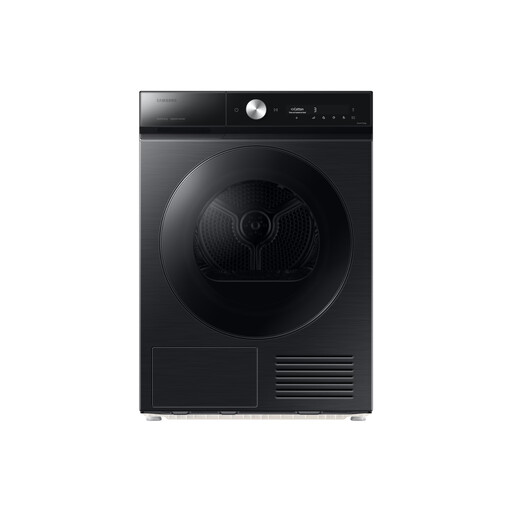
Samsung Series 8 AI Energy DV90BB9545GBS1 9 kg heat-pump tumble dryer
This 9 kg model is worth comparing if your cotton loads are larger and the available space can accommodate its installation requirements.
Measure the full position, including room to open the door, and check the operating instructions for a cold utility area.
View on Joybuy
 No image available
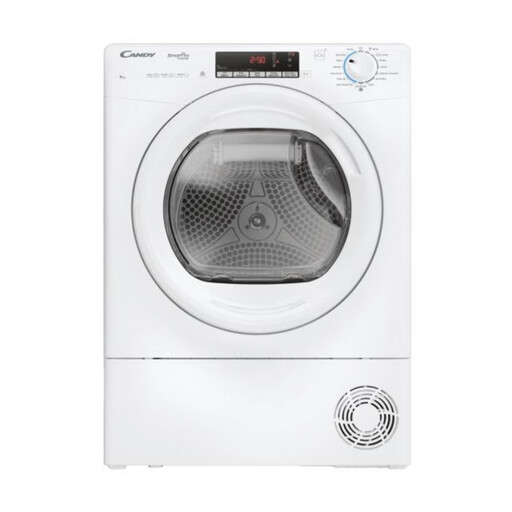
Candy CROE H9A3TE-80/N 9 kg heat-pump tumble dryer
Compare this 9 kg Sensor Dry model if larger cotton loads and selectable drying control matter to you.
Confirm its installation clearances, room-temperature requirements and water-handling arrangement for your intended position.
View on Joybuy
 No image available
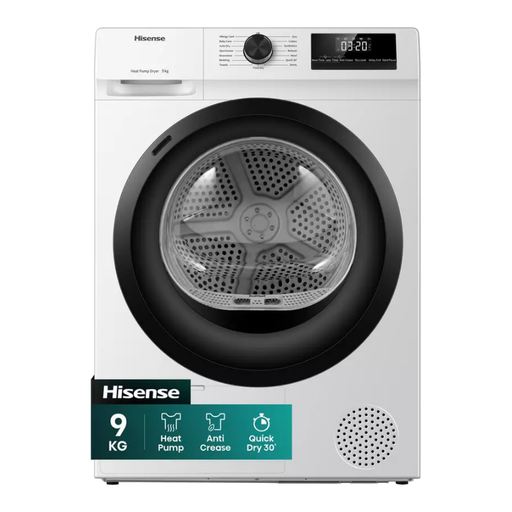
Hisense 1 Series DH1Q902BW2 9 kg heat-pump tumble dryer
This freestanding 9 kg model is relevant if you regularly dry larger cotton loads and have room for its installed footprint.
Hisense specifies an anti-crease function. Its Quick Dry 30′ programme is for three lightweight shirts, so use the cotton programme details when assessing normal loads.
View on Joybuy
 No image available
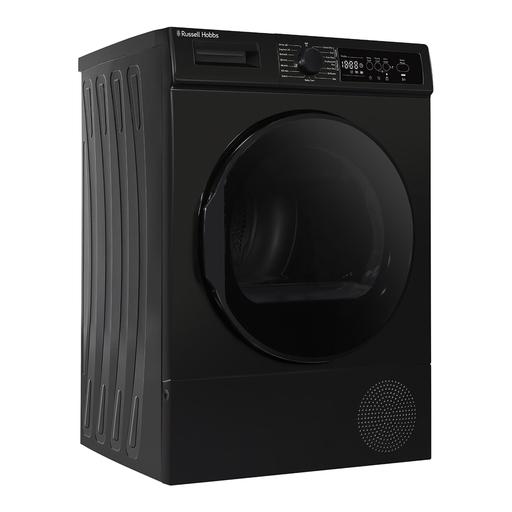
Russell Hobbs RH8HPTD1E12B 8 kg heat-pump dryer
Consider this 8 kg option if your regular cotton load fits that capacity and installation space is a deciding factor.
Check door swing, required clearances, water handling and the model’s instructions for use in an unheated room.
View on Joybuy
Frequently asked questions
Does a heat-pump tumble dryer need an external wall vent?
A heat-pump dryer does not normally need an external wall vent. Hoover’s installation guidance distinguishes it from a vented dryer, but you still need to follow the exact model’s instructions for air circulation and positioning.
Can I put a heat-pump dryer in a cold garage?
Check the model’s permitted operating conditions before placing it in a cold garage. Hoover says heat-pump dryers work best in spaces above 10°C, so a location that drops below that temperature in winter needs particular attention.
Will I need to empty a water container?
That depends on the dryer’s water-handling arrangement. Condenser and heat-pump models may collect water in a container, while a direct drain is an option only where the particular product supports it and a suitable connection is available. Check the model’s instructions and any required kit.
How should I compare tumble dryer energy information?
Compare the energy label and product information sheet for the exact models you are considering, alongside capacity and the programmes you expect to use. Check the information shown for your regional listing rather than treating an energy-class letter on its own as a complete comparison.


