For a student house that regularly dries tumble-safe sportswear, start with a heat-pump dryer offering a suitable low-temperature programme and moisture-sensor drying, but follow each garment’s care label rather than the programme name alone. Compare capacity, dimensions, stated noise and energy-label information for the actual shared space; a conventional condenser dryer is another option without an external vent hose, while a vented dryer needs a workable route outside and permission for the installation.
Who needs to consider what?
Sportswear-care sharers
If gym kits or synthetic training clothes go through the dryer regularly, check each label before choosing a programme. A lower-temperature setting and moisture sensors are worth looking for, but neither makes a garment tumble-safe when its label says otherwise.
Bills-conscious housemates
For frequent shared use, compare energy-label information alongside the size of the loads you normally dry. Energy Saving Trust notes that appliance labels include energy-use, noise and performance information.
Space- and noise-limited renters
If the dryer will stand near a bedroom or in a small shared room, check the exact model’s dimensions, installation instructions and stated noise figure before ordering.
What matters when choosing?
For a student house drying sportswear whose labels permit tumble drying, settle the garment-care requirements before comparing shared-load size and where the machine can stand.
Heat-pump dryer
Consider when: Regular sportswear loads make a label-appropriate lower-temperature programme and moisture sensors priorities; check the exact model for both.
Bear in mind: A heat-pump label alone does not establish the available programmes, cycle duration or noise level.
Conventional condenser dryer
Consider when: An external vent hose is impractical and a model’s programmes suit the garments you need to dry.
Bear in mind: Compare its energy-label information with heat-pump models of a suitable capacity rather than assuming the types use the same amount of electricity.
Vented dryer
Consider when: The property has a suitable route to vent outside and the installation arrangement is permitted.
Bear in mind: Its external hose route must remain unobstructed, which may restrict placement in a shared rental.
| Concern |
What to check |
Who this matters to |
| Sportswear care |
Check each garment’s tumble-drying symbol and required heat setting. Confirm the exact dryer has a compatible programme and, if wanted, moisture sensors. |
I need to dry permitted training clothes without using more heat than their labels allow. Around 42% of consumers put label-compatible fabric care first. |
| Shared loads and electricity use |
Match drum capacity to normal shared loads, then compare energy-label information for dryers of suitable sizes. |
Our house will use the dryer often, so I want enough room for our usual loads without choosing capacity we seldom use. Roughly 33% of consumers prioritise shared-load management and electricity use. |
| Space, noise and installation |
Measure the intended space and access route; check installation clearances, stated noise and any external-vent requirement. |
If the machine sits near bedrooms or in a tight utility area, I need one that fits and can be installed there. Around 25% of consumers put space, noise and installation fit first. |
Mistakes to avoid
-
Assuming a sportswear programme suits every kit
A programme name cannot override a garment label; the wrong heat setting can damage clothing.
Read each label and use a low-heat, delicate or synthetic cycle only where its instructions permit tumble drying at that setting.
-
Ordering a vented dryer before checking the exhaust route
A vented model needs a hose routed outside, which affects where it can stand in a rented house.
Confirm the route, the model’s installation requirements and any necessary landlord or property-manager permission before ordering.
-
Leaving lint-filter care to someone else
Shared responsibility can make routine cleaning easy to overlook. West Yorkshire Fire and Rescue Service advises clearing lint and fluff from the filter after each use.
Agree who clears the filter after every load, and keep ventilation unobstructed.
-
Comparing energy ratings without considering capacity
A rating alone does not show whether a drum suits the loads the house actually dries.
Compare product-specific energy-label information among suitably sized models, using normal shared loads rather than occasional oversized items as the starting point.
Relevant brands to compare
Beko
A reference point for shoppers considering a freestanding 9kg heat-pump dryer with moisture-sensor programmes.
- Beko describes lower-temperature heat-pump drying and sensor programmes that stop at the selected dryness level on its BM3T3944 model.
- Check programme choices and dimensions on the exact Beko model; the BM3T3944 description does not establish features across the range.
Bosch
Relevant when comparing heat-pump dryers in capacities suited to the house’s regular loads.
- Bosch describes its heat-pump range as reusing heated air through a heat exchanger for low-temperature drying.
- Check the exact model’s programmes, noise and dimensions rather than applying a range description to every machine.
Miele
Relevant to shoppers looking at a named 9kg heat-pump model with a dedicated Sportswear programme.
- Miele lists Sportswear and a feature it calls SilenceDrum for the TWL780WP.
- Those listed features belong to the TWL780WP; compare its stated noise and programme instructions with other specific models.
Joybuy product choices
These choices cover a 9kg heat-pump dryer and a 10kg conventional condenser dryer for shared-house loads. Check each model’s programme instructions against your sportswear labels before choosing between them.
 No image available
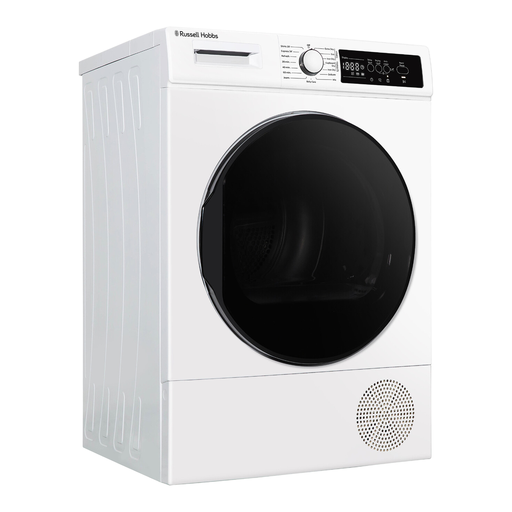
Russell Hobbs RH9HPTD1E12W 9kg heat-pump dryer
Consider this for regular shared loads if its programme instructions offer the temperature required by your tumble-safe sportswear.
9kg heat-pump dryer in white. Check the installation clearances, stated noise and product-specific energy information for your intended space.
Joybuy
 No image available
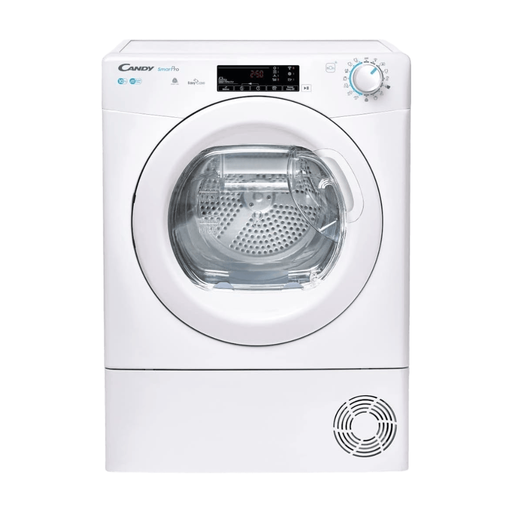
Candy Smart Pro CSOEC10TE-80 10kg condenser dryer
Consider this if a conventional condenser dryer suits the property and its programmes match the care labels on your sportswear.
10kg drum, B energy rating, sensor drying and Wi-Fi connectivity; white finish. Compare product-specific energy information and check the dimensions and stated noise before choosing a place for it.
Joybuy
Common questions
Can all sportswear go in a tumble dryer?
No. Tumble-dry a garment only if its care label permits it, and use the temperature or programme the label requires. A sportswear setting does not make an unsuitable garment safe to tumble-dry.
What drum capacity makes sense for a student house?
Choose capacity around the house’s usual combined loads, not an occasional large item. 8–9kg is generally described as a large household capacity for around three or four people, but you still need to check the available space and compare energy information for the models you are considering.
Does the dryer need an external vent?
A vented dryer needs a hose routed outside; a conventional condenser dryer does not need that hose. Follow the exact model’s installation instructions and confirm any permission needed for changes to a rented property.
How should housemates share dryer maintenance?
Agree a routine for clearing lint and fluff from the filter after every use, as West Yorkshire Fire and Rescue Service advises. Keep ventilation unobstructed and follow the model’s instructions for its other routine care.


