
24/7 Customer Support

Free returns

Same-day & Next-day Delivery

Quality Guaranteed

Unlock Your Welcome Offers: FREE Delivery | Up to 80% OFF | Free 30-day JoyPlus trial
Download the APP
A tumble dryer can save considerable time in a UK household, particularly during wet winters or when outdoor drying space is limited. However, choosing between condenser, heat pump and vented tumble dryers is not simply a matter of selecting the lowest price.
The wrong appliance may consume more electricity than expected, take up too much space or leave you with a drum that is too small for bedding and towels. Marketing language can also make basic functions sound more advanced than they are. This guide explains the key specifications to check before buying and matches different tumble dryers to common household needs.
An 8kg tumble dryer may suit a couple or medium-sized household, while 9kg tumble dryers and 10kg tumble dryers provide more room for family laundry and bulky items. Buying a drum that is too small can mean splitting loads, increasing drying time and making it harder for warm air to circulate.
A larger drum is not automatically more suitable, though. It also requires more floor space and may cost more to run if you regularly dry small loads. Match the dryer capacity with your typical washing-machine load and available installation space.
A lower purchase price may be attractive, but traditional condenser and vented tumble dryers generally use a different heating approach from heat pump models. Heat pump tumble dryers recycle warm air and dry at lower temperatures, while condenser and vented models typically use more direct heating.
Compare the stated energy class, annual energy consumption and likely usage pattern together. A model labelled A+++ or A++ may be worth considering for frequent use, but the purchase price, cycle duration and maintenance requirements also matter.
Smart tumble dryers and Wi-Fi tumble dryers can offer remote monitoring, app controls, extra programmes and notifications. These features may be useful for busy households, but they do not replace the fundamentals: suitable capacity, reliable moisture sensing, accessible filters and a practical water-tank position.
If you rarely use smartphone controls, a straightforward model with sensor drying and useful fabric programmes may provide better value for your routine.
Always check the manufacturer’s installation instructions, ventilation clearances, plug requirements and whether the door can open comfortably in your chosen location.
Standard freestanding models are commonly around 85cm high and 60cm wide, but depth varies. For example, compact tumble dryers can be far shallower, while 9kg and 10kg appliances may need approximately 58–61cm of depth, plus clearance for ventilation and door movement.
Measure:
For compact homes, a 2.5kg compact tumble dryer may suit small loads, student accommodation or a worktop installation. It will not be practical for frequent family-sized laundry.
Sensor dry tumble dryers measure moisture and can stop when the selected dryness level is reached. This may help reduce over-drying compared with relying only on a fixed timer. Look for selectable results such as iron dry, hanger dry, cupboard dry and extra dry.
Useful programmes include cottons, synthetics, delicates, wool, shirts, sportswear and refresh cycles. An anti-crease tumble dryer can continue gentle movement after the main cycle, helping reduce deep creases when laundry cannot be removed immediately.
Also check noise levels if the appliance will be near a bedroom or open-plan living area. The difference between approximately 60dB and 68dB may be noticeable during evening use.
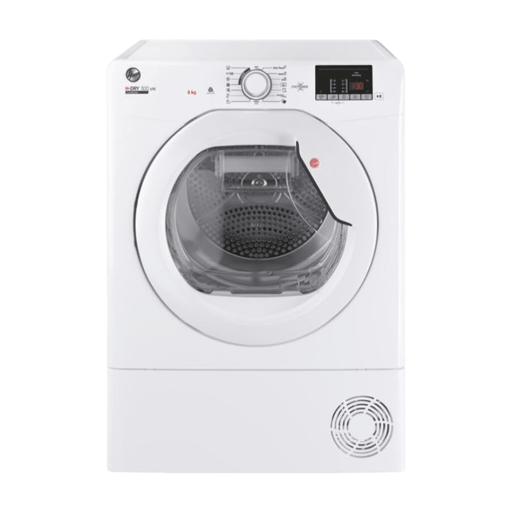
Why This Fits Their Persona: An 8kg condenser format suits couples, small families and renters who need flexible placement without an external vent hose.
It provides a clearly stated 8kg capacity, four dryness levels and a front-accessible water tank rather than relying on vague convenience claims.
Condenser installation; 12 programmes; 85 x 60 x 53cm dimensions.
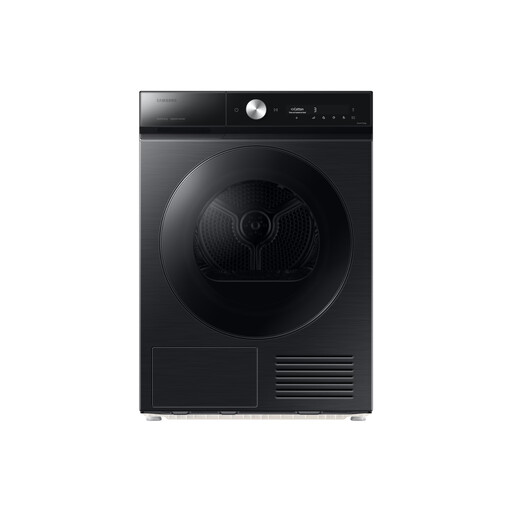
Why This Fits Their Persona: A 9kg drum, app connectivity and a 60dB stated noise level suit households wanting connected laundry management in an open-plan home.
Its product specifications identify heat pump technology, four dryness levels and SmartThings Wi-Fi instead of treating connectivity as a substitute for core drying controls.
A+++ energy class; 23 programmes; reversible door and Wi-Fi control.
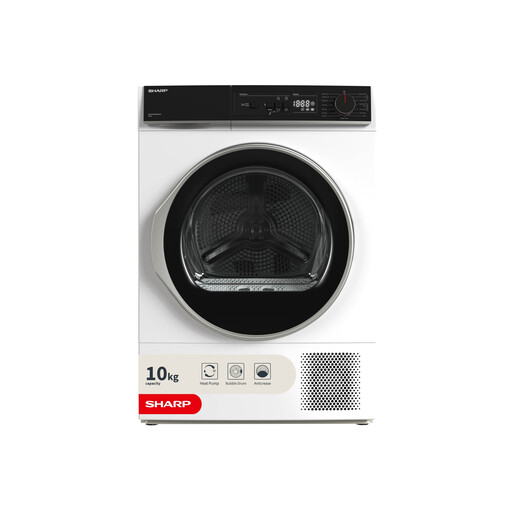
Why This Fits Their Persona: The 10kg drum is suited to larger households handling bedding, towels and substantial weekly laundry loads.
The capacity, 15 programmes and sensor drying are stated clearly, helping heavy users assess practical load handling rather than choosing on drum size alone.
A++ energy class; 64dB stated noise level; Express 34 and Shirts 20 programmes.
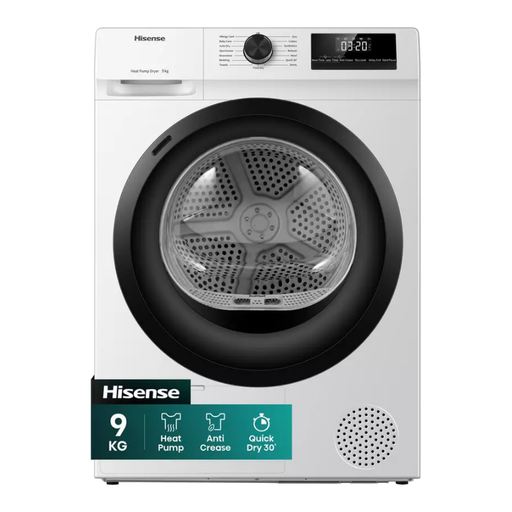
Why This Fits Their Persona: A 9kg heat pump dryer with anti-crease movement and 16 programmes fits busy families that cannot unload immediately after every cycle.
The anti-crease function is paired with three drying levels and a 24-hour delay, making the convenience claim easier to relate to everyday laundry routines.
A++ energy class; 64dB stated noise level; front water tank.
We have compiled a complete, real-time list of products that fully satisfy these strict selection criteria and UK safety regulations.
Before buying, confirm that the dryer can connect directly to a suitable wall socket. Avoid extension leads unless the manufacturer specifically permits them. Clean the lint filter after each cycle and empty the water tank when required. Heat pump models also need the heat exchanger and surrounding areas maintained according to the manual.
Never place garments contaminated with petrol, solvents, cooking oil or other flammable substances in a tumble dryer. Check pockets for matches and lighters, and follow garment-care labels. Do not obstruct vents or stop a cycle early without removing and spreading out warm laundry safely.
They are designed to use lower-temperature, recirculated air and may consume less electricity than some condenser or vented models. Actual running costs depend on the appliance’s energy consumption, load size, programme and electricity tariff. Compare the stated kWh figure rather than relying on the energy class alone.
Many families choose 9kg tumble dryers, while a 10kg model can be useful for frequent bedding, towels and larger wash loads. An 8kg dryer may be sufficient for a smaller family or for households that do laundry more frequently. Capacity should also be compatible with your washing machine and available space.
Lifespan depends on build quality, frequency of use, installation and maintenance. Cleaning the lint filter, emptying the tank and keeping airflow clear can support consistent operation. Check the manufacturer’s guarantee, parts coverage and service information before ordering, as these terms vary between models.