What matters when buying?
For bread fillings and savoury bakes, decide how much control the recipe needs over liquid and oil, then choose a tin size that fits your planned use.
| Concern | What to check | Who this matters to |
|---|
| Liquid and oil in the mixture |
Check the packing medium and whether the recipe specifies drained tuna. Compare nutrition figures on the same per 100 g basis. |
If I am making a filled roll or savoury bake, I want to decide how much liquid and oil goes into the mixture. About 44% of consumers put that recipe control first. |
| Preparation time and mess |
Look for an explicit no-drain claim and check the size of each tin. |
For a quick toastie or topping, I would rather assemble the meal without draining a conventional tin; avoiding that step is the main concern for about 33% of consumers. |
| Pack size and leftovers |
Check can size, labelled drained weight where relevant, and the instructions for storage after opening. |
When I plan several tuna meals, I need tins I can use within the label's stated period after opening. Matching the pack to planned portions comes first for about 23% of consumers. |
Joybuy tuna selections
These tins cover spring-water chunks for recipe-controlled fillings, a no-drain option for quick bread meals and sunflower-oil chunks for recipes that suit added oil.
 Image unavailable
Morrisons Fad Free Tuna Chunks in Spring Water, 6 x 145 g
For fillings where you intend to drain the tuna and manage the liquid yourself, this spring-water six-pack offers separate 145 g tins. Check the labelled drained weight if your recipe specifies an exact amount.
 Image unavailable
John West Tuna Chunks in Springwater, 4 x 125 g
For planned fillings or bread-based meals using spring-water tuna, this pack contains four 125 g tins. If the recipe gives a drained weight, check the amount on the can rather than using the tin size as the drained yield.
 Image unavailable
Morrisons Fad Free Tuna Chunks in Spring Water, 145 g
For a recipe or bread meal where a single tin is more useful than a multipack, this is a 145 g spring-water option. Check its drained weight if you need a measured amount for the filling.
 Image unavailable
John West No Drain Tuna Chunks in Springwater, 3 x 100 g
For a quick toastie or topping, the no-drain format avoids a draining step; the pack contains three 100 g tins. Check the recipe before using it where a measured drained amount or tightly controlled moisture is required.
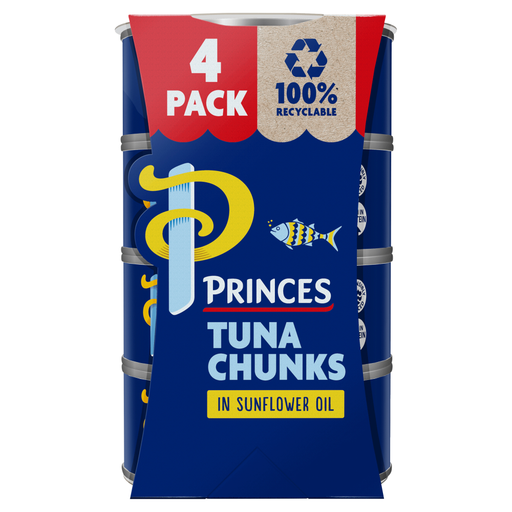 Image unavailable
Princes Tuna Chunks in Sunflower Oil, 4 x 145 g
For a filling or savoury bake whose recipe suits tuna packed in oil, this pack contains four 145 g tins. Sainsbury's lists 9.5 g fat per 100 g drained for the matching Princes product; account for the oil rather than substituting it directly for spring-water tuna.
Questions about using tinned tuna
Should I use tuna in spring water or oil for a bread filling?
Use spring-water tuna when the recipe calls for drained fish and you want to control additions to the filling. Choose oil-packed tuna when the recipe suits that oil; Sainsbury's lists 9.5 g fat per 100 g drained for the checked Princes sunflower-oil chunks, compared with the 1.0 g per 100 g drained listed by ASDA Groceries for the checked Asda spring-water chunks.
Do I need to drain tuna before using it with bread?
Follow the recipe's instructions for the intended texture and any specified drained weight. A topping may have different needs from a baked filling, while the John West No Drain product listed by ASDA Groceries is explicitly labelled ready to eat without a draining step.
How should I store tuna left in an opened tin?
Follow the particular can's label: the checked Asda and M&S products instruct you to transfer unused tuna to a non-metallic container, refrigerate and use it within two days; the checked Sainsbury's product specifies one day. Food Standards Scotland also advises checking food labels for the correct storage instructions.
Does pregnancy affect how much tinned tuna someone can eat?
Yes. The NHS advises people who are pregnant or trying for a baby to have no more than four cans of tuna a week or two tuna steaks a week because tuna contains more mercury than other fish. This guidance does not identify one of these brands as safer than another.
What should I check if fish is an allergen for my household?
Tuna is fish, and the checked tuna labels declare fish as an allergen. Read the label on the product you are buying, as ingredient and allergen information can change.


