Parents making school-holiday lunches
For sandwiches, wraps or pasta, consider how the tuna will mix with other ingredients. Check the packing medium and fish allergen on the tin; Princes suggests its canned tuna for children’s lunchtime sandwiches.


Choose tuna in organic olive oil if the organic ingredient matters to you: the Fish4Ever, Carmelo and Serrats product descriptions identify the oil as organic, not the tuna itself. Choose spring-water tuna if you would rather add your own sandwich ingredients without packing oil; in either case, check the individual product’s ingredients, fish allergen and sourcing claims.
For sandwiches, wraps or pasta, consider how the tuna will mix with other ingredients. Check the packing medium and fish allergen on the tin; Princes suggests its canned tuna for children’s lunchtime sandwiches.
Check whether “organic” describes the oil or the product more broadly. The cited Fish4Ever, Carmelo and Serrats listings identify organic olive oil. The Department for Environment, Food & Rural Affairs says products labelled organic must meet organic production rules.
Look at the claim for the exact tin or jar. Princes says its tuna is MSC certified, while Fish4Ever and Carmelo describe pole-and-line sourcing for the cited products; those statements do not establish the catch method of every tuna product.
Start with what the organic wording covers, then choose a packing medium and format that fit the lunch you plan to make.
| Priority | What to check | Your needs |
|---|---|---|
| Organic claim | Read the product name, ingredients and organic labelling. Establish whether the claim applies to the olive oil or to something else. | I want to know exactly which ingredient is organic, rather than assuming the tuna is. The cited Fish4Ever, Carmelo and Serrats listings identify organic olive oil. |
| Lunch format | Compare spring water with olive oil, and chunks with steaks or fillets. Check the ingredients if you plan to add mayonnaise or other fillings. | For a mixed sandwich filling, I may prefer to add the dressing myself. If I am serving the tuna more simply, oil-packed pieces may suit the recipe. |
| Sourcing | Look for an MSC mark or a stated catch method on the exact product. Check the named species if that matters to your choice. | I want sourcing details for the tin I am buying, not a claim carried over from another product in the range. |
| Fish meals | Keep tuna distinct from oily fish when using NHS fish guidance: the NHS says fresh and canned tuna do not count as oily fish. | If I am planning family fish meals around NHS guidance, I will not count a tuna lunch as an oily-fish meal. |
| Allergens | Read the full product label for fish and check any food rules that apply where the lunch will be served. | Before making lunch for a child, I need to account for anyone who must avoid fish. |
The cited Fish4Ever, Carmelo and Serrats product information identifies the packing oil as organic. That wording does not establish an organic claim for the fish.
Read the ingredients and the scope of any organic wording on the exact product. The Department for Environment, Food & Rural Affairs says products labelled organic must meet organic production rules.
The NHS says fresh and canned tuna do not count as oily fish, so a tuna sandwich does not fill that role in a meal plan based on NHS fish guidance.
If you are planning oily-fish meals, consider them separately from tuna lunches.
MSC labelling and stated catch methods are different kinds of information. The Princes brand statement and the cited Fish4Ever and Carmelo product descriptions should not be treated as interchangeable claims about every product.
Check the exact tin or jar for its MSC mark, species, catch-method wording and ingredients.
A particular tin or jar may not be available when you need it; the Serrats retailer listing, for example, showed its cited jar as sold out when recorded.
Check the current listing and pack size before planning a lunch around that product. If necessary, compare another option by its ingredients and sourcing claims.
Its cited 160g skipjack tuna steaks are packed in organic olive oil.
The cited tuna fillets offer an organic-oil option for lunches served with fewer added ingredients.
The cited Bonito del Norte, or albacore, jar is an alternative for shoppers comparing tuna species and organic-oil ingredients.
A tuna range to consider for family sandwiches when sourcing information matters more than an organic-oil ingredient.
Its cited MSC tuna chunks in spring water offer a water-packed option for mixed fillings.
This tuna-steak option suits a school-holiday lunch plan that calls for olive oil as the organic ingredient. Check the individual label if the precise scope of the organic claim matters to you.
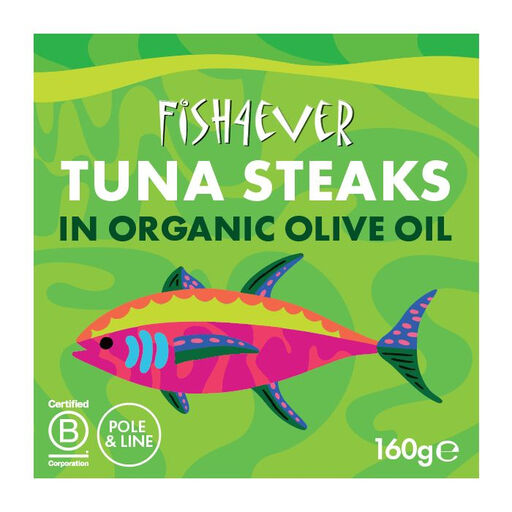 Image unavailable
For sandwiches or other lunches where you want tuna packed in olive oil, consider this 160g tuna-steak tin. The product name identifies the oil as organic; check the pack for the full ingredients, fish allergen and scope of its organic labelling.
No. The cited Fish4Ever, Carmelo and Serrats descriptions identify the olive oil as organic, not the tuna. Read the exact product’s ingredients and labelling; the Department for Environment, Food & Rural Affairs says products labelled organic must meet organic production rules.
Choose spring-water tuna if you prefer to add your own mayonnaise or other ingredients without packing oil. Choose tuna in organic olive oil if you want that oil in the filling and its organic ingredient claim matters to you; check the complete ingredients on either product.
No. The NHS says fresh and canned tuna do not count as oily fish. If you are planning fish meals around NHS guidance, account for oily fish separately.
Check the exact product for an MSC mark or a stated catch method. Princes says its tuna is MSC certified, while the cited Fish4Ever and Carmelo products describe pole-and-line sourcing; one statement should not be assumed to cover a different product.
Tuna is fish. Read the full label and account for anyone who must avoid fish, as well as any food rules that apply where the lunch will be served.