Choose tinned tuna in spring water when you want a ready-to-eat ingredient and its nutrition label fits your meal plan. Choose plain frozen tuna steaks when you want a cooked fillet and can store, thaw and cook it as directed; oil-packed tins are another option, but check the exact can’s energy values rather than assuming the formats are interchangeable. For weight management, the NHS emphasises an eating pattern that reduces calories and fits everyday life, not a single food.
Who these formats suit
The useful distinction is how the tuna fits your meals: a tin needs less preparation, while a frozen steak is intended for a cooked meal.
Quick-meal planners checking energy labels
If you regularly assemble lunches or light evening meals, compare the packing medium and the energy values on the exact tin. Princes Food and Drinks lists different values for its spring-water chunks and sunflower-oil sandwich tuna, so the word “tuna” alone does not settle the choice.
Home cooks who want a tuna fillet
A frozen steak suits a meal built around a cooked piece of fish, provided you have freezer space and time to follow the pack’s thawing and cooking instructions. Tesco and Asda list frozen tuna-steak products for this use.
Consumers who are pregnant or trying for a baby
The NHS gives weekly tuna limits for this group. Consider your tuna intake across tins and steaks when planning meals; the preparation format does not remove that consideration.
What to check before buying
Tuna in spring water
Choose when: You want ready-to-eat tuna chunks and the exact tin’s nutrition values suit the meal you are making.
Bear in mind: Check the drained weight and follow the pack’s instructions for storing any leftovers.
Tuna in sunflower oil
Choose when: You prefer the oil-packed format and have checked how that particular tin fits your meal.
Bear in mind: Princes Food and Drinks lists different energy values for its sunflower-oil sandwich tuna and spring-water chunks; that product-specific comparison does not apply to every tin.
Plain frozen tuna steaks
Choose when: You want a cooked fillet rather than ready-to-eat chunks and can plan its preparation.
Bear in mind: Frozen steaks need freezer storage and cooking; check whether their nutrition values refer to the product before or after cooking.
For tinned tuna and frozen steaks used in weight-management meals, identify the need that matters most to you, then check the corresponding product label and handling instructions.
| Concern |
What to check |
Who this matters to |
| Energy and protein |
Compare energy and protein on the same label basis, such as per 100 g drained for tins. Princes Food and Drinks lists 99 kcal and 23.5 g protein for its spring-water chunks, against 224 kcal and 20.0 g protein for its sunflower-oil sandwich tuna, both per 100 g drained. |
If I am planning a meal around its energy value, I need to know what the tuna contributes without treating one product as representative of every tin. About 33% of consumers would put that label comparison first. |
| Usable quantity |
Check drained weight, pack size and how much you will use before the opened product needs storing. |
For repeat meals, I want a pack size that matches the portions I will actually prepare, rather than leaving tuna unused. This is the main concern for about 27% of consumers. |
| Preparation time |
Check whether the tin needs draining and read its opened-storage instructions. |
When I have little time to prepare lunch, ready-to-eat tuna matters more to me than a fillet that needs cooking. About 20% of consumers would prioritise that convenience. |
| Cooked-fillet meals |
Check freezer and cooking instructions, and whether nutrition is stated for cooked or uncooked fish. Tesco instructs buyers not to refreeze its tuna steaks after thawing. |
If I want tuna as a cooked fillet, I need a format I can store and prepare as directed. That is the primary need for about 20% of consumers. |
Common buying mistakes
-
Treating every tuna tin as nutritionally alike
Packing medium and product recipe matter. Princes Food and Drinks lists 99 kcal per 100 g drained for its spring-water chunks and 224 kcal per 100 g drained for its sunflower-oil sandwich tuna; those figures describe two specific products.
Compare the exact cans’ energy, protein, salt and drained-weight information before deciding which fits your meal.
-
Counting tuna as your oily-fish choice
The NHS says fresh and canned tuna do not count as oily fish. Choosing tuna does not, by itself, cover the oily-fish part of its general fish guidance.
If you are planning fish meals, consider tuna separately from an oily-fish choice.
-
Buying frozen steaks as though they were ready to eat
A frozen tuna steak needs storage and cooking, unlike ready-to-eat tinned chunks. Cooked-steak and drained-tin nutrition values also use different preparation bases.
Choose steaks for meals you can prepare according to the pack, and check the basis before comparing nutrition panels.
-
Overlooking tuna limits during pregnancy
The NHS advises people who are pregnant or trying for a baby not to eat more than 4 cans of tuna or 2 tuna steaks a week.
Take account of both tinned tuna and steaks when planning your week, and consult the NHS guidance rather than assuming a change of format removes the limit.
Relevant brands for reference
These examples help distinguish product formats and labels; a brand name alone does not determine the nutrition or handling instructions of every variant.
John West
John West offers tinned-tuna formats including No Drain Tuna Chunks in Springwater, as listed by Tesco.
- A no-drain format may suit meals where you want fewer preparation steps.
- Check the exact can’s edible quantity and nutrition basis before comparing it with a conventional drained tin.
Princes
Princes Food and Drinks lists both tuna chunks in spring water and sandwich tuna in sunflower oil.
- Its product labels give a like-for-like drained basis: 99 kcal and 23.5 g protein per 100 g for the spring-water chunks, and 224 kcal and 20.0 g protein for the cited oil-packed sandwich tuna.
- These values belong to those variants, not every Princes tuna product.
Tesco
Tesco lists both tinned tuna in spring water and frozen yellowfin tuna steaks, covering ready-to-eat chunks and fillets intended for cooking.
- The two formats offer different ways to plan a tuna meal.
- Check the current label and preparation basis; drained tinned values should not be read as directly equivalent to cooked-steak values.
Asda
Asda lists a plain frozen yellowfin tuna-steak product for cooked-fillet meals.
- Asda states 151 kcal and 32 g protein per 100 g pan-fried for its 280 g two-steak product.
- It needs cooking; its pan-fried nutrition basis differs from the drained basis used on the cited tins.
M&S
M&S lists a 160 g tin of tuna chunks in spring water.
- The M&S label lists 99 kcal, 23.5 g protein and 0.75 g salt per 100 g.
- Check the current pack label. For this product, M&S instructs buyers to refrigerate unused contents in a non-metallic container and eat them within 2 days.
Tinned tuna selections on Joybuy
These tins cover spring-water chunks, a no-drain spring-water format and sunflower-oil chunks for ready-to-eat meals. If you want a cooked frozen fillet instead, use the storage, cooking and nutrition-basis checks above when choosing a steak.
 No image available
Morrisons Fad Free Tuna Chunks in Spring Water, 6 × 145 g
Consider the six-tin pack if you use spring-water tuna for several ready-to-eat meals. Check the drained quantity on the cans when planning portions, and follow their instructions for storing any opened tuna.
View on Joybuy
 No image available
John West Tuna Chunks in Springwater, 4 × 125 g
This four-tin spring-water pack suits meals where you want ready-to-eat tuna chunks. Use the current label’s drained quantity and nutrition basis when comparing it with another pack.
View on Joybuy
 No image available
Morrisons Fad Free Tuna Chunks in Spring Water, 145 g
A single spring-water tin may fit a meal planned around one can rather than a multipack. Check its drained quantity for the portion you intend to use and follow the pack’s opened-storage guidance.
View on Joybuy
 No image available
John West No Drain Tuna Chunks in Springwater, 3 × 100 g
The no-drain format may appeal when you want to open a tin without a draining step. Check the current label’s nutrition basis before comparing its per-100 g values with those of drained tuna.
View on Joybuy
 No image available
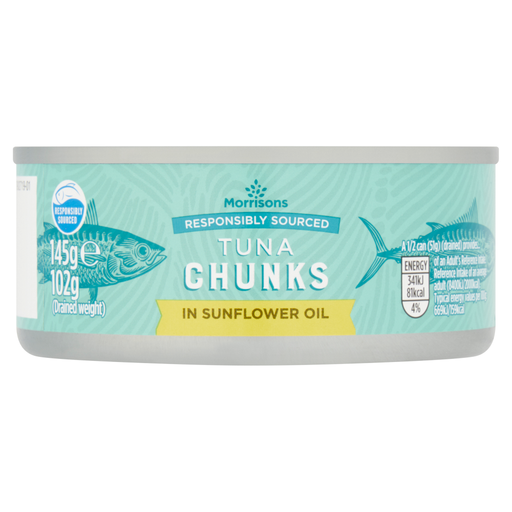
Morrisons Fad Free Tuna Chunks in Sunflower Oil, 145 g
Choose this format if you prefer tuna packed in sunflower oil and its label fits the meal you are planning. Compare energy using the same drained-weight basis as any spring-water tin you are considering.
View on Joybuy
Questions about choosing tuna
Should I choose tuna in spring water instead of tuna in oil?
Choose by the exact product label and the meal you are making. Princes Food and Drinks lists 99 kcal per 100 g drained for its spring-water chunks and 224 kcal per 100 g drained for its sunflower-oil sandwich tuna, but that difference is specific to those products; an oil-packed tin can still be considered within your overall meal plan.
Does tuna count towards the NHS oily-fish recommendation?
No. The NHS says fresh and canned tuna do not count as oily fish. Its general fish guidance recommends at least two portions of fish a week, including one portion of oily fish.
How much tuna can I have if I am pregnant or trying for a baby?
The NHS advises no more than 4 cans of tuna or 2 tuna steaks a week for people who are pregnant or trying for a baby. Take both formats into account when planning tuna meals; consult the NHS guidance if you eat a mixture of tins and steaks.
How do I handle leftover tinned tuna or thawed tuna steaks?
Follow the instructions on the individual product. M&S says to transfer unused contents of its spring-water tuna tin to a non-metallic container, refrigerate them and eat them within 2 days. Tesco says not to refreeze its frozen tuna steaks once thawed.


