For general care-home recipes, compare tinned tuna in spring water, brine and oil against the meal plan and the product label: Princes’ listed spring-water example has less energy than its sunflower-oil example, but that does not make either suitable for every resident. Before choosing frozen fillets instead, establish the required portion, storage, cooking and final texture; a description such as “soft” cannot establish suitability for someone with a prescribed texture level.
Who is choosing the tuna?
Care-menu planners
Planners choosing tuna for meals served to several residents need to consider the complete recipe alongside individual nutrition plans. Princes’ product information shows why the packing medium and per-100 g drained values are worth comparing.
Texture-modified-diet catering teams
For residents with an assessed swallowing need, the relevant question is whether the finished meal meets the prescribed texture level. South Tees Hospitals NHS Foundation Trust advises that modified-texture diets follow assessment; a tin or fillet description is not a substitute.
Kitchen and procurement teams
Teams ordering for routine service can compare pack configuration and preparation steps. John West describes a no-drain format, while Tesco lists several can sizes; neither detail alone establishes how a product will fit a particular kitchen’s service routine.
What matters when buying?
Settle each resident’s prescribed texture and nutrition requirements before choosing a packing medium, then check how the pack will work in the kitchen.
| Concern |
What to check |
Who this matters to |
| Prescribed texture |
Check the resident’s care plan and prescribed IDDSI level; assess the finished dish, not the fish format alone. |
If a resident needs modified-texture food, I need the served meal to match their assessed requirement. About 36% of consumers put prescribed texture first. |
| Nutrition and salt |
Compare energy, protein, fat and salt on the delivered label using the same per-100 g basis, and consider the complete recipe. |
When planning a resident’s meal, I need the tuna’s contribution to fit their individual nutrition plan. Approximately 29% of consumers make nutrition their primary concern. |
| Kitchen handling |
Confirm can count, usable quantity, opening method and whether the chosen format needs draining. |
For meals prepared in batches, I need a pack that fits the kitchen’s portioning routine. Around 21% of consumers prioritise handling. |
| Specification consistency |
Check the current supplier specification, pack configuration, ingredients and fish-allergen declaration against the delivered product. |
For repeat orders, I need the product received to match the menu specification. About 14% of consumers put that consistency first. |
Buying pitfalls
-
Assuming “soft” means suitable for dysphagia
NHS England has reported harm associated with imprecise texture terms. Ordinary tuna chunks and frozen fillets do not establish the texture of the finished meal.
Follow the resident’s prescribed IDDSI level and the service’s method for assessing the prepared food.
-
Choosing a packing medium by a general label
Princes lists 99 kcal per 100 g drained for its spring-water chunks and 180 kcal for its sunflower-oil chunks. The difference matters only in the context of the resident’s nutritional plan and the full recipe.
Compare the delivered pack’s nutrition values on a like-for-like basis before setting a menu specification.
-
Treating a retailer listing as the kitchen specification
Tesco lists tuna in different can and multipack formats, which may result in different usable quantities and handling requirements.
Confirm the current pack configuration and product specification with the supplier before ordering for routine service.
-
Treating frozen fillets as interchangeable with tinned chunks
A decision between these formats must account for the intended portion and how the fish will be stored, cooked and prepared for service. Neither format establishes that a finished dish meets a resident’s texture requirement.
Specify those requirements before deciding whether frozen fillets fit the menu better than tinned tuna.
Brands to consider for reference
Princes
Its tuna chunks in spring water, brine and sunflower oil provide examples for comparing packing media within one range.
- Princes lists 23.5 g protein per 100 g drained for all three examples; its listed salt values are 0.85 g for spring water and 0.9 g for brine and sunflower oil.
- Those product values do not establish whether a prepared meal meets an individual resident’s nutrition or texture plan.
John West
Its No Drain Tuna Chunks in Spring Water offer a format to consider where draining is a kitchen step.
- John West describes a twist-and-pull opening and lists tuna, spring water and salt as ingredients.
- The no-drain description does not establish a labour or waste saving for a particular care-home kitchen.
Tesco
Its grocery listing provides a reference for comparing tuna chunks in spring water across can and multipack formats.
- The Tesco listing includes own-label 145 g and 400 g formats alongside other brands.
- Confirm the specification of the product actually supplied before using it in a resident’s menu plan.
Tinned tuna options on Joybuy
These tinned-tuna packs offer spring-water and sunflower-oil choices for care-home menu planning. Check each delivered label and the finished meal against the relevant resident plan before use.
 Image unavailable
John West No Drain Tuna Chunks in Springwater, 3 × 100 g
Consider this spring-water pack where the kitchen wants to assess a no-drain format for its recipes. It contains three 100 g cans; check the fish-allergen declaration and assess the final dish against any prescribed texture level.
View on Joybuy
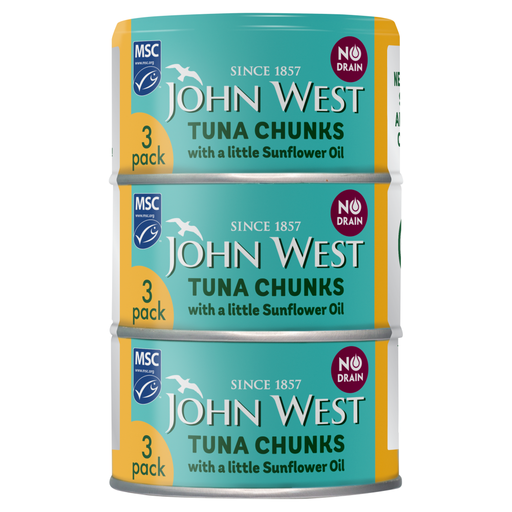 Image unavailable
John West No Drain Tuna Chunks in Sunflower Oil, 3 × 100 g
Consider this oil-packed format only where it fits the intended menu or resident’s nutrition plan and a no-drain pack suits kitchen preparation. The pack contains three 100 g cans; check its label and the texture of the finished meal.
View on Joybuy
 Image unavailable
John West Tuna Chunks in Sunflower Oil, 4 × 125 g
This four-can oil-packed option needs to be assessed against the complete recipe and individual nutrition plan. The product information warns that some bones may remain; follow the kitchen’s preparation procedures and assess any prescribed final texture.
View on Joybuy
 Image unavailable
Morrisons Fad Free Tuna Chunks in Spring Water, 6 × 145 g
This six-can spring-water pack is an option when its configuration fits planned kitchen use. Check the delivered nutrition and fish-allergen information, and assess the prepared meal against each relevant resident plan.
View on Joybuy
Frequently asked questions
Can ordinary tinned tuna be served on a texture-modified diet?
Only if the finished dish meets the resident’s assessed requirement. South Tees Hospitals NHS Foundation Trust advises that modified-texture diets follow assessment, while NHS England warns against relying on imprecise descriptions such as “soft diet”. Check the prescribed IDDSI level and assess the prepared meal.
Should spring-water tuna always be the care-home choice?
No. Princes lists 99 kcal per 100 g drained for its spring-water chunks, compared with 180 kcal for its sunflower-oil chunks, but the appropriate choice depends on the resident’s nutrition plan and the complete recipe. Compare the actual product labels rather than applying one packing-medium rule to every meal.
How should a kitchen handle fish-allergen information?
Check the delivered tuna label and keep the recipe’s fish-allergen information clear for service. Food Standards Agency research describes written menus, labels and allergen matrices as ways to communicate allergens in out-of-home food settings; the kitchen must also check each resident’s allergy record.
Does the residential-care-home food-safety supplement cover nursing homes?
No. GOV.UK states that its Safer food, better business supplement for residential care homes is not intended for nursing homes, which require other food-safety procedures. Confirm the provider type and the procedures applicable to that service before using the supplement.


