Choose an instant-read food probe if you can check the centre of the turkey joint near the end of cooking; choose a leave-in probe with an alarm if you need to monitor it while attending to other tasks. In a shared kitchen, whichever format you choose must also be practical to clean after use and store away from contaminated utensils.
Who needs which thermometer?
Shared-kitchen cooks focused on hygiene
If several people use the same drawers and worktops, choose a probe you can clean fully after contact with poultry and put away without mixing it with used utensils. GOV.UK advises cleaning a cooking thermometer after every use to avoid cross-contamination.
Cooks managing several dishes
If you need to prepare sides or coordinate oven use while the joint cooks, a leave-in probe can monitor the food without repeated manual checks. ETI describes its DOT thermometer as having a probe that remains in the food during cooking.
Occasional turkey-joint cooks
If you can return to the oven for a manual centre-temperature check near the end of cooking, an instant-read food probe may be enough. Check that its display and stated temperature range suit the cooking instructions you will follow.
What matters when choosing?
Decide whether you can take a manual reading or need continuous monitoring, then assess how you will clean and store the probe in the shared kitchen.
| Concern |
What to check |
Who this matters to |
| Centre-temperature checking |
Choose a food penetration probe with a readable Celsius display and a stated range covering the cooking temperature you need to check. |
If I need to confirm that the middle of the joint is cooked, a surface reading will not answer the question; around 42% of consumers put centre-temperature checking first. |
| Cleaning and storage |
Check the cleaning instructions and whether the probe folds away or has a cover; confirm any water-resistance rating for the exact model. |
When I share drawers and worktops, I want to clean the probe fully and keep it apart from used utensils; shared-kitchen hygiene comes first for around 33% of consumers. |
| Roast monitoring |
For manual checks, compare the stated response time and display. For continuous monitoring, look for a leave-in food probe and an audible alarm. |
If I am preparing other dishes or coordinating oven time, I want a way to follow the roast without repeated checks; around 25% of consumers prioritise monitoring that suits their cooking routine. |
Mistakes to avoid
-
Taking a reading at the surface
A shallow reading does not establish the temperature at the centre. Safefood identifies the centre as the thickest part of a turkey crown or boned-and-rolled joint.
Insert a clean food probe into the centre of the joint rather than relying on the oven setting or an outside reading.
-
Putting a used probe straight back in a shared drawer
A probe that has touched poultry can transfer contamination to other kitchen items. GOV.UK advises fully cleaning a cooking thermometer after each use.
Clean the probe and any parts that touched food, dry them and store the thermometer away from unclean utensils.
-
Assuming all digital probes have the same protection
Speed, stated accuracy and water resistance vary by model. ETI lists a one-second response and IP67 protection for Thermapen ONE; those specifications do not describe every digital food probe.
Compare the exact model’s stated response time, accuracy tolerance and cleaning instructions if those features matter to you.
-
Choosing a format that does not fit the cooking routine
An instant-read probe requires someone to take the reading, while a leave-in probe remains in the food during cooking. An alarm does not remove the need to check that the probe is positioned correctly.
Choose an instant-read model for supervised checks near the end of cooking, or a leave-in alarm model when you need ongoing monitoring.
Brands to consider for turkey-joint checks
ETI / Thermapen
ETI offers instant-read, leave-in alarm and catering-style food probes, so the useful distinction is the format and specification of the individual model.
- ETI specifies a one-second response, ±0.3°C accuracy and IP67 protection for Thermapen ONE. Its DOT model uses a probe that remains in food during cooking.
- Thermapen ONE still requires a manual check; its specifications should not be assumed to apply to other ETI models.
Salter
Salter has both manual probe and leave-in digital thermometer options for home cooking.
- Salter specifies a 180 mm probe for its Precision Meat Thermometer. Its Leave-In Digital Kitchen Thermometer provides monitoring and an alarm.
- Check the specifications of the particular model if response time, accuracy tolerance or water resistance will affect your choice.
Taylor Pro
The Taylor Pro Digital Meat Thermometer Probe is a manual-check option with a reading-hold function.
- Lakeland lists a protective cover that also serves as an extended handle, allowing the reading to be held after the probe is moved away from the oven.
- If speed, numeric accuracy tolerance or water resistance is important, confirm those details for this model before choosing it.
Joybuy product choices
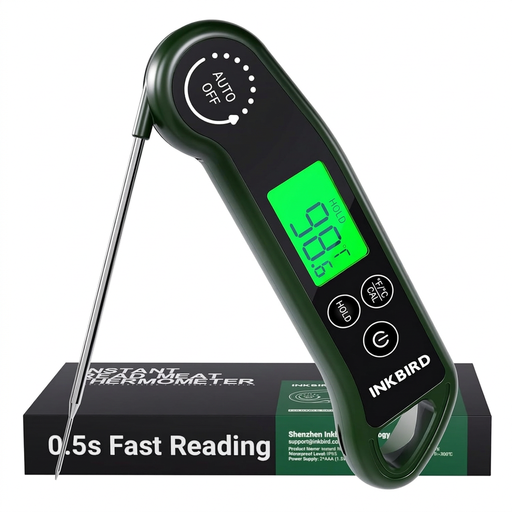
This instant-read food thermometer is relevant if you plan to check the turkey joint manually. Before using it for that purpose, confirm that its temperature range, display units and cleaning instructions suit your cooking and shared-storage routine.
 No image available
INKBIRD RHT-11K K-Sensor digital meat thermometer, green
For a cook who can take a manual reading during a roast, this model has an LCD screen. Its product title claims a 0.5-second reading; check its displayed units, temperature range and cleaning instructions before using it to assess a turkey joint in a shared kitchen.
View on Joybuy
Common questions
What temperature should I check at the centre of a turkey joint?
GOV.UK food-hygiene guidance for businesses advises a core temperature of 70°C for two minutes. Use a food probe to check the centre rather than relying on the oven setting, and follow any more specific cooking instructions on the joint’s packaging.
Where should the probe go in a turkey crown or boned-and-rolled joint?
Insert a clean probe into the centre of the joint. Safefood identifies that as the thickest part of a turkey crown or boned-and-rolled joint; a surface reading does not establish the centre temperature.
How should I handle a probe used in a shared kitchen?
Fully clean it after every use to avoid cross-contamination, as GOV.UK advises. Clean any cover or handle that has touched food, then dry and store the thermometer away from unclean shared utensils.
Do I need a leave-in alarm thermometer?
Choose a leave-in alarm model if you want to monitor the joint while doing other tasks; an instant-read probe suits manual checks when you can return to the oven. ETI describes its DOT probe as remaining in food during cooking, whereas an instant-read model must be inserted when you take each reading.


