Focused classical-album listener
You sit down for complete works and are comfortable cueing a manual deck. The turntable, its support and the rest of your hi-fi system matter more to your choice than reducing handling.


If your office speakers or amplifier accept only a line-level input, choose a turntable with a suitable built-in phono stage or plan for a separate one. A manual deck suits listeners comfortable cueing records and checking the rest of their hi-fi system; if work interruptions make handling difficult, consider automatic operation instead. In either case, check desk stability, available space and the speeds your records require.
You sit down for complete works and are comfortable cueing a manual deck. The turntable, its support and the rest of your hi-fi system matter more to your choice than reducing handling.
You use powered speakers or an amplifier without a PHONO input and want to establish a suitable connection without automatically adding a separate phono preamplifier.
You play records around work interruptions and would value automatic tonearm operation or a wireless connection, provided the turntable supports the speeds in your collection.
For classical LPs in a home office, establish how the turntable will connect to your existing audio system, then decide how much manual handling and desk space you can accommodate.
| Concern | Buying checks | Who this matters to |
|---|---|---|
| Attentive manual playback | Check the supported speeds, speed-selection method and whether you are comfortable cueing the tonearm yourself. | When I sit down for a complete work, I want to control how playback begins and ends. Around 31% of consumers put attentive manual listening first. |
| Connection to existing equipment | Identify your speaker or amplifier input and check whether the turntable needs a separate phono stage. | With powered speakers or no PHONO input, I want a suitable connection without adding equipment unnecessarily; roughly 25% of consumers prioritise connection simplicity. |
| Handling around interruptions | Check whether operation is fully automatic or only lifts the tonearm at the end of a side. | If work regularly pulls me away from a record, I would rather handle the tonearm less. About 19% of consumers place automatic convenience first. |
| Desk and record fit | Measure the support surface and lid clearance; check for 78 rpm only if your records require it. | My office furniture needs to hold the deck securely, and its speeds must match my collection; around 25% of consumers make placement and collection fit their primary concern. |
A cartridge signal cannot necessarily feed a standard line input directly. A built-in phono stage can simplify the connection, but it still has to match the inputs on your speakers or amplifier.
Note the inputs on your existing equipment, then compare them with the turntable’s documented outputs and phono-stage controls.
An incompatible setup may require a separate phono preamplifier, suitable cables or different amplification.
Dimensions, weight and surface stability affect where a turntable can be placed. Technics specifies the SL-1500C at 453 × 169 × 372 mm and approximately 9.9 kg; construction features on another model do not make an unstable desk suitable.
Measure the usable surface, allow room for the lid and cables, and choose a level, stable position away from avoidable vibration.
Automatic operation changes how much handling playback requires; it does not, by itself, establish how one turntable will sound compared with a manual model.
Choose the operating style that fits your interruptions, then compare documented speeds, connections and setup requirements.
GOV.UK says customers buying online can cancel within 14 days of receiving an item even when it is not faulty. A change-of-mind cancellation is separate from seeking a remedy for faulty or misdescribed goods.
Keep your order and delivery records, check the retailer’s return process, and contact the seller promptly if the turntable arrives with a fault.
Rega’s Planar 1 and Planar 1 Plus illustrate straightforward manual belt-drive choices with different connection arrangements.
The manual Debut Carbon EVO is relevant if you want to consider its specified platter, tonearm and speed-selection features.
The AT-LP70XBT is an option to examine when automatic operation and flexible office-system connections matter.
The manual direct-drive SL-1500C is relevant if your collection or system calls for its specified speeds and outputs.
These Sony turntables offer Bluetooth and automatic playback for listeners who want less handling around office work. Check the connection to your own audio equipment and the space available on your desk before choosing.
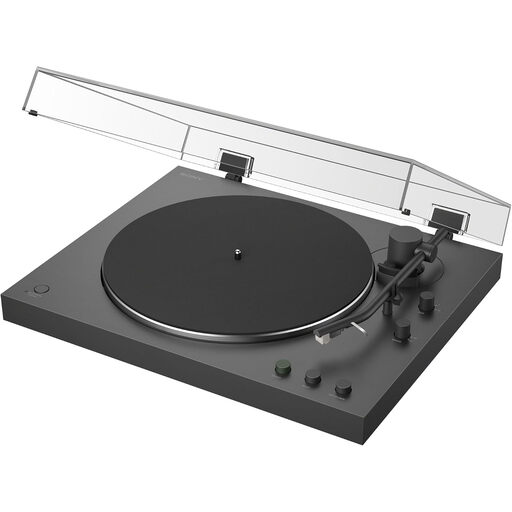 No image available
Consider this model if automatic playback would make listening around work interruptions easier. Bluetooth is specified in its product name; confirm compatibility with your receiving device and allow room for the deck, lid and cables.
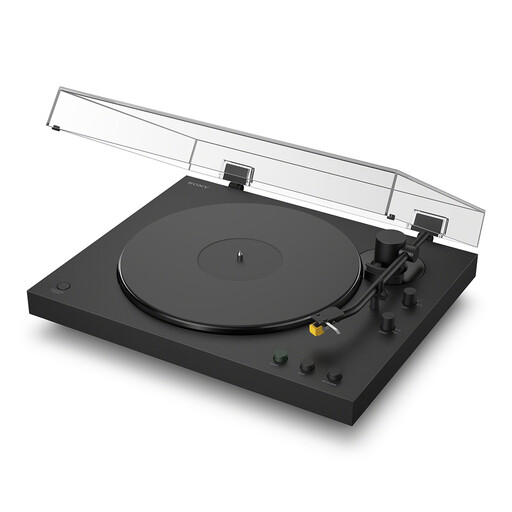 No image available
Consider this model if you want automatic playback and a Bluetooth option in your office. Before using a wired connection, confirm its connector matches your equipment; also check the deck’s dimensions, lid clearance and the stability of its support.
You need a suitable phono stage somewhere in the connection path, but it need not be a separate unit. Check whether the turntable has one built in and whether your amplifier offers a PHONO input or your powered speakers require a line-level signal.
Fully automatic operation is worth considering if interruptions make reduced tonearm handling important. It is a convenience choice rather than a sound-quality verdict; a manual deck remains an option if you prefer to cue records yourself.
Standard 33⅓ rpm classical LPs do not require 78 rpm playback. If you also own records that require 78 rpm, check that capability separately: Technics specifies it for the SL-1500C, while Audio-Technica specifies 33⅓ and 45 rpm for the AT-LP70XBT.
GOV.UK says online customers can cancel within 14 days of receiving an item even if it is not faulty. Check the retailer’s process and handle the turntable carefully while deciding; a fault or misdescription is a separate reason to seek a remedy.