For quiet folk-LP listening, choose a turntable that connects correctly to your speakers or amplifier before deciding which playback features you want. A built-in phono preamp can serve a line-level input, while a standard phono-output deck needs an appropriate phono stage. Automatic operation reduces routine handling, but your amplifier, powered speakers or headphone system controls the final listening level.
Who these choices suit
Quiet listeners using powered speakers or headphones
If your equipment lacks a PHONO input, establish how the turntable will provide a line-level signal. Check the connection to your actual speakers or headphone setup rather than assuming a turntable connects directly to headphones.
Listeners who prefer less handling
If you would rather not cue and return the tonearm for each side, look at the exact model's automatic functions. Audio-Technica describes its AT-LP60X as fully automatic; other turntables may require manual cueing.
Hi-fi owners with an existing amplifier
Check whether your amplifier has a suitable PHONO input or only line-level inputs. Rega's Planar 1 instructions call for an appropriate phono stage, whereas the Planar 1 Plus has an integrated stage intended for a line-level input.
What matters when choosing
Start with the input on the equipment you already use. Then decide how much record handling you want and whether any additional connection or playback features serve a specific purpose.
| Concern | What to check | Who this matters to |
|---|
| Phono-stage and input matching |
Identify whether your speakers or amplifier take a PHONO or line-level input, then check the turntable's output mode or the need for a separate phono stage. |
If my powered speakers have only a line input, I need a suitable signal path before I can play a record through them; around 40% of consumers would put connection matching first. |
| Playback and handling |
Check whether the exact model is fully automatic or needs manual cueing, and what its initial setup involves. |
When I put on an LP for a relaxed listening session, I may prefer not to cue and return the arm myself; roughly 30% of consumers would make low-handling playback their primary concern. |
| Features for later use |
Check stylus compatibility and choose Bluetooth, USB or 78 RPM capability only if you have a use for it. |
If I expect to add wireless listening or play other record formats, I want those plans to shape my choice; around 30% of consumers would prioritise future flexibility. |
Buying pitfalls
-
Choosing a phono-output deck for line-only speakers
A standard phono-output turntable needs an appropriate phono stage before its signal reaches a line-level speaker input. Rega specifies this connection for the standard Planar 1.
Read the input labels on your equipment and check whether the exact turntable has a usable built-in preamp or needs a separate one.
A separate phono stage also adds a connection step.
-
Treating Bluetooth as the answer to quiet listening
Bluetooth provides a connection option on models that include it; it does not establish how a particular speaker or headphone system will perform at low volume.
Confirm the complete connection path and where you will control volume before choosing Bluetooth for convenience.
-
Overlooking stylus compatibility and care
A replacement stylus must suit the fitted cartridge. Audio-Technica gives a model-specific service-life range for its ATN3600LC replacement stylus, not a figure that applies to every turntable.
Note the fitted cartridge and stylus model, follow its maker's cleaning guidance and confirm compatibility before selecting a replacement.
Brands to consider
Audio-Technica
Its AT-LP60X and AT-LP70XBT are relevant if you want automatic playback and a built-in switchable phono preamp.
- Audio-Technica lists Bluetooth on the AT-LP70XBT and a VM95-series stylus-upgrade path for that model.
- Check the exact model: Bluetooth and other connection features do not apply across every Audio-Technica turntable.
Rega
The manual Planar 1 and Planar 1 Plus offer different routes for an existing hi-fi system: a separate phono-stage connection or an integrated stage.
- Rega specifies a factory-fitted Carbon moving-magnet cartridge for the Planar 1 and an integrated moving-magnet phono stage for the Plus.
- A Rega-hosted Hi-Fi Choice group test describes the Planar 1 Plus as fully manual, so it requires cueing rather than automatic operation.
Pro-Ject
The E1 range is worth checking by variant if you want to choose your phono connection before deciding whether Bluetooth is useful.
- Pro-Ject identifies an internal preamp on the E1 Phono and both a preamp and Bluetooth transmission on the E1 BT.
- Do not assume the standard E1 has the E1 Phono's internal preamp; confirm the full variant name.
Joybuy turntables for this setup
These Sony automatic-playback models are options to consider if you want less routine handling and Bluetooth. Check each model's output against your speakers or amplifier; neither model name establishes its sound quality at low volume.
 No image available
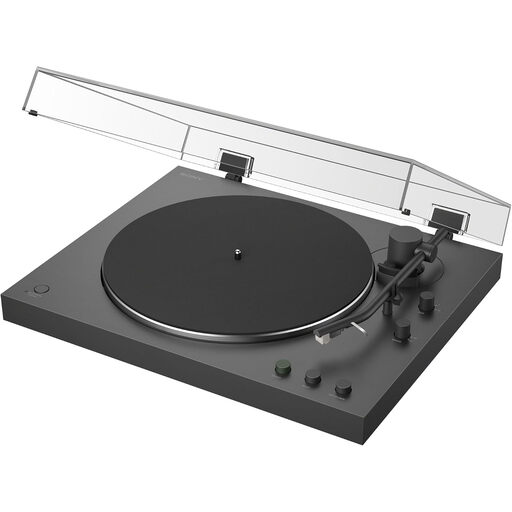
Sony PS-LX3BT Bluetooth Automatic Turntable
Consider this model if you want automatic playback for your folk LPs. Bluetooth is listed in its name; before connecting wired speakers or an amplifier, confirm the available output mode and match it to the equipment's input.
Joybuy
 No image available
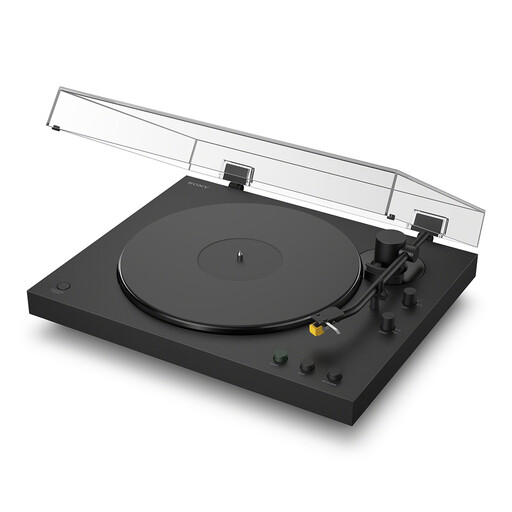
Sony PS-LX5BT Bluetooth Automatic Turntable
Consider this model if automatic playback and Bluetooth match how you plan to listen. If your amplifier has a PHONO input, confirm whether this model offers an appropriate output mode before connecting it.
Joybuy
Common questions
Do I need a phono preamp with powered speakers?
You need a suitable phono stage if the powered speakers accept only a line-level input. A turntable with a built-in phono preamp can provide that route; check its output setting and the speaker input before connecting them.
Is an automatic turntable necessary for folk LPs?
No: automatic operation is a handling preference, not a requirement of folk records or quiet playback. Audio-Technica's AT-LP60X is fully automatic, whereas a Rega-hosted Hi-Fi Choice group test describes the Planar 1 Plus as a manual deck that requires cueing.
How should I plan for stylus care and replacement?
Keep the fitted stylus model recorded and use a replacement confirmed for its cartridge. Follow the manufacturer's record and stylus cleaning guidance; Audio-Technica's approximate 300–500-hour figure applies to its ATN3600LC replacement stylus, not automatically to other stylus models.


