Choose a turntable that plays at 45 RPM and works with your speakers: a built-in phono preamp can feed an appropriate line-level input, while a conventional phono-output deck needs a phono stage in the system. An automatic model reduces handling during short office listening sessions; a manual deck asks more of you. Check your singles’ centre holes too, as large-hole records need a compatible adaptor.
Who these setups suit
Listeners who want simple 45 RPM playback
If you want to play a single between tasks without building a separate hi-fi system, consider an automatic turntable with a built-in phono preamp. Audio-Technica’s AT-LP60X is one such model; its line-level output still needs a suitable speaker or amplifier input.
Powered-speaker users without a phono input
Your first decision is how the turntable will connect. Pro-Ject presents the E1 Phono, which has an internal phono preamp, for systems without one; its E1 BT variant also adds Bluetooth transmission. Check the inputs or wireless capabilities of the equipment you intend to use.
Listeners building a separates system
If you are happy to cue records manually and have an appropriate phono stage, a deck such as Rega’s Planar 1 fits that approach. Rega’s instructions call for a phono stage and explain that changing between 33⅓ and 45 RPM means moving the belt between pulley steps.
What to check before buying
For jazz singles, establish 45 RPM playback and any adaptor need first. Then match the turntable to your speakers and decide how much hands-on operation you want.
| Concern | What to check | Who this matters to |
|---|
| Single playback |
Confirm 45 RPM support on the exact model. Inspect your records for large centre holes and check adaptor compatibility if needed. |
I mainly play singles, so the correct speed and a securely centred record matter more to me than extra controls. Roughly 33% of consumers would put single compatibility first. |
| Speaker connection |
Identify your speakers’ inputs and whether the system has a phono stage; passive speakers also need amplification. |
My office speakers are already in place, and I want the turntable to work with them without an unplanned change to the system. Around 42% of consumers would make connection their primary concern. |
| Operation and upkeep |
Compare automatic and manual operation, the speed-change method and any tonearm adjustments required by the exact model. |
I need to decide whether quick, low-handling listening or hands-on control suits my workday. For about 25% of consumers, operation and upkeep would come first. |
Common buying mistakes
-
Assuming every 7-inch single needs an adaptor
A small-hole single fits a standard spindle without a centre adaptor; a large-hole single needs a compatible one, according to Audio T.
Look at a few records you own and check the turntable’s spindle before ordering an adaptor.
If your collection includes large-hole singles, you may need to obtain an adaptor separately.
-
Choosing the deck before checking the speakers
A built-in phono preamp and a conventional phono output require different connection paths. Rega’s Planar 1 instructions, for example, call for an appropriate phono stage.
Check whether you have powered speakers with a suitable line input, or an amplifier with a phono input, before settling on a model.
An incompatible setup may require a separate phono stage, amplification or different speakers.
-
Expecting every deck to change speed with a switch
Rega instructs Planar 1 owners to move the belt between pulley steps to switch between 33⅓ and 45 RPM.
If you often alternate between albums and singles, check the exact model’s speed-change procedure.
-
Overlooking tonearm and stylus care
Audio-Technica warns that incorrect tonearm setup can cause distortion or sound from only one channel; a stylus also wears with use.
Follow the exact-model setup instructions and check which replacement stylus fits its cartridge.
Brands to consider
Audio-Technica
Its AT-LP60X and AT-LP120XUSB illustrate different approaches to office listening: straightforward automatic playback and a more adjustable manual deck.
- Audio-Technica specifies 33⅓ and 45 RPM playback and a switchable built-in phono preamp for the AT-LP60X.
- The AT-LP120XUSB adds direct drive, selectable phono preamp, USB output and adjustable anti-skate, but remains fully manual.
Pro-Ject
Its manual E1 variants offer different connection options, so the variant matters as much as the range name.
- Pro-Ject specifies an internal phono preamp for the E1 Phono and adds Bluetooth transmission on the E1 BT.
- Check the precise variant and be prepared to cue a manual turntable yourself.
Rega
The Planar 1 suits a manual separates setup, while the Planar 1 Plus is the variant Rega describes as having a built-in MM phono stage.
- Rega describes the Planar 1 as having pre-set bias and a factory-fitted Carbon cartridge.
- The Planar 1 needs an appropriate phono stage, and its manual specifies moving the belt to change speed.
Joybuy turntables for office listening
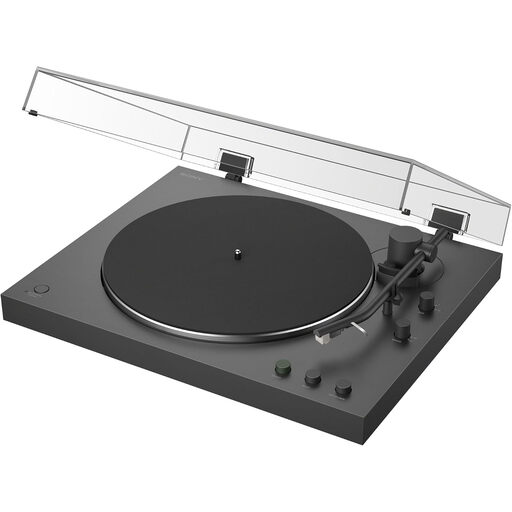
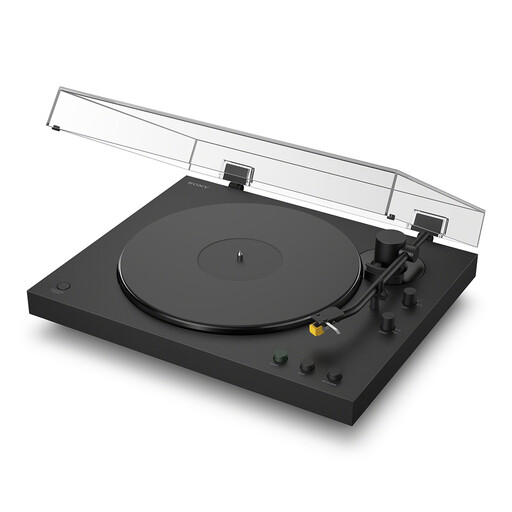
These Sony automatic Bluetooth turntables are choices for listeners who prefer less manual handling. Before choosing either for jazz singles, confirm its 45 RPM setting, speaker connection and fit on your desk.
 No image available
Sony PS-LX3BT Bluetooth automatic turntable
For office listeners who prefer automatic playback to manual cueing. Check that its connection options suit your speakers and that its footprint fits your desk; if you own large-hole singles, confirm adaptor compatibility.
View on Joybuy
 No image available
Sony PS-LX5BT Bluetooth automatic turntable
For home-office listening where automatic operation and a Bluetooth connection are priorities. Check compatibility with your intended speakers, the available desk space and whether you need a separate adaptor for large-hole singles.
View on Joybuy
Questions about singles and setup
Do all 7-inch jazz singles need a 45 RPM adaptor?
No. Audio T explains that an adaptor is for a 7-inch record with a large centre hole; a record with its small centre hole does not need one. The turntable still needs to run at 45 RPM for a 45 RPM single.
Can I connect a turntable directly to my office speakers?
Yes, if the turntable’s output and the speakers’ inputs are compatible. A built-in phono preamp can feed an appropriate line-level input; a conventional phono-output deck needs a phono stage, and passive speakers also need amplification.
Is switching between albums and singles easy on a manual deck?
It depends on the speed-change mechanism, not simply on whether the deck is manual. Rega’s Planar 1 instructions require moving the belt between pulley steps, so check the procedure for any model you expect to switch frequently.
What turntable maintenance should I plan for?
Follow the instructions for the exact tonearm and cartridge, and plan for stylus replacement as it wears. Audio-Technica cautions that incorrect tonearm setup can cause distortion or one-channel sound; check adjustment requirements and replacement-stylus compatibility before buying.


