Simple hobby-room system builders
If you already have powered speakers, a basic stereo or Bluetooth listening equipment, work out the connection path before choosing a deck. In particular, check whether the setup needs a phono stage.


Choose a turntable whose phono or line output works with the speakers or amplifier already in your hobby room; if they have only line-level inputs, the setup needs a phono stage. For long live-album sessions, automatic operation suits listeners who want fewer steps, while a manual deck suits those happy to cue records themselves. Choose Bluetooth only if you intend to use compatible wireless listening equipment.
If you already have powered speakers, a basic stereo or Bluetooth listening equipment, work out the connection path before choosing a deck. In particular, check whether the setup needs a phono stage.
If you mainly play complete album sides, the difference between automatic and manual operation may matter more to you than additional setup options.
If you want to explore cartridge choices, phono-stage arrangements, additional record speeds or USB transfer, check those capabilities on the exact model and variant.
Start with your speakers or amplifier and the space available for the deck. Then decide how much manual operation you want during an album session.
| Concern | What to check | Who this matters to |
|---|---|---|
| Connection to your system | Check the receiving equipment's phono or line input and whether the exact turntable has a suitable phono-stage setting. For wireless listening, check Bluetooth compatibility. | If my speakers only have a line input, I want to avoid an incomplete setup; around 33% of consumers put the connection path first. |
| Ease of operation | Confirm whether playback is automatic or manual, and which tonearm or cartridge settings come factory-set. | When I settle in for a full album side, I would rather minimise cueing and setup; for around 27% of consumers, straightforward operation is the primary need. |
| Hobby-room placement | Choose a flat, stable position away from heat and moisture. If the room gets dusty, check whether the selected version includes a cover. | With other activities going on in my hobby room, I need somewhere stable and clear of spills for the deck; placement comes first for around 27% of consumers. |
| Formats and future changes | Match the deck's stated speeds to your records. Check USB output, stylus options or MM/MC phono-stage compatibility only if you need them. | If my collection includes other record speeds or I plan to change the system later, I want those options identified before buying; around 13% of consumers prioritise that flexibility. |
A turntable's cartridge signal and an ordinary line-level speaker input do not necessarily form a complete connection path.
Identify the receiving equipment's phono, line or Bluetooth input, then check the exact deck's output and phono-stage arrangement.
Depending on the equipment you already own, completing the wired setup may require a separate phono preamp, suitable powered speakers or an amplifier.
Pro-Ject lists the E1.2 Phono with a switchable built-in phono preamp; that distinction matters when matching the deck to an amplifier or speakers.
Check the full variant name and its phono-stage arrangement on the product listing before ordering.
An unstable surface or a position near heat and moisture makes the location unsuitable for playback. Electrical Safety First recommends a flat, stable surface away from moisture and heat.
Set aside a stable, dry position clear of active work, and keep cables and the plug accessible.
An imported or third-party unit needs a power setup suitable for its intended place of use. Electrical Safety First advises checking for a UK three-pin fused plug and warns against using a travel adapter when a product may not meet UK safety standards.
Confirm the supplied plug and power specification before purchase rather than relying on an adapter to make an unsuitable unit fit.
Its AT-LP70XBT and AT-LP5X illustrate different choices between automatic listening and more involved manual operation.
The manual belt-drive Planar 1 and Planar 1 Plus are relevant to a conventional wired system, with different phono-stage arrangements.
The manual belt-drive E1.2 offers factory-set setup features, with a separate Phono variant for systems needing a built-in stage.
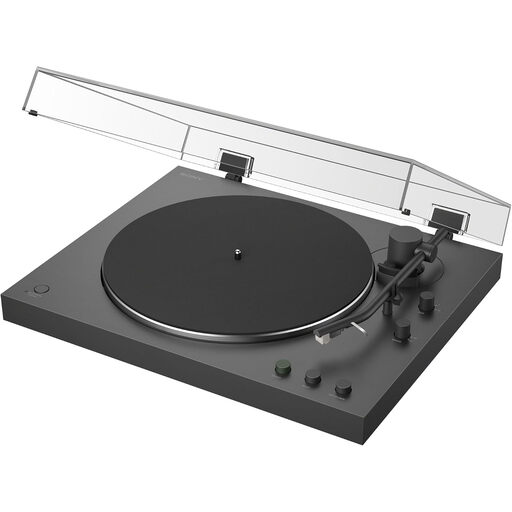
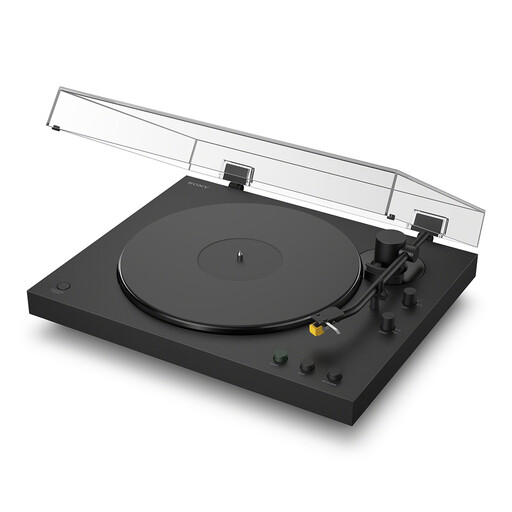
These Sony models offer automatic playback and Bluetooth for hobby-room album sessions. Check how each would connect to your listening equipment, along with the supplied mains accessories.
 No image available
Consider this model if you want automatic playback for album sessions and a Bluetooth connection option. Check that your intended listening equipment accepts the connection you plan to use, and confirm the supplied UK plug before ordering.
 No image available
Consider this model if you want automatic playback and plan to use Bluetooth listening equipment. Confirm the connection path and supplied UK plug; if hobby-room dust is a concern, also check whether a cover comes with this variant.
You need a phono stage somewhere in the wired signal path, but not necessarily a separate unit. Check whether the turntable has a suitable built-in stage or the receiving amplifier or speakers provide a phono input, and match the output setting to that input.
No. Choose Bluetooth if you intend to listen through compatible wireless equipment; otherwise, check the wired phono or line connection to the speakers or amplifier already in your hobby room.
Put it on a flat, stable surface away from moisture and heat, as Electrical Safety First advises. Keep it clear of active work areas and follow the instructions for the turntable and associated equipment.
Confirm the supplied plug and power specification are suitable for the intended UK setup. Electrical Safety First advises checking for a UK three-pin fused plug and not using a travel adapter to make an unsuitable electrical product fit.
Only if records in your collection require 78 RPM playback. Check the speed marked on your records against the exact model's supported speeds; Audio-Technica specifies 33⅓, 45 and 78 RPM for the AT-LP5X.