Who is this for?

Listeners dealing with room vibration

If people walk near the deck or speakers make its furniture vibrate, you need space for a rigid, level support. Keeping the turntable physically separate from speakers where practical matters alongside any damping features on the deck.

First-time listeners who want simpler playback

If you already have compatible speakers, automatic operation and a suitable built-in phono stage can reduce setup decisions. Check the exact model’s outputs before assuming it will connect to the equipment you own.

Listeners building a separate-component system

If you are comfortable setting up a manual deck, compare its cartridge and stylus options, controls and phono-stage arrangements with your planned system. Those choices matter more when you intend to change components later.

What matters when choosing?

Start with a place for the deck and a workable path to your speakers. Then decide whether automatic playback or additional format and adjustment options matter to you.

Concern What to check Who this matters to
Stable placement Allow room for a rigid, level support; separate the deck from speakers where practical. When footfall or nearby speakers might shake the furniture, I want a dependable place for the deck before choosing its features. Around 36% of consumers put stable placement first.
Speaker connection Match Bluetooth, PHONO or LINE output and phono-stage provision to your speakers or amplifier. If I want to use the speakers I already own, I need a connection that works without an unplanned change to the system. Around 29% of consumers prioritise a straightforward speaker connection.
Ease of operation Check whether playback is automatic and whether the cartridge or tonearm needs setting up. For regular listening, I would rather start a record with little handling than learn manual cueing and initial adjustment. Roughly 21% of consumers put ease of operation first.
Formats and flexibility Check for 78 RPM or USB only if you need them; consider stylus options and phono connections for later changes. If my collection includes 78 RPM records or I plan to digitise records or change components, I want those options considered now. About 14% of consumers primarily seek format or system flexibility.

Buying pitfalls

  • Choosing the deck before planning the playback chain

    A turntable is not necessarily a self-contained record player with speakers. According to Which?, turntables use separate amplification and speakers, unlike standalone record players with those parts built in.

    List the speakers and inputs you have, then match them to the deck’s Bluetooth, PHONO or LINE connection and phono-stage arrangement.

    Depending on that combination, you may also need a phono preamp, amplifier, suitable cables or powered speakers.

  • Expecting damping features to fix a vibrating shelf

    Pro-Ject describes damped parts on the Debut EVO 2, but its technical guidance also calls for a level turntable. Deck construction does not make the support beneath it irrelevant.

    Set aside a rigid, level position and avoid sharing vibrating furniture with speakers when another arrangement is possible.

    If the available furniture vibrates, a different position, platform or shelf may be needed.

  • Assuming models in one range have the same phono stage

    Rega specifies an integrated moving-magnet phono stage for the Planar 1 Plus; that feature should not be assumed for the Planar 1. Connection options also vary between Audio-Technica models.

    Check the complete model name and its PHONO, LINE and Bluetooth options against the input on your receiving equipment.

  • Choosing 78 RPM or USB features without a use for them

    Audio-Technica specifies both 78 RPM playback and USB output for the AT-LP120XBT-USB, but neither is needed solely to play a typical 33⅓ RPM live LP.

    Let your record collection and any definite digitisation plans determine whether those features belong on your shortlist.

Brands to consider for these setups

Audio-Technica

Its relevant models span simpler automatic connections and more adjustable manual operation. Compare the particular deck rather than treating the range as one specification.

  • Audio-Technica specifies a switchable built-in phono preamp for the automatic AT-LP70XBT and Bluetooth and USB output for the manual AT-LP120XBT-USB.
  • Do not assume every model has USB, 78 RPM playback or adjustable tracking force; stable placement remains necessary.

Rega

The wired Planar 1 models are worth comparing if you want a fitted-cartridge setup for a separate speaker system.

  • Rega describes the Planar 1 as having a factory-fitted cartridge and pre-set bias; it specifies an integrated moving-magnet phono stage for the Planar 1 Plus.
  • Confirm which version you are considering before planning a connection to a line-level input.

Pro-Ject

The manual Debut EVO 2 suits a listener willing to plan a separate-component system and its physical setup.

  • Pro-Ject describes a damped aluminium platter and height-adjustable damped feet on the Debut EVO 2.
  • Allow for manual operation, a suitable connection chain and a stable, level support rather than relying on the deck’s construction alone.

Technics

The SL-1500C and SL-1500CS are manual direct-drive models to examine for a wired system; their exact specifications should be checked separately.

  • Technics lists 33⅓, 45 and 78 RPM speeds plus PHONO and LINE outputs for the SL-1500C, and describes a built-in phono equaliser for the SL-1500CS.
  • Check the full model suffix, supplied components and connection requirements for the version you intend to buy.

Automatic Bluetooth models on Joybuy

These Sony models are options if you want automatic playback with Bluetooth for compatible speakers. Check your speaker connection and the deck’s position in the room before choosing between them.
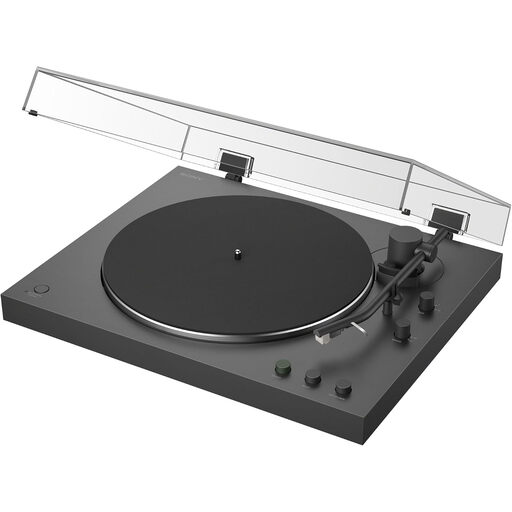
Sony PS-LX3BT Bluetooth turntable with automatic playback

Sony PS-LX3BT Bluetooth Turntable with Auto Playback

Consider this model if automatic operation and Bluetooth suit your listening setup. Confirm compatibility with your speakers or amplifier, and provide a rigid, level position away from speaker vibration where practical.

View on Joybuy
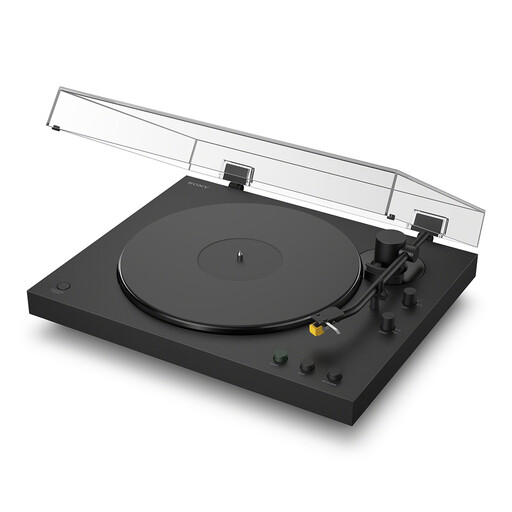
Sony PS-LX5BT Bluetooth turntable with automatic playback

Sony PS-LX5BT Bluetooth Turntable with Auto Playback

This is another automatic Bluetooth option for a compatible speaker setup. Check the connection your equipment needs and reserve a rigid, level support; do not rely on the turntable alone to manage furniture or speaker vibration.

View on Joybuy

Common questions

Do I need speakers or an amplifier with a turntable?

You need a compatible way to amplify and hear its output. Which? distinguishes turntables used with separate amplification and speakers from standalone record players with those parts built in. Check whether your intended setup uses compatible Bluetooth speakers, powered speakers or an amplifier and passive speakers.

Will I need a separate phono preamp?

That depends on the exact deck and the input you will use. Audio-Technica specifies a switchable built-in phono preamp for the AT-LP70XBT, Rega specifies an integrated phono stage for the Planar 1 Plus, and Technics lists both PHONO and LINE outputs for the SL-1500C. Match the chosen output to your speakers or amplifier before deciding whether another component is needed.

Where should the deck go in an open-plan flat?

Place it on a rigid, level support away from speaker vibration where practical. Pro-Ject’s Debut EVO 2 guidance stresses levelling, while Richer Sounds describes an isolated shelf as a way to reduce mechanical vibration reaching a turntable.

Can a Bluetooth turntable play my live albums?

Yes, provided the deck plays your records and pairs with your listening equipment. Audio-Technica specifies Bluetooth pairing for models including the AT-LP70XBT; check the exact model’s record speeds and your speaker or headphone compatibility. Wireless audio does not change the need for stable physical placement of the deck.