Choose the turntable for its connection to your speakers or amplifier, the record speeds you need and the amount of manual operation you want. Speakers close to a wall present a separate placement question: check the speakers’ guidance and give the turntable rigid, level support rather than expecting a different deck to correct a room-specific bass or vibration problem.
Who this setup suits
Listeners with limited speaker space
If your speakers must sit near a rear wall, identify their port arrangement and try the placement recommended for your model. KEF’s guidance makes wall clearance particularly relevant for rear-ported speakers. Keep the turntable on a separate, rigid, level support where practical.
Owners of powered speakers
If your speakers or amplifier have line inputs but no phono input, check how the turntable’s cartridge signal will reach line level. Rega’s Planar 1 Plus has an integrated moving-magnet phono stage; other arrangements may require a separate stage.
Collectors with more than LPs
If your live recordings include 45 RPM editions or 78 RPM records, check each deck’s stated speeds before choosing. Audio-Technica specifies all three speeds for the fully manual AT-LP5X; decide whether cueing and returning the tonearm yourself suits the way you listen.
What to check before choosing
For live albums with speakers near a wall, settle the speaker placement and turntable support first. Then match the deck to your existing inputs, records and preferred level of setup.
| Concern |
What to check |
Who this matters to |
| Placement and vibration |
Check the speaker ports and their placement guidance; give the turntable a rigid, level support. For rear-ported speakers, KEF suggests trying 15–30 cm wall clearance in small rooms as a starting point. |
If my speakers must sit close to the wall, I want to address bass and possible vibration before changing the deck; roughly 36% of consumers put placement and vibration first. |
| Connection compatibility |
Identify the speakers’ or amplifier’s phono and line inputs, then check whether the turntable’s phono stage is built in, switchable or external. |
With powered speakers or a line-only amplifier, I need a connection that works with the inputs I have; around 29% of consumers make connection compatibility their primary concern. |
| Record speeds and operation |
Confirm the speeds your records require and whether you are comfortable cueing and returning the tonearm manually. |
When my collection includes different record formats, I want the right speed and an operation style I will use comfortably; roughly 21% of consumers prioritise formats and operation. |
| Initial setup |
Compare factory-set cartridge arrangements with the adjustments you are willing to make; check the phono-stage requirements of any conventional phono-output deck. |
I may prefer fewer adjustments at the start, or a more hands-on setup I can refine later; around 14% of consumers put that setup choice first. |
Mistakes to avoid
-
Expecting a turntable change to fix near-wall bass
Moving to another deck does not change how a speaker interacts with the wall. KEF’s placement guidance is especially relevant when the speakers are rear-ported.
Check the speaker manual and try feasible positions before deciding whether the turntable itself needs changing.
-
Overlooking the phono-stage connection
A conventional phono-output turntable needs a suitable phono stage before its signal reaches a line input. Rega’s setup guidance distinguishes this from a system with an integrated phono stage.
Record the exact inputs on your speakers or amplifier, then check the chosen deck’s output and phono-stage arrangement.
A system without a suitable phono input may need a separate phono stage and connecting leads.
-
Assuming a damped design cannot suffer feedback
Construction details alone cannot establish how a deck will behave on your furniture at your listening level. Rega advises placing a turntable on a rigid, level surface.
Stabilise the support and check playback at your normal listening level before settling on a position. If considering a wall bracket, confirm both model compatibility and a suitable mounting location.
-
Forgetting stylus care
Which? warns that a worn stylus can potentially damage records, making its condition relevant beyond the initial turntable choice.
Follow the chosen model’s instructions for cleaning and check which replacement stylus or cartridge it accepts.
Relevant brands to consider
Rega
Rega’s Planar models offer different starting points for a conventional hi-fi connection or a simpler line-level setup.
- According to Rega, the Planar 1 has a factory-fitted Carbon cartridge and preset bias, while the Planar 1 Plus adds an integrated moving-magnet phono stage.
- Rega specifies its turntable wall bracket for Planar 1, 2, 3 and 6 and certain older models, but not current Planar 8 or Planar 10 decks. Check the exact model before planning a wall installation.
Audio-Technica
Selected Audio-Technica models suit listeners considering three-speed playback and different connection options.
- Audio-Technica specifies 33-1/3, 45 and 78 RPM playback and a switchable MM/MC preamp for the AT-LP5X; the AT-LP120XBT-USB offers USB and Bluetooth connections.
- Both of those models are fully manual, so they require you to cue and return the tonearm.
Pro-Ject
The Debut EVO 2 is a manually operated belt-drive option for listeners planning a conventional hi-fi setup.
- Pro-Ject specifies a carbon-fibre tonearm, a TPE-damped aluminium platter, height-adjustable feet and electronic 33/45 speed selection for the Debut EVO 2.
- Plan the required phono-stage connection and a rigid, level support rather than treating its construction features as a solution to speaker placement.
Joybuy turntables for this setup
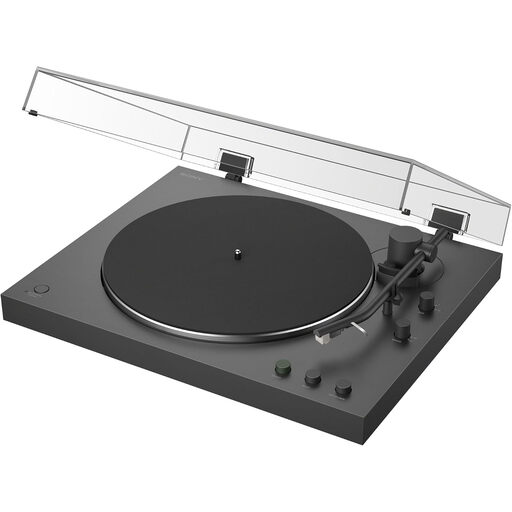
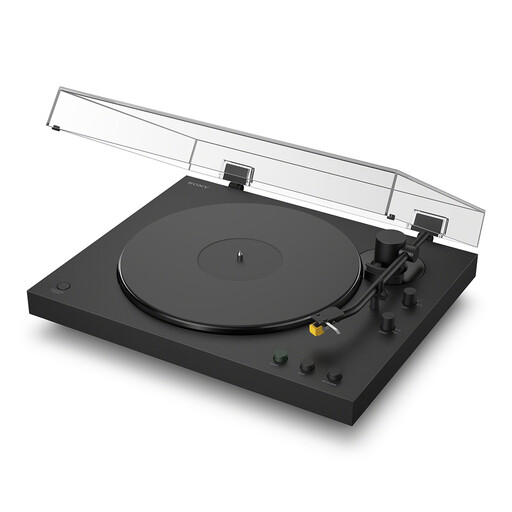
These Sony turntables offer automatic playback and Bluetooth for listeners considering a simpler way to play live albums. Check each model’s connection to your existing speakers or amplifier, and plan speaker placement and turntable support separately.
 No image available
Sony PS-LX3BT Bluetooth Turntable with Automatic Playback
Consider this model if you want automatic playback and a Bluetooth connection for live-album listening. Confirm that its wired or wireless connection suits your speakers, and use a rigid, level turntable support.
View on Joybuy
 No image available
Sony PS-LX5BT Bluetooth Turntable with Automatic Playback
Consider this model if automatic playback and Bluetooth suit the way you listen. Check its connection options against your speakers or amplifier; its turntable features do not remove the need to position the speakers and support the deck carefully.
View on Joybuy
Common questions
Do speakers near a wall call for a special turntable?
Not necessarily: near-wall bass is primarily a speaker-placement issue, while the turntable needs stable support and a compatible connection. For rear-ported speakers in small rooms, KEF suggests starting with 15–30 cm of wall clearance and adjusting placement where possible; follow the guidance for your own speakers.
Can a turntable with a built-in phono stage connect to powered speakers?
It can connect directly when its output and the powered speakers’ line input are compatible. Rega says the integrated moving-magnet phono stage in the Planar 1 Plus provides a signal for suitable line inputs; check the speaker’s input and required cable before buying.
What if my amplifier has no phono input?
A conventional phono-output turntable will need a suitable external phono stage if the amplifier has no integrated one. Rega’s setup guidance calls for a stage appropriate to the turntable connection, so check the cartridge and amplifier inputs as well as the deck.
What upkeep should I plan for when playing records regularly?
Keep records and the deck clean, and monitor the stylus for wear. Which? warns that dust can reduce audio quality and a worn stylus can potentially damage records; use the selected model’s instructions for cleaning and replacement.


