What matters when buying?
Decide where the turntable can sit and how it will connect before choosing between automatic convenience and manual controls. Audio-Technica advises placing a turntable on a flat, level surface away from speakers that cause vibration.
| Concern |
What to check |
Who this matters to |
| Stable placement |
Check for a flat, level surface away from the speakers, with room to open the dust cover. |
If the speakers and furniture must share a small area, I need a stable spot for the deck before deciding where it goes. Around 36% of consumers put placement and vibration control first. |
| Easy shared operation |
Check whether start, stop and tonearm movement are automatic, and what initial setup is required. |
When several people use the lounge system, I would rather they could start a record without learning to cue it manually. For around 29% of consumers, straightforward shared operation is the primary need. |
| Speaker compatibility |
Identify the speakers' or amplifier's PHONO or line input, or check Bluetooth compatibility. |
My existing speakers determine how I can hear the records, so the turntable's output needs to match them. Connection compatibility comes first for around 21% of consumers. |
| Manual control and record speeds |
Check the speeds printed on your records and whether you want manual cueing, adjustments or stylus options. |
If I own records needing another speed or want to adjust the deck myself, those controls matter more than push-button playback. Around 14% of consumers prioritise that flexibility. |
Joybuy turntables for shared use
These Sony models offer automatic playback, Bluetooth and a built-in phono stage for a shared-lounge setup. Choose between them by checking the connections and controls you will use, rather than treating either as a substitute for a suitable position and compatible speakers.
 No image available
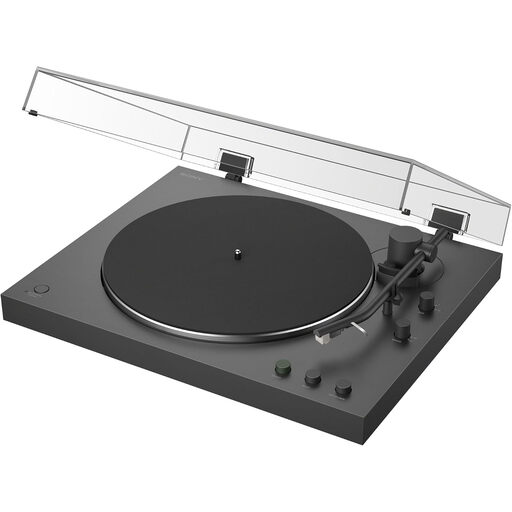
Sony PS-LX3BT Bluetooth turntable
Automatic start, return and stop suit a lounge where several people will play records.
Supports 33⅓ and 45 RPM, with Bluetooth and a built-in phono preamp that has PHONO/LINE switching. The described connections also include a USB-B recording output.
Check pairing with your intended speakers or headphones, confirm the supplied mains adapter and product information suit your location, and allow a flat, level position away from vibrating speakers.
View on Joybuy
 No image available
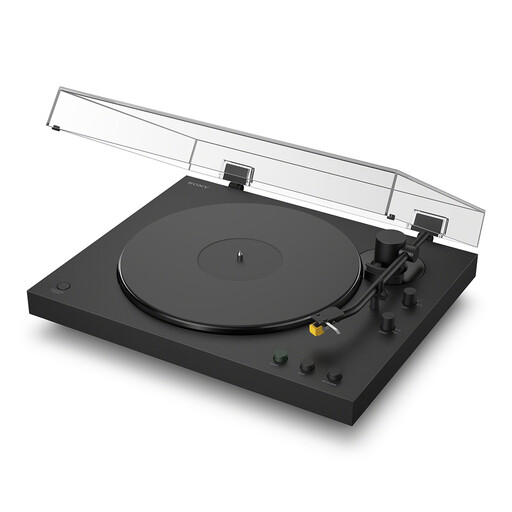
Sony PS-LX5BT Bluetooth turntable
Fully automatic playback suits listeners who do not want to cue the tonearm manually.
Supports 33⅓ and 45 RPM, with Bluetooth, a built-in phono preamp and line-out. The description also specifies LOW/MID/HIGH gain settings and an aluminium tonearm.
Check pairing with your intended speakers or headphones, confirm the supplied mains adapter and product information suit your location, and plan a flat, level position away from vibrating speakers.
View on Joybuy
Common questions
Can I put a turntable next to the lounge speakers?
Keep it away from speakers that cause vibration where possible. Audio-Technica's AT-LP70XBT setup guidance calls for a flat, level surface away from such speakers, so establish a suitable position before choosing the deck.
Do I need a separate phono preamp?
You need a suitable phono stage somewhere in the connection path, but it need not be a separate component. The Audio-Technica AT-LP70XBT has a switchable built-in stage, while Rega says the Planar 1 Plus has an integrated moving-magnet stage for a suitable line input; match the deck's output setting to your amplifier or speakers.
Is Bluetooth enough for a shared lounge?
Bluetooth can provide the speaker connection if the chosen deck and speaker pair successfully, but it does not solve placement or power requirements. Check compatibility with the speaker you intend to use and whether a wired connection would also suit your system.
Do I need 78 RPM playback for live albums?
Choose 78 RPM support only if records in your collection require it. Check the speed printed on each record: Audio-Technica specifies 33⅓, 45 and 78 RPM for the manual AT-LP120XBT-USB, whereas its automatic models discussed here cover 33⅓ and 45 RPM.
What should I check when buying a mains-powered turntable for Great Britain?
Check the seller and product identity, instructions, supplied mains adapter or plug, and the marking applicable to that product. Department for Business and Trade guidance recognises CE marking alongside UKCA marking for Great Britain where the relevant product requirements are met; Northern Ireland has separate arrangements, so do not apply that Great Britain conclusion there without checking its rules.


