Choose the connection that works with your speakers or amplifier before choosing a turntable: a suitable built-in phono preamp can feed a line-level input, while a phono-only deck needs a PHONO input or a separate phono stage. Fully automatic operation reduces tonearm handling; if your collection includes records marked 78 RPM, check both three-speed playback and stylus compatibility. Measure the intended surface and lid clearance for the exact model.
Who is this setup for?
Low-effort spoken-word listeners
If you mainly play 33⅓ or 45 RPM records and prefer not to place and return the tonearm yourself, consider fully automatic operation. Audio-Technica lists its AT-LP60X as a fully automatic model with a built-in switchable phono preamp.
Small-room system builders
If you already own powered speakers or an amplifier, match the turntable output to an available input before choosing a model. Measure the intended level surface as well: Rega publishes closed-lid dimensions for its Planar 1 Plus, giving you a model-specific figure to compare with your furniture.
Archive and 78 RPM listeners
If any spoken-word records are labelled 78 RPM, check for a three-speed turntable and a compatible 78 RPM stylus or cartridge. Audio-Technica identifies its AT-LP120XUSB as a three-speed model and advises using an appropriate SP stylus for 78 RPM records.
What matters when choosing?
Start with the input your speakers or amplifier can accept. Then decide how much tonearm handling you want and read your record labels for any 78 RPM discs; a small-room setup also needs a measured, level place for the deck.
| Concern |
What to check |
Who this matters to |
| Connection compatibility |
Identify whether your speakers are powered and whether your amplifier offers PHONO or a line-level input. Match the turntable output to that input. |
If I already have speakers, I want the turntable to work with them without routing the signal through two phono preamps. Around 46% of consumers put existing-system compatibility first. |
| Low-handling playback |
Check whether the exact model is fully automatic and supports the speeds marked on your records. |
When I regularly listen to spoken-word records, I may prefer starting and stopping playback without handling the tonearm each time. Roughly 36% of consumers prioritise that convenience. |
| 78 RPM records |
Read your record labels; for 78 RPM discs, check both the speed setting and availability of a compatible SP stylus or cartridge. |
If my collection includes older records marked 78 RPM, a standard two-speed setup will not meet my playback needs. Around 18% of consumers make 78 RPM compatibility their primary concern. |
Setup mistakes to avoid
-
Choosing a phono-only deck for line-level speakers
A phono-level output cannot simply take the place of a line-level output. A setup with powered speakers or only an AUX or CD input may need a phono stage between the turntable and speakers.
Identify the input on your equipment, then choose a compatible turntable output or plan for a separate phono stage. Henley Audio specifies a built-in switchable stage for the Pro-Ject E1 Phono; do not assume the standard E1 has the same connection route.
-
Sending a LINE output into a PHONO input
Audio-Technica warns that this uses the turntable’s internal preamp and the amplifier’s phono preamp together, causing considerable distortion.
For a switchable turntable, use LINE with a line-level input. If connecting to a dedicated PHONO input, follow the model’s instructions for its PHONO setting.
-
Assuming all spoken-word records use 33⅓ or 45 RPM
A record marked 78 RPM calls for a suitable speed setting and stylus, not merely a turntable that plays LPs. Audio-Technica explains that an SP stylus for 78 RPM records has a larger tip radius than a typical LP stylus.
Check the labels in your collection and confirm stylus or cartridge compatibility for the exact turntable before choosing a three-speed model.
You may need to obtain a compatible SP stylus or cartridge separately.
-
Measuring only the shelf width
Depth, lid clearance and cable space also affect whether a turntable can sit on a stable, level surface. Rega states that the Planar 1 Plus measures 447 × 117 × 360 mm with its lid closed.
Measure the available width, depth and height where you will use the deck, then compare them with the dimensions and lid requirements of the exact model.
Relevant brands to consider
Audio-Technica
Its AT-LP60X and AT-LP120XUSB illustrate different routes: lower-handling two-speed playback or manual three-speed playback.
- Audio-Technica specifies fully automatic operation and a built-in switchable phono preamp for the AT-LP60X.
- The AT-LP60X plays 33⅓ and 45 RPM records, not 78 RPM records. The three-speed AT-LP120XUSB is fully manual.
Rega
The Planar 1 Plus is a manual option with a built-in moving-magnet phono stage for a suitable line-level setup.
- Rega gives closed-lid dimensions of 447 × 117 × 360 mm for checking the intended space.
- The cited Planar 1 Plus specification lists 33 and 45 RPM, so check a different route if your collection includes 78 RPM records.
Pro-Ject Audio Systems
The E1 range offers distinct connection versions for listeners comfortable with a manual turntable.
- Henley Audio specifies a switchable phono stage for the E1 Phono, allowing connection to a suitable line-level input.
- The standard E1 has phono-level output and needs a phono stage elsewhere in the system; check the variant rather than treating the E1 versions as interchangeable.
Joybuy turntables for automatic playback
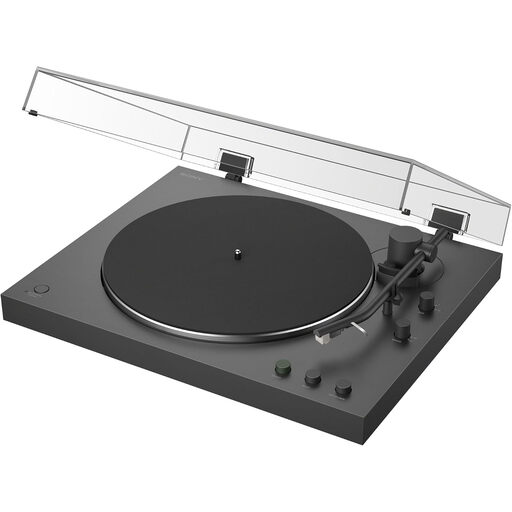
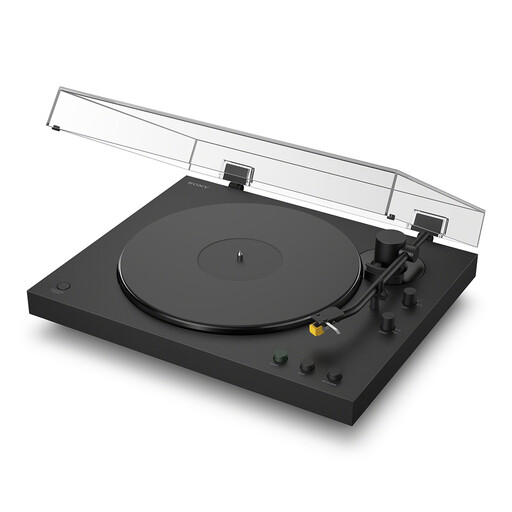
These Sony models are options to consider if automatic playback and a Bluetooth connection suit your small-room setup. Before choosing either one, match its connections to your speakers, check the space it needs and confirm record-speed compatibility for your collection.
 No image available
Sony PS-LX3BT Bluetooth Turntable with Auto Playback
Consider this model if you want less tonearm handling while playing spoken-word records and a Bluetooth connection suits your speakers.
For a wired setup, check that the output setting matches your speaker or amplifier input. Confirm the closed-lid space it needs and, if you own 78 RPM records, both speed and SP stylus compatibility.
View on Joybuy
 No image available
Sony PS-LX5BT Bluetooth Turntable with Auto Playback
Consider this model if automatic playback is a priority and you plan to assess Bluetooth alongside your existing audio equipment.
Check its wired connection against your available input and measure the space for the deck and dust cover. If your collection includes 78 RPM discs, confirm speed support and a compatible SP stylus or cartridge.
View on Joybuy
Common questions
Can a turntable with a built-in preamp connect to powered speakers?
Yes, if the turntable provides a LINE-level output and the powered speakers accept a compatible line-level input. Audio-Technica advises using the LINE setting on a switchable turntable to engage its internal phono preamp for this connection.
Can I connect a turntable set to LINE to an amplifier’s PHONO input?
No: use a suitable line-level input instead. Audio-Technica warns that connecting LINE to PHONO puts the signal through both phono preamps and can cause considerable distortion.
How much room should I allow for a turntable?
Allow a stable, level surface that accommodates the exact model’s width and depth, plus its dust cover and cable routing. As one model-specific reference, Rega lists the Planar 1 Plus at 447 × 117 × 360 mm with the lid closed; measure your intended location rather than relying on room size alone.
Will my usual LP stylus play a 78 RPM spoken-word record?
Do not assume it will. Audio-Technica explains that a 78 RPM/SP stylus has a substantially larger tip radius than a typical LP stylus, so confirm both 78 RPM speed support and a compatible stylus or cartridge for your exact turntable.


