Choose a turntable around the records you own and the input on your speakers or amplifier: a built-in, switchable phono preamp can serve a line input, while a phono-output deck needs an appropriate phono stage. Genelec explains that placing speakers near a wall can increase low-frequency output, so assess speaker bass controls and keep the turntable on a rigid, level support rather than expecting the deck to correct the room. If you own shellac 78s, check for both 78 rpm playback and a compatible dedicated SP/78 stylus or cartridge.
Who this setup concerns
Listeners with mixed second-hand records
If your collection includes LPs, singles or possibly shellac 78s, identify the formats before choosing a deck. Audio-Technica and Ortofon distinguish the dedicated stylus needed for shellac records from an ordinary LP stylus; replaceable styli and correct cartridge setup also matter for ongoing use.
Listeners with speakers close to a wall
Genelec explains that nearby walls can increase a speaker’s low-frequency output. Check whether your speakers offer room or bass adjustment, and give the turntable a rigid, level position away from a vibrating speaker where possible.
Powered-speaker users seeking simpler connections
If your speakers accept a line-level signal, a turntable with a selectable built-in phono preamp may avoid a separate phono stage. Confirm the input and output settings before connecting them; automatic operation is a separate choice about day-to-day handling.
What to check before choosing
Identify your speaker or amplifier input and the records you own before choosing between automatic convenience and a more adjustable deck. Treat near-wall bass balance as a speaker-and-room check, not a turntable specification.
| Concern |
What to check when buying |
Who this matters to |
| Near-wall bass and vibration |
Check for speaker room or bass controls and a separate, rigid, level place for the turntable. |
If my speakers must sit near a wall, I want to address heavy bass without relying on a new deck to change the room’s sound. Around 31% of consumers put wall-related bass and turntable vibration first. |
| Phono and line connections |
Identify the speaker or amplifier input, then check for a suitable phono stage and the turntable’s output setting. |
With powered speakers or an amplifier whose inputs I have not checked, I need to know whether the turntable can connect correctly. Roughly 31% of consumers make connection compatibility their primary concern. |
| Used-record formats and stylus care |
Confirm your records’ speeds and stylus-replacement options; shellac 78s also require a compatible dedicated SP/78 stylus or cartridge. |
When my second-hand collection includes different formats or record conditions, I want to avoid using the wrong stylus and maintain the deck over time. Around 23% of consumers put record-format and stylus care first. |
| Everyday handling |
Check whether operation is fully automatic and whether the supported speeds match your records. |
If I play records often and prefer fewer cueing steps, automatic operation matters more to me than extra adjustments. Roughly 15% of consumers prioritise simpler everyday use. |
Mistakes to avoid
-
Expecting a turntable upgrade to fix near-wall bass
Genelec notes that speakers close to boundaries can produce more low-frequency output. Changing the cartridge or deck does not itself adjust the speakers’ response to the room.
Check your speakers’ documented room or bass controls, then position the turntable on a rigid, level support away from speaker vibration where possible.
-
Using an LP stylus on a shellac 78
Audio-Technica warns that using a standard LP stylus on a shellac SP record can damage the record and cartridge. A 78 rpm speed setting alone is not enough.
If you own shellac 78s, confirm a compatible dedicated SP/78 stylus or cartridge and follow its setup requirements.
A dedicated stylus or cartridge is an additional component to plan for.
-
Treating phono and line inputs as interchangeable
A phono-output turntable needs an appropriate phono stage before an ordinary line input. Rega’s Planar 1 manual, for example, directs its output to a phono stage.
Read the input labels on your speakers, hub or amplifier, then confirm whether the turntable’s built-in preamp or a separate phono stage provides the required connection.
A separate phono stage adds another component if your system has only a line input.
-
Overlooking tracking-force setup
Audio-Technica notes that incorrect tonearm setup can cause distortion or an imbalance between channels.
Follow the cartridge maker’s tracking-force instructions, set anti-skate where applicable, and recheck the setup when changing a compatible stylus or cartridge.
Relevant turntable brands
Audio-Technica
Its turntable range includes automatic models and the adjustable AT-LP120XUSB, offering different routes for line-input connections and mixed record formats.
- Audio-Technica specifies a selectable phono preamp, adjustable tracking force and anti-skate, and 33⅓/45/78 rpm operation for the AT-LP120XUSB.
- The automatic AT-LP70XBT is specified for 33⅓ and 45 rpm, not 78 rpm. Check the exact model and stylus before planning shellac playback.
Rega
The manual Planar 1 is a route for a conventional hi-fi system with an appropriate phono stage. Rega also offers wall brackets with model-specific compatibility.
- The Planar 1 has a factory-fitted cartridge and bias arrangement intended to simplify initial setup.
- Rega’s Planar 1 manual calls for an appropriate phono stage; powered speakers with line inputs alone need one added. Check bracket compatibility for the particular deck.
REKKORD
The automatic F300 combines a floating sub-chassis with adjustable tracking force and anti-skate for listeners choosing a 33/45 rpm deck.
- REKKORD specifies adjustable tracking and anti-skating force and a pre-adjusted AT91 cartridge for the F300.
- The F300 is specified for 33 and 45 rpm and has a phono output, so it needs a suitable phono input or stage and is not a shellac 78 route.
Joybuy turntables for this setup
These automatic Bluetooth turntables are choices to consider for everyday second-hand LPs and singles. Before buying either for speakers near a wall, check the wired input and output arrangement, stylus-replacement options and a suitable position for the deck; shellac 78 playback needs separate confirmation.
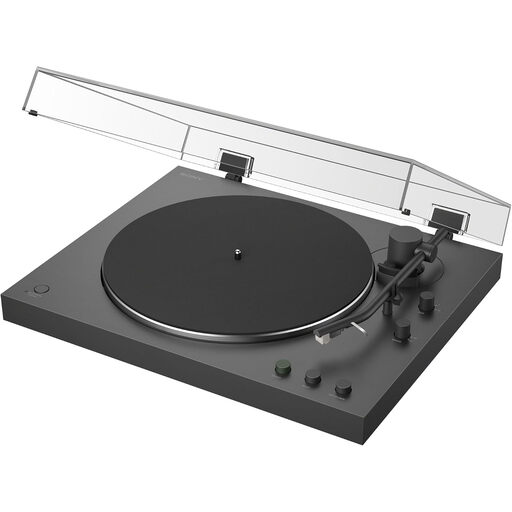 Image unavailable
Sony PS-LX3BT Bluetooth Turntable with Automatic Playback
Consider this model if automatic playback would reduce the handling involved in playing your used records.
For a wired connection to powered speakers, check the PHONO/LINE setting against their input. Confirm replacement-stylus availability for ongoing use and, if you own shellac 78s, check both speed and dedicated-stylus compatibility before choosing it.
View on Joybuy
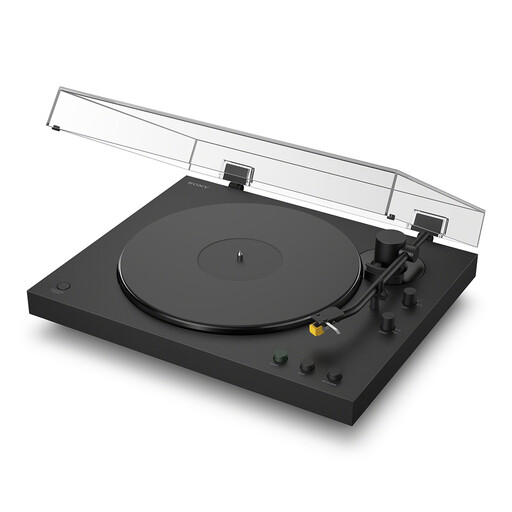 Image unavailable
Sony PS-LX5BT Bluetooth Turntable with Automatic Playback
Consider this model if you want automatic operation for regular listening to second-hand records.
Before connecting it by wire, confirm its output mode against your speaker or amplifier input. Check replacement-stylus availability for ongoing use; shellac 78s require confirmation of both the correct speed and a compatible dedicated stylus.
View on Joybuy
Common questions
Can I connect any turntable directly to powered speakers?
No: powered speakers with an ordinary line input need a phono stage before the turntable’s signal reaches that input. Use a suitable built-in preamp or an external phono stage, and check the output setting; a dedicated phono input calls for the corresponding phono-output configuration.
Will changing the turntable fix excessive bass near a wall?
Changing the turntable will not itself correct wall-related speaker bass. Genelec explains that nearby boundaries can increase low-frequency output; check speaker placement and documented room or bass controls, while keeping the deck on a rigid, level support away from vibration where possible.
Is a 78 rpm speed setting enough for shellac records?
No: shellac 78s also call for a compatible dedicated SP/78 stylus or cartridge. Audio-Technica warns against using a standard LP stylus on an SP record because it can damage the record and cartridge; check the stylus and its setup requirements before playback.
What should I check when buying a second-hand turntable?
Inspect or test the turntable where practical, ask about modifications and instructions, and check for recalls. Also assess the stylus condition, supported record speeds and phono connection before putting it into your speaker setup.


