Convenience-focused listeners
You mainly pick up 33⅓ and 45 RPM records and want to start listening without much adjustment. Automatic operation and a connection that suits your speakers matter more to you than manual controls.


Choose a turntable that connects to your listening system and plays the speeds in your record collection before weighing up other features. Automatic operation and Bluetooth can make everyday listening simpler, but the deck still needs a level spot away from speakers, heat and moisture. If you buy 78 RPM records, choose a model that explicitly supports that speed and check the stylus requirements for those records.
You mainly pick up 33⅓ and 45 RPM records and want to start listening without much adjustment. Automatic operation and a connection that suits your speakers matter more to you than manual controls.
You expect to handle records in varying condition and want a manageable routine for cleaning, stylus replacement and protecting the turntable between listening sessions. Pro-Ject Audio Systems identifies the stylus as a part that wears with use.
You may bring home older 78 RPM records alongside LPs and singles. Explicit speed support becomes a purchase requirement, as does checking which stylus or cartridge arrangement suits the particular records.
Start with a suitable place for the turntable, then match its connection to your speakers or amplifier and check the speeds printed on your records. For consumers choosing a deck for used records in a kitchen diner, the table relates each concern to the people who would make it their primary purchase priority.
| Concern | What to check | Who this matters to |
|---|---|---|
| Placement | Measure the surface and lid clearance. Follow Audio-Technica UK's advice to use a level spot away from speakers, considerable heat, humidity and vibration. | I need room to open the lid without putting the deck beside a speaker or a source of steam; around 33% of consumers would put suitable placement first. |
| Speaker connection | Identify whether your equipment accepts PHONO, Line/CD/AUX or Bluetooth. For a line-level wired connection, check whether the turntable has a built-in phono preamp. | If I already own speakers or an amplifier, I want a connection that works with their actual inputs; roughly 27% of consumers would make system connection their primary concern. |
| Used-record care | Check replacement-stylus availability for the exact model and whether the deck has a dust cover. Plan to inspect and clean used records. | When I regularly play second-hand finds, I need a practical way to care for records and replace worn parts; around 27% of consumers would prioritise that upkeep. |
| 78 RPM playback | Check record labels for their speeds. If you buy 78s, confirm both explicit 78 RPM operation and a suitable stylus or cartridge arrangement. | I do not want an older 78 to be unplayable on my new deck; about 13% of consumers would make 78 RPM compatibility their deciding need. |
A convenient-looking kitchen surface may be close to steam, heat or vibrating appliances. Audio-Technica UK recommends a flat, level location away from speakers and those conditions.
Measure the intended furniture, including space to open the lid, and keep speakers on a separate surface where possible.
Audio-Technica UK specifies 33⅓ and 45 RPM for the AT-LP60XBT, but adds 78 RPM to the AT-LP120XBT-USB. The distinction matters if your second-hand finds include 78s.
Read your record labels before buying. If 78s are part of the collection, confirm the deck's speed and the stylus arrangement needed for those records.
A turntable's output has to suit the receiving equipment. A built-in phono preamp can provide a route to a compatible line-level input, while Bluetooth needs a compatible receiver.
Check the input labels and the turntable's output settings together before choosing a wired or wireless setup.
If the equipment does not match, completing the setup may require a separate phono stage, suitable speakers or cables.
The stylus still wears during playback. Pro-Ject Audio Systems includes its condition in turntable maintenance guidance, while replacement arrangements depend on the model.
Check which replacement stylus fits the exact deck, inspect second-hand records and follow the manufacturer's cleaning and maintenance instructions.
These manufacturer ranges illustrate different setup choices; the features below belong to the named models, not every turntable from each brand.
Its AT-LP60XBT illustrates the automatic, Bluetooth-enabled route for 33⅓ and 45 RPM records; its AT-LP120XBT-USB offers a manual route that also supports 78 RPM.
The E1 Phono is a wired choice for listeners who want factory-adjusted setup and an integrated phono preamp.
The Planar 1 and Planar 1 Plus illustrate why it matters to distinguish a standard wired deck from a version with an integrated phono stage.
These two Sony models suit listeners considering automatic playback and Bluetooth for a kitchen-diner setup. Check your speaker connection, available space and record speeds before deciding between them.
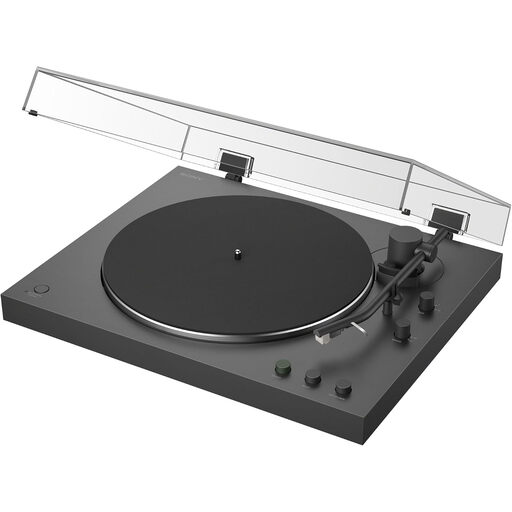 No image available
Consider this automatic model if you want Bluetooth listening and a straightforward playback routine. Keep it away from kitchen steam and liquids, and check the available lid clearance, replacement-stylus options and 78 RPM capability if those matter to your collection.
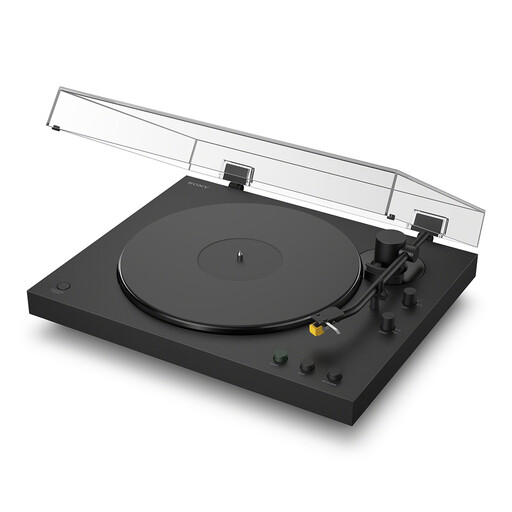 No image available
This automatic Bluetooth model is another option if those are your preferred controls and connection. Before choosing it for a kitchen diner, confirm its dimensions and lid clearance, whether a dust cover is included, replacement-stylus options and 78 RPM capability if needed.
Yes, if it has a flat, level position away from speakers, considerable heat, humidity, dirt and extreme vibration, in line with Audio-Technica UK's setup guidance. A worktop beside a hob or a steam-producing appliance should not be treated as a suitable spot without checking those conditions.
Not for a compatible line-level connection if your chosen turntable has a built-in phono preamp. If your amplifier instead has an input labelled PHONO, follow the turntable manufacturer's output-switch instructions so the connection uses the appropriate phono stage.
No: the required speed depends on the records you buy. Audio-Technica UK specifies 33⅓ and 45 RPM for the AT-LP60XBT and also lists 78 RPM for the AT-LP120XBT-USB; check each record's label and the appropriate stylus arrangement before playing 78s.
Inspect the turntable's visible electrical condition and check for relevant product-safety alerts or recalls before buying or using it. Business Companion advises that second-hand electrical goods offered for sale must meet safety requirements, while the UK Office for Product Safety and Standards provides product-safety alerts and recall information.