Large-room system builders
If you have or plan to buy powered speakers or an amplifier, check their inputs against the turntable's output before choosing a deck.


Choose the amplifier and speaker connection before choosing the turntable: a deck with a built-in phono stage can feed a compatible line-level input, while one without it needs a suitable phono input or separate stage. Give the deck a stable, level position away from loudspeakers. Prioritise 78 rpm only if you intend to play shellac records, which need a dedicated stylus and appropriate setup, as Audio-Technica advises.
If you have or plan to buy powered speakers or an amplifier, check their inputs against the turntable's output before choosing a deck.
If you mainly play second-hand LPs and singles, a fitted cartridge and simpler initial setup may matter more to you than specialist format controls.
If your collection may include shellac 78s, look for 78 rpm operation, a suitable dedicated stylus and tonearm settings you can adjust for it.
For a large-room system, settle the speaker connection and the deck's position before deciding whether specialist record-format controls are worth having.
| Concern | What to check | Who this matters to |
|---|---|---|
| Speaker compatibility | Check whether your amplifier or powered speakers accept phono-level or line-level output, and whether the deck has a built-in or selectable phono stage. | If my speakers have only a line-level input, I need a connection that works without assuming the deck supplies the right signal; around 36% of consumers put system compatibility first. |
| Stable placement | Plan a level support away from loudspeakers; check how the deck can be levelled on your furniture. | With the speakers and record player in the same room, I want a stable place for the deck before arranging the system; for around 29% of consumers, placement is the primary concern. |
| Used-record care | Identify the fitted cartridge and replacement-stylus options, then follow the maker's tracking-force and anti-skate instructions where adjustments are provided. | When records have an uncertain history, I want to know which stylus is fitted and how to set it correctly; around 21% of consumers prioritise used-record care. |
| Shellac 78s | Confirm 78 rpm operation, a compatible dedicated 78 stylus and the tonearm settings required for that stylus. | If I bring home shellac 78s, ordinary LP playback is not enough for my collection; 78 rpm capability comes first for around 14% of consumers. |
A turntable's phono-level output cannot simply be treated as a line-level speaker input. A built-in phono stage changes the connection options, but it does not replace the need for compatible amplification and speakers.
Choose your amplifier or powered-speaker arrangement, then check the deck's output mode against its inputs.
Depending on that arrangement, you may also need a separate phono preamp.
Audio-Technica warns that vibration and acoustic sound pressure near loudspeakers can affect turntable playback.
Use a stable, level support away from the speakers, adjusting the feet if the model provides that option.
Audio-Technica advises against using a standard LP stylus on a shellac 78: the groove differs and both the record and cartridge can be damaged.
Identify the record format before playback, and choose a 78-capable deck only if you intend to play 78s.
Shellac playback also calls for a compatible dedicated 78 stylus or cartridge and the appropriate setup changes.
The UK Office for Product Safety and Standards warns that used products may have worn or modified components.
If buying a used turntable, ask about alterations, check that instructions are available and check for product-safety recalls before use.
Rega's Planar 1 Plus is a reference point for listeners seeking a simpler connection to compatible line-level equipment.
The AT-LP120XUSB is a manual, adjustable option for listeners whose second-hand collection may include different record formats.
The Debut EVO 2 is a component-turntable option to consider for conventional LPs and singles.
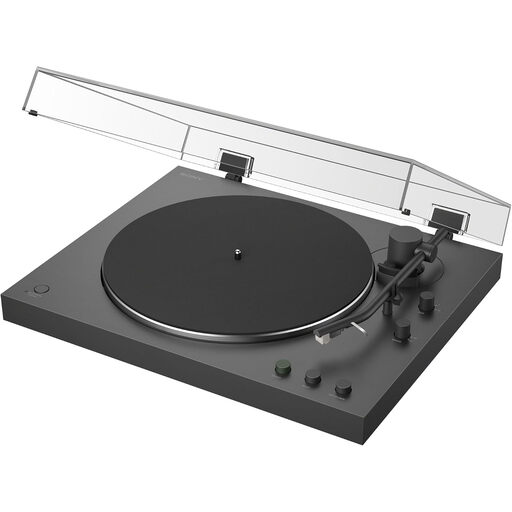
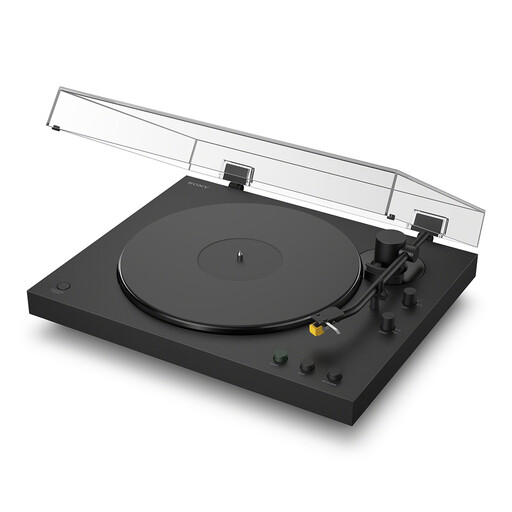
These Sony automatic Bluetooth turntables are choices to consider if you want straightforward operation for your living-room system. Check each deck's output connection, supported speeds and stylus options against your equipment and records before buying.
 No image available
Consider this model if you want automatic playback while putting together a system for second-hand records. Confirm its output connection against your amplifier or powered speakers, and check speed and stylus compatibility if you own shellac 78s.
 No image available
Consider this model if automatic playback suits how you want to use your living-room system. Check its output mode and replacement-stylus options for your records, and plan a stable, level position away from loudspeakers.
You need a compatible phono stage somewhere in the signal path: it may be built into the deck, provided by an amplifier's phono input or supplied as a separate unit. Check the turntable's output mode and the receiving equipment's input before buying.
Choose a position away from loudspeakers instead. Audio-Technica's setup guidance warns against placing a turntable on or near them because vibration and acoustic sound pressure can affect playback; use a stable, level support.
No: Audio-Technica advises using a dedicated 78/SP stylus or cartridge rather than an ordinary LP stylus. You also need a deck that runs at 78 rpm and must set it appropriately before playback, then reset it when returning to LPs.
Check its condition and history before use. The UK Office for Product Safety and Standards advises asking about modifications, checking that instructions are available and checking whether the product is subject to a recall.
That depends on your speaker connection and record formats. You may need amplification and speakers, a separate phono preamp if your equipment has no suitable phono stage, or a dedicated compatible stylus if you plan to play shellac 78s.