Choose the turntable around your records and existing speakers: a built-in phono stage can feed a line-level input, while a phono-output deck needs a PHONO input or separate phono stage. If your collection includes shellac 78s, check for both 78 RPM speed and a suitable stylus; for LPs and singles, give more weight to connection compatibility, handling and stable placement.
Who each setup suits
LP and single listeners seeking a simple connection
If you mainly play 33⅓ RPM LPs and 45 RPM singles, match the turntable’s output to your amplifier or active speakers. A built-in phono stage is useful when the receiving equipment has a line-level input but no PHONO input.
Collectors with possible shellac 78s
Check the labels and sleeves before choosing a deck. Audio-Technica’s guidance distinguishes 78 RPM speed from stylus suitability: its dedicated AT-VMN95SP 3 mil stylus is a different option from the AT-VM95E elliptical stylus supplied with the AT-LP120XUSB.
Listeners fitting a turntable into an existing hi-fi system
If the hobby room already has speakers, an amplifier or a computer, check the required output as well as the space available for the deck, cables and dust cover. Decide whether manual operation or computer recording matters to you before comparing models.
What to check before buying
For vintage soundtrack listening in a hobby room, identify your record formats, match the output to your speakers, then check the controls and intended shelf. The priorities below describe consumers according to the need they put first.
| Concern |
What to check |
Who this matters to |
| Speaker connection |
Check for a PHONO input. With only a line-level input, choose an appropriate built-in phono stage or use a separate one. |
If my speakers accept only a line-level signal, I want to connect the turntable without an extra component; around 33% of consumers put connection simplicity first. |
| Record format and stylus |
Check the collection for 78 RPM records, then confirm both the deck’s speed and a suitable stylus. Follow the manufacturer’s setup instructions when changing styli. |
When my collection may include shellac 78s, I need more than an LP stylus and the right speed; roughly 27% of consumers make 78 RPM suitability their primary concern. |
| Outputs and recording |
Decide whether USB recording or Bluetooth transmission is needed, and check the exact model variant for those connections. |
If I plan to make digital copies or use another listening connection, I need the relevant output on the model I buy; around 20% of consumers put that flexibility first. |
| Placement and handling |
Measure the support surface, allowing for cables and dust-cover movement, and check whether manual cueing suits you. |
If the deck must share a hobby-room shelf with other equipment, I need it to fit securely and be comfortable to operate; approximately 20% of consumers prioritise placement and handling. |
Common buying mistakes
-
Assuming 78 RPM speed is enough for shellac records
The Audio-Technica AT-LP120XUSB lists 78 RPM speed, but its supplied AT-VM95E elliptical stylus is not the dedicated AT-VMN95SP 3 mil option that Audio-Technica identifies for 78s.
Identify your record formats and check the compatible stylus and setup instructions. Audio-Technica advises resetting downforce and anti-skate when returning from 78s to LPs or singles.
A suitable 78 RPM stylus may need to be obtained separately.
-
Matching a phono output to a line-only input
The base Pro-Ject T1 EVO has a direct phono output, while the T1 EVO Phono and Rega Planar 1 Plus offer built-in phono-stage routes. That difference determines what the receiving equipment needs.
Check your amplifier or speakers for a PHONO input before ordering a phono-output deck.
Without that input, the connection needs a separate phono stage or a turntable with an appropriate built-in one.
-
Treating every T1 EVO variant as the same model
Pro-Ject lists different outputs for the base T1 EVO, T1 EVO Phono and T1 EVO BT. The family name alone does not establish how a particular deck connects.
Confirm the complete model suffix and its output specification against the equipment you intend to use.
-
Overlooking the shelf and dust-cover clearance
Technics specifies the SL-1500C at 453 × 169 × 372 mm and approximately 9.9 kg. A deck also needs a stable, level position away from strong speaker vibration.
Measure the intended spot, including room for cables and the dust cover, and check that the furniture can support the deck.
Relevant brands to consider
Audio-Technica
The manual, direct-drive AT-LP120XUSB is relevant if you want 33⅓, 45 and 78 RPM speeds, a selectable phono preamp and USB output.
- Audio-Technica specifies a VM95-series cartridge body that accepts compatible replacement styli.
- For shellac 78s, do not treat the supplied AT-VM95E elliptical stylus as the dedicated 78 RPM option; check the stylus and setup procedure.
Rega
The belt-drive Planar 1 and Planar 1 Plus suit listeners choosing between a phono-output deck and a model with an integrated MM phono stage.
- Rega states that the Planar 1 has preset bias and a fitted Carbon cartridge; the Planar 1 Plus adds an MM phono stage.
- Rega’s Planar 1 instructions specify moving the belt between pulley steps to change between 33⅓ and 45 RPM. These models are not a 78 RPM route.
Pro-Ject
The T1 EVO range offers different connection arrangements for an existing hi-fi system.
- Pro-Ject lists direct phono output for the base T1 EVO, a switchable preamp for T1 EVO Phono and Bluetooth transmission for T1 EVO BT.
- Check the exact variant suffix: the T1 EVO family name does not identify which output options are present.
Technics
The manual, direct-drive SL-1500C is relevant if you want three-speed playback, a built-in phono equaliser and an end-of-record arm lift.
- Technics specifies 33⅓, 45 and 78 RPM speeds, a bundled cartridge and an auto lifter that raises the arm at record end.
- At 453 × 169 × 372 mm and approximately 9.9 kg, it calls for a suitable support surface. Its auto lifter does not make it a fully automatic deck.
Joybuy turntable choices
These Sony choices are aimed at LP and single listening where Bluetooth and automatic playback appeal. If your collection includes 78s, or computer recording is important, check the exact model’s speed, stylus and output options before choosing.
 No image available
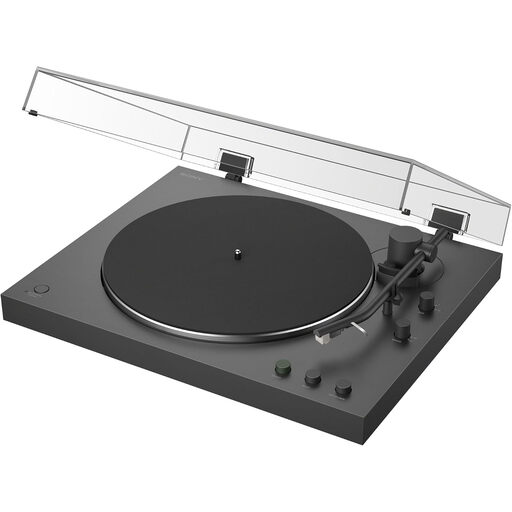
Sony PS-LX3BT Bluetooth Turntable with Auto Playback
Consider this model if automatic playback and a Bluetooth connection matter for your LP and single listening. Check its stated speeds and the connection to your existing speakers; if you have shellac 78s, confirm both playback speed and stylus suitability.
View on Joybuy
 No image available
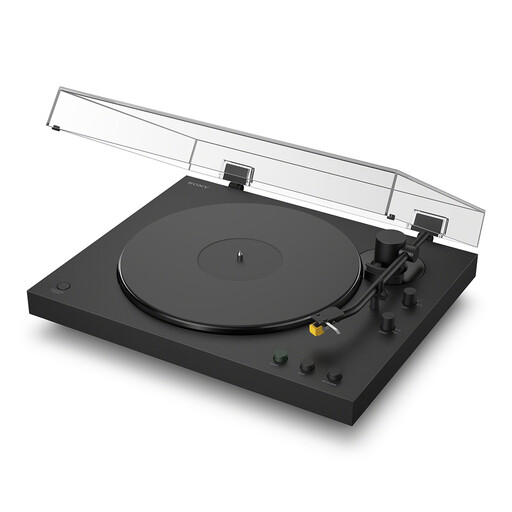
Sony PS-LX5BT Bluetooth Turntable with Auto Playback
Consider this model if Bluetooth listening and automatic playback are priorities. Confirm its speeds and speaker connection, measure the intended shelf, and check recording options separately if you want to make digital copies.
View on Joybuy
Turntable questions
Do vintage soundtracks require a 78 RPM turntable?
Only if your records include 78s: LPs normally use 33⅓ RPM, while many singles use 45 RPM. For shellac 78s, check both the turntable’s speed and an appropriate stylus; Audio-Technica identifies its AT-VMN95SP 3 mil stylus as suitable for a wide variety of 78 RPM records.
Can a turntable connect directly to active speakers?
Yes, if the signal reaching the speakers suits their input. For speakers with only a line-level input, use a turntable with an appropriate built-in phono stage or add a separate one; Rega’s Planar 1 Plus is an example with an integrated MM phono stage.
Does a built-in phono stage make a turntable automatic?
No. A phono stage handles the signal connection, not record handling. Audio-Technica describes the AT-LP120XUSB as fully manual; Technics describes the SL-1500C as manual with an arm lift at the end of a record.
What electrical-product markings should I check for Great Britain?
Check the product information, supplied instructions and applicable markings when buying for Great Britain. GOV.UK guidance says CE marking continues to be recognised alongside or in place of UKCA marking for the Great Britain market where applicable; Northern Ireland has separate arrangements, so confirm the requirements for that destination if relevant.


