Households sharing the controls
If several people will play folk LPs in the lounge, automatic start and stop can mean fewer occasions to handle the tonearm. Check how the deck connects to the speakers already in the room.


Choose a turntable that connects to the lounge speakers and suits the people who will operate it. A built-in phono stage offers a route to powered speakers or an ordinary line input; Bluetooth is useful only with a compatible receiving device. Automatic operation reduces tonearm-handling steps, while a manual deck can suit listeners happy to cue records themselves. Either way, plan a stable, level position away from the speakers.
If several people will play folk LPs in the lounge, automatic start and stop can mean fewer occasions to handle the tonearm. Check how the deck connects to the speakers already in the room.
Powered speakers, an amplifier with a PHONO input and an ordinary line input call for different connection arrangements. Identify the available input before deciding whether the turntable needs its own phono stage.
Nearby speakers, light furniture and people moving around the room make a stable, level position worth planning. U-Turn Audio advises placing the turntable and speakers on separate surfaces where possible.
For folk LPs in a shared lounge, settle the speaker connection and the way people will operate the deck before comparing less relevant features. These routes differ in how much equipment and manual handling they require.
Choose it when: Several people will start and stop records, and a compatible Bluetooth speaker or headphones would make connection easier. The Audio-Technica AT-LP60XBT is an example with automatic operation, Bluetooth and wired RCA output.
Bear in mind: Bluetooth needs a compatible receiving device; it does not resolve speaker placement or replace a suitable wired connection plan.
Choose it when: You are comfortable cueing records and need to feed powered speakers or an ordinary line input. Pro-Ject specifies a built-in switchable phono preamp for the E1 Phono; Rega specifies an integrated moving-magnet phono stage for the Planar 1 Plus.
Bear in mind: You still cue and return the arm manually, and an enabled built-in phono stage should feed a line input rather than a PHONO input.
Choose it when: Your amplifier has a suitable PHONO input, or you want to use a separate phono preamp. The standard Rega Planar 1 requires an appropriate phono stage.
Bear in mind: With only ordinary line inputs available, this route requires a separate phono preamp as well as manual cueing.
| Concern | What to check | Who this matters to |
|---|---|---|
| Speaker connection | Identify whether the speakers are powered and whether the amplifier has a PHONO or ordinary line input; check the turntable’s phono-stage setting. | If I want to use the lounge speakers I already have, I need a turntable output that matches their input. Around 40% of consumers put connection compatibility first. |
| Ease of operation | Check whether start and stop are automatic or require manual cueing, and whether initial cartridge settings are preset. | When several people use the deck, I want starting and ending a record to involve fewer tonearm-handling steps; roughly 30% of consumers prioritise ease of operation. |
| Stable placement | Check the available surface and plan for a level, stable position, with speakers on separate furniture where possible. | If speakers sit close to the deck or people move around the lounge, I need a position less exposed to vibration. For around 30% of consumers, placement is the primary concern. |
A turntable without an enabled phono stage cannot simply feed an ordinary line input at the level that input expects.
Identify the speaker or amplifier input first. Choose an appropriate built-in phono stage, a suitable amplifier PHONO input or a separate phono preamp.
A separate phono preamp adds another component and connection to the setup.
Speaker vibration can reach the cartridge and contribute to feedback, distortion or tracking problems.
U-Turn Audio advises using separate surfaces where possible. Give the turntable a stable, level support; isolation pads are a compromise where separation is difficult, not a universal substitute.
Making room for separate speaker stands or a sturdier support may change how you arrange the lounge.
A Bluetooth-equipped turntable still needs a compatible receiving speaker, headphones or amplifier.
Check the intended receiver and keep a suitable wired route in mind. Wireless transmission does not remove the need to position the turntable securely.
An enabled built-in phono stage has already amplified the signal. Cambridge Audio warns that connecting a non-phono source to a PHONO input can cause unwanted distortion.
Use an ordinary analogue line input when the turntable’s preamp is enabled. Use a suitable PHONO input only with an appropriate phono-level output.
Its AT-LP60X models offer an automatic route for a lounge used by more than one listener.
The manual E1 range is worth considering if you prefer a deck with preset initial adjustments.
The manual Planar 1 models provide two distinct connection routes.
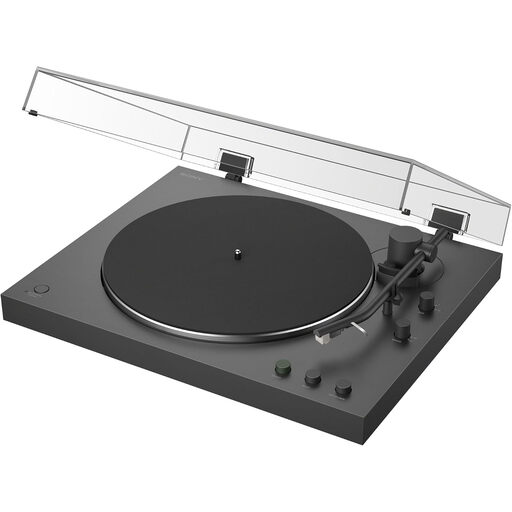
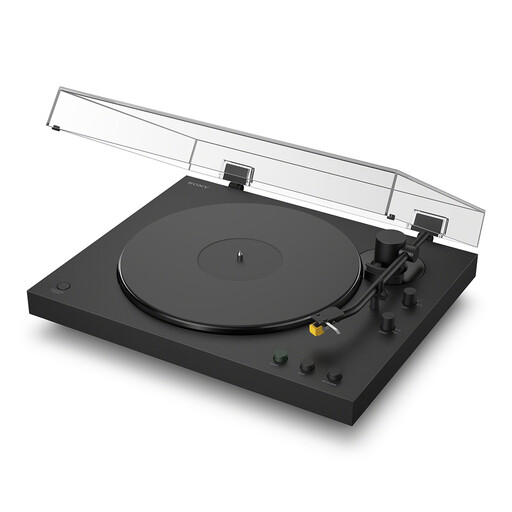
These Sony models are choices for listeners considering automatic playback and Bluetooth in a shared lounge. Check the connection to your existing speakers and the space available for the deck before choosing between them.
 No image available
Automatic playback suits a lounge where several people may start a record. Bluetooth use requires a compatible receiving device; check the intended wired connection and confirm that the supplied power adapter suits UK use.
Plan a stable, level position away from speakers. If stylus replacement, a dust cover or the deck’s dimensions affect your choice, confirm those details before ordering.
 No image available
Automatic playback is useful when different people will operate the lounge turntable. Use Bluetooth only with a compatible receiver, and check how its wired output would connect to your existing system.
Allow for a stable, level position away from speakers. Confirm stylus replacement options if they matter to you, and check that the supplied power adapter suits UK use.
Yes, if the turntable has an enabled built-in phono preamp or its signal passes through a separate one. A turntable without either needs a suitable amplifier PHONO input before you can use an ordinary line-level connection.
No: connect that line-level output to an ordinary analogue input. Cambridge Audio advises against feeding a non-phono source into a PHONO input because it may cause distortion; a suitable PHONO input is for an appropriate phono-level output.
Put it on a stable, level surface, with the speakers on separate furniture where possible. U-Turn Audio identifies speakers as a source of unwanted vibration; it notes that isolation pads are less helpful at low frequencies than at medium and high frequencies.
Not merely because the music is folk: standard LP playback uses 33⅓ RPM, which the named Audio-Technica and Pro-Ject models support. Check for 78 RPM capability separately if your collection also includes records made for that speed.